Table of Contents
| Quick Specs: Semi-Auto vs CNC Crimping Machines | |
|---|---|
| Machine Types | Semi-automatic (manual start/stop) vs CNC (fully programmable) |
| Tonnage Range | 80–830 ton |
| Hose Size Range | 1/4″ – 6″ |
| CNC Precision | ±0.03 mm crimp diameter |
| Cycle Time | Semi-auto: 10-15 sec / CNC: 6-8 sec |
| Die Compatibility | G1-G12 series, interchangeable |
| Data Logging | Semi-auto: none / CNC: USB + PLC memory |
| Power Supply | 110-380V, single or three phase |
What Is a Hydraulic Crimping Machine?
A hydraulic crimping machine uses fluid power to compress a ferrule onto a hose fitting with precise tonnage. Unlike manual hydraulic hose crimpers that rely on a hand pump, electric crimping machines use a motor-driven hydraulic pump to deliver consistent force cycle after cycle.
Within the electric category, there are two control systems: semi-automatic and CNC. The difference is not about tonnage or hose range — it is about control, repeatability, and data.
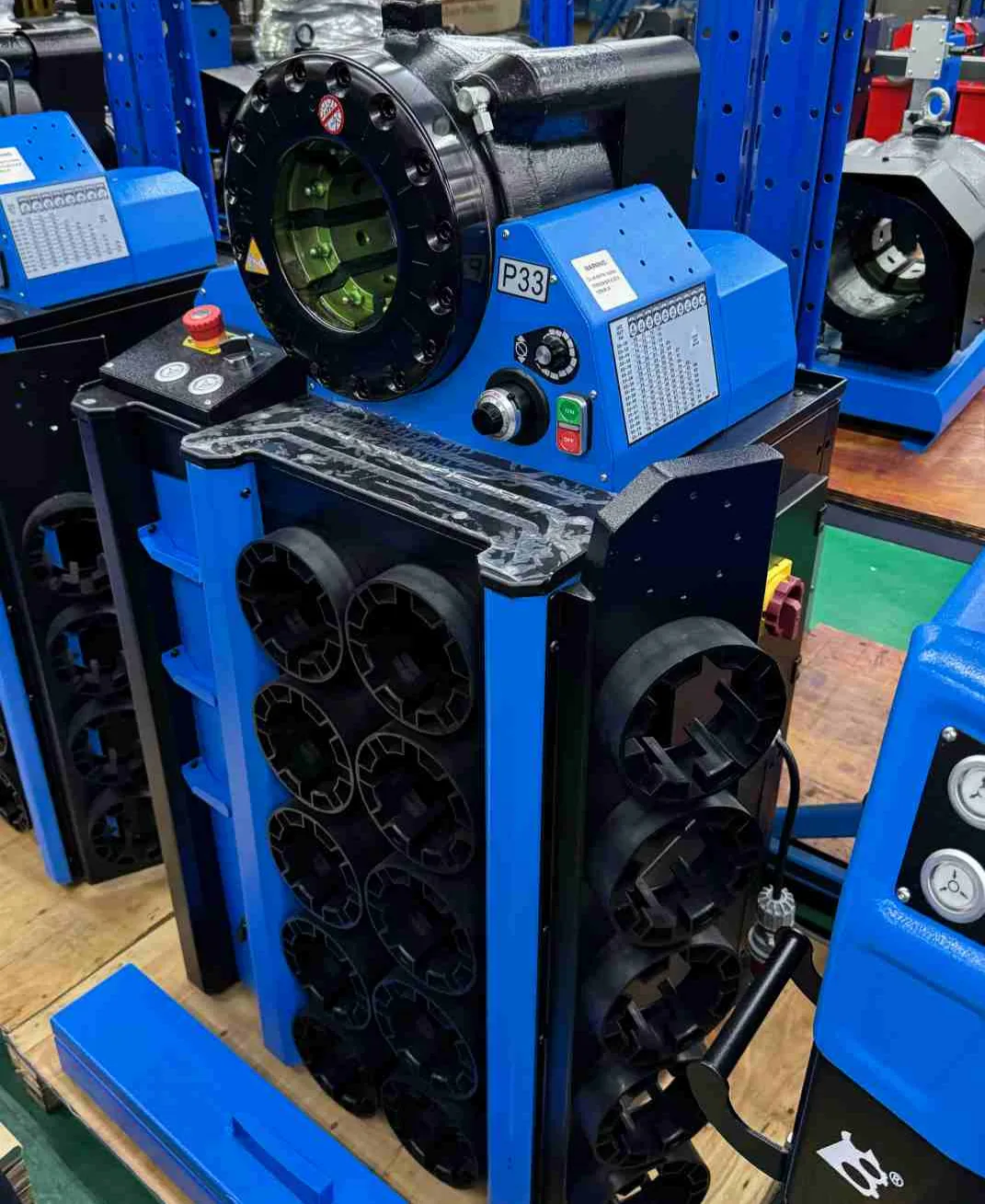
A semi-auto machine starts and stops the crimp cycle when the operator presses a button or when a mechanical limit switch triggers. A CNC machine uses a programmable logic controller (PLC) with servo valves to control the crimp profile — applying Pascal’s Law with digital precision. The CNC stores hundreds of crimp recipes, each specifying die size, target diameter, and holding time. This is the same approach described in Wikipedia’s crimp joining overview for industrial production.
Semi-Auto vs CNC: How They Work
Semi-Automatic Crimping Machine
The operator sets the die, positions the hose, and presses the start button. The machine runs the hydraulic pump until the die closes to a preset position (mechanical limit switch) or the operator releases the button. The positioning stop (micrometer dial) allows fine adjustment: each full turn equals 1 mm, each graduation equals 0.01 mm. The operator then measures the crimp diameter with calipers to verify quality.
CNC Crimping Machine
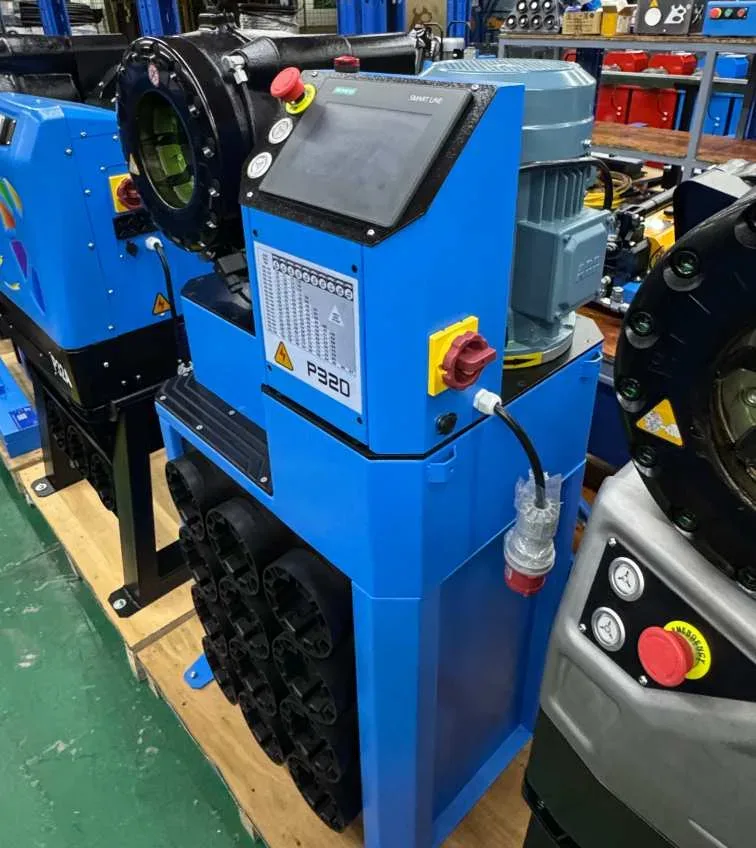
The operator selects a stored recipe on the touchscreen (or the machine auto-detects the die via RFID). The CNC controller manages the entire cycle: fast approach → controlled crimp → hold → retract. Target diameter is measured internally by a linear encoder — no caliper verification needed unless required by QC protocol.
Examples: TRC P32D, P20D, P120C.
Feature-by-Feature Comparison
| Feature | Semi-Auto (P32A) | CNC (P32D) |
|---|---|---|
| Control System | Relay + limit switch | PLC + servo valve + encoder |
| Die Change | Manual, 2-3 min | Manual or auto-detect |
| Recipe Storage | None | 500+ recipes |
| Crimp Precision | ±0.1 mm | ±0.03 mm |
| Cycle Time | 10-15 sec | 6-8 sec |
| Data Logging | None | USB export, traceability |
| Step Crimp | No | Yes (multi-stage) |
| Alarm System | Basic (over-pressure) | Full (diameter, tonnage, die, oil temp) |
| Operator Skill | Medium (must calibrate) | Low (select recipe, press start) |
| ISO Traceability | Manual logbook | Automatic digital record |
Real Production Data: 3 Volume Levels
Here is what production looks like at three common volume levels, using real data from TRC customers and industry benchmarks:
| Metric | Low Volume (5-20/day) | Medium (20-80/day) | High (80-200/day) |
|---|---|---|---|
| Recommended Machine | Semi-auto (P20/P22) | CNC (P32D) | CNC (P120C/TRC120L) |
| Daily Output | 5-20 assemblies | 20-80 assemblies | 80-200 assemblies |
| Reject Rate | 3-5% | <0.5% | <0.2% |
| Labor Per Hose | 8-12 min | 3-5 min | 2-3 min |
| Caliper Checks | Every hose | First + every 20th | First + every 50th |
| Traceability | Paper logbook | Digital + USB | Digital + networked |
At 20 hoses per day, the semi-auto operator spends 30-60 minutes on caliper verification alone. A CNC machine eliminates most of this — the encoder checks every crimp internally. For quality standards, refer to ISO 8434 and the hydraulic hose construction guide on Wikipedia.
ROI Breakdown: When to Upgrade
The math is straightforward. Here are three scenarios:
Scenario 1: Field Service Shop (5 hoses/day)
Stick with semi-auto or even a manual P16HP. The volume does not justify CNC. ROI on a P32D at this volume: 18-24 months.
Scenario 2: Growing Workshop (25 hoses/day)
A semi-auto operator produces 25 hoses in about 4 hours, including setup and QC. A CNC does the same in 2 hours with zero rejects. The time savings alone pays for the upgrade in 6-9 months.
Break-even calculation:
- Semi-auto labor cost: 4 hrs × $30/hr = $120/day
- CNC labor cost: 2 hrs × $30/hr = $60/day
- Daily savings: $60
- CNC upgrade premium: ~$3,000-5,000 over semi-auto
- Payback: 50-83 working days (2-4 months)
Scenario 3: Production Line (100+ hoses/day)
CNC is the only viable option. At this volume, semi-auto’s 3-5% reject rate means 3-5 scrapped hoses daily — each costing $20-80 in materials. A CNC reduces rejects to near-zero. Combined with automated hose cutting and skiving, the full production line runs with one operator instead of three.
A TRC120L heavy-duty CNC or P175 (830 ton) handles up to 6″ spiral hose at production speeds.

TRC Model Selection Guide
| Model | Type | Tonnage | Hose Range | Best For |
|---|---|---|---|---|
| P20 | Semi-auto | 80T | 1/4″ – 1″ | Small shops, low volume |
| P22 | Semi-auto | 120T | 1/4″ – 1½″ | General workshop |
| P32/P32A | Semi-auto | 200T | 1/4″ – 2″ | Medium workshop |
| P20D | CNC | 120T | 1/4″ – 1½″ | CNC entry level |
| P32D | CNC | 200T | 1/4″ – 2″ | Production CNC |
| P120C | CNC | 320T | 1/4″ – 4″ | Large hose production |
| TRC120L | CNC | 320T | 1/4″ – 4″ | Heavy duty CNC |
| P140 | CNC | 500T | 1/4″ – 6″ | Industrial production |
All models use standard die sets and are compatible with SAE, DIN, and ISO standard fittings. The full electric hydraulic hose crimper lineup covers every shop size.
Common Mistakes When Upgrading
1. Buying CNC for Low Volume
If you make 5 hoses per week, a CNC machine sits idle 95% of the time. The extra $3,000-5,000 spent on CNC features buys zero return at this volume. A semi-auto P22 or even a pneumatic P18AP is the right choice.
2. Ignoring Power Supply Requirements
CNC machines above 200 ton typically require 3-phase power (380V). If your workshop only has single-phase 220V, you need to factor in electrical upgrades. TRC’s P20D and P32D run on standard 220V single phase. For more on matching equipment to facility requirements, see Omni Services’ guide to SAE standards.
3. Not Budgeting for Die Sets
The machine is one cost. Die sets are another. A full set of dies for 6 fitting series costs $2,000-6,000 depending on size range. Factor this into your total investment.
4. Skipping Operator Training
A CNC machine with 500 recipes is only useful if someone knows how to program them. Budget 2-3 days for initial training. TRC provides remote setup support within 4 hours.
FAQ
What is the main difference between semi-auto and CNC crimping machines?
Control. Semi-auto uses a mechanical limit switch — the operator sets the stop position and verifies each crimp with calipers. CNC uses a PLC with an encoder to hit the target diameter automatically, storing recipes and logging data.
Is CNC crimping more accurate than semi-auto?
Yes. CNC achieves ±0.03 mm repeatability. Semi-auto is typically ±0.1 mm, depending on operator consistency. For reference, SAE J517 requires ±0.05 mm for rated assemblies.
Can I upgrade my semi-auto machine to CNC?
Not easily. The control system, hydraulic valves, and encoder are different hardware. It is more cost-effective to sell the semi-auto unit and buy a CNC model.
How long does it take to set up a CNC crimping machine?
About 30 minutes for initial assembly and die installation. Programming recipes takes another 1-2 hours. TRC provides pre-loaded die charts for common fitting series.
What tonnage do I need for my hose size?
For wire-braided hose (1/4″ – 2″): 80-200 ton. For spiral hose (2″ – 4″): 320 ton. For 4″ – 6″ spiral: 500-830 ton. See the heavy duty hydraulic crimper series for larger sizes.
Do CNC machines require more maintenance?
No. The hydraulic system is the same. The PLC and encoder are solid-state with no moving parts. Standard maintenance: hydraulic oil change every 2,000 hours (use 68# anti-wear hydraulic oil), seal kit replacement every 12 months. Die seat hardness should be ≥HRC 60, die hardness ≥HRC 50 — check these specs before buying. Always lubricate die seat sliding surfaces before each startup.
Can I use the same dies on semi-auto and CNC machines?
Yes, if they are the same die series (G1-G12). The die seats are interchangeable across TRC machines. Check the die compatibility chart for cross-reference.
What is step crimping and do I need it?
Step crimping applies force in multiple stages — approach, crimp, hold. It reduces stress on the hose reinforcement layers and produces a more consistent bond. Only CNC machines offer this feature. You need it for spiral hose and safety-critical assemblies.
| Ready to Upgrade Your Crimping Setup?
TRC offers 19 electric models from 80 to 830 ton. Semi-auto and CNC options. Global shipping in 72 hours. |
Related Articles