Table of Contents
What a New Workshop Actually Needs
Starting a hydraulic hose assembly workshop? Most equipment dealers will try to sell you 15 items you don’t need in month one. Here’s the reality: a profitable hose shop can start with 4 core pieces of hose crimping equipment.
We’ve seen 300+ distributors set up shops across 50+ countries. The ones who succeed fast start lean.
The ones who overspend on day one take 12–18 months to break even. This guide covers what you actually need — and what to skip until month six.
The 4-Station Setup (Minimum Viable)
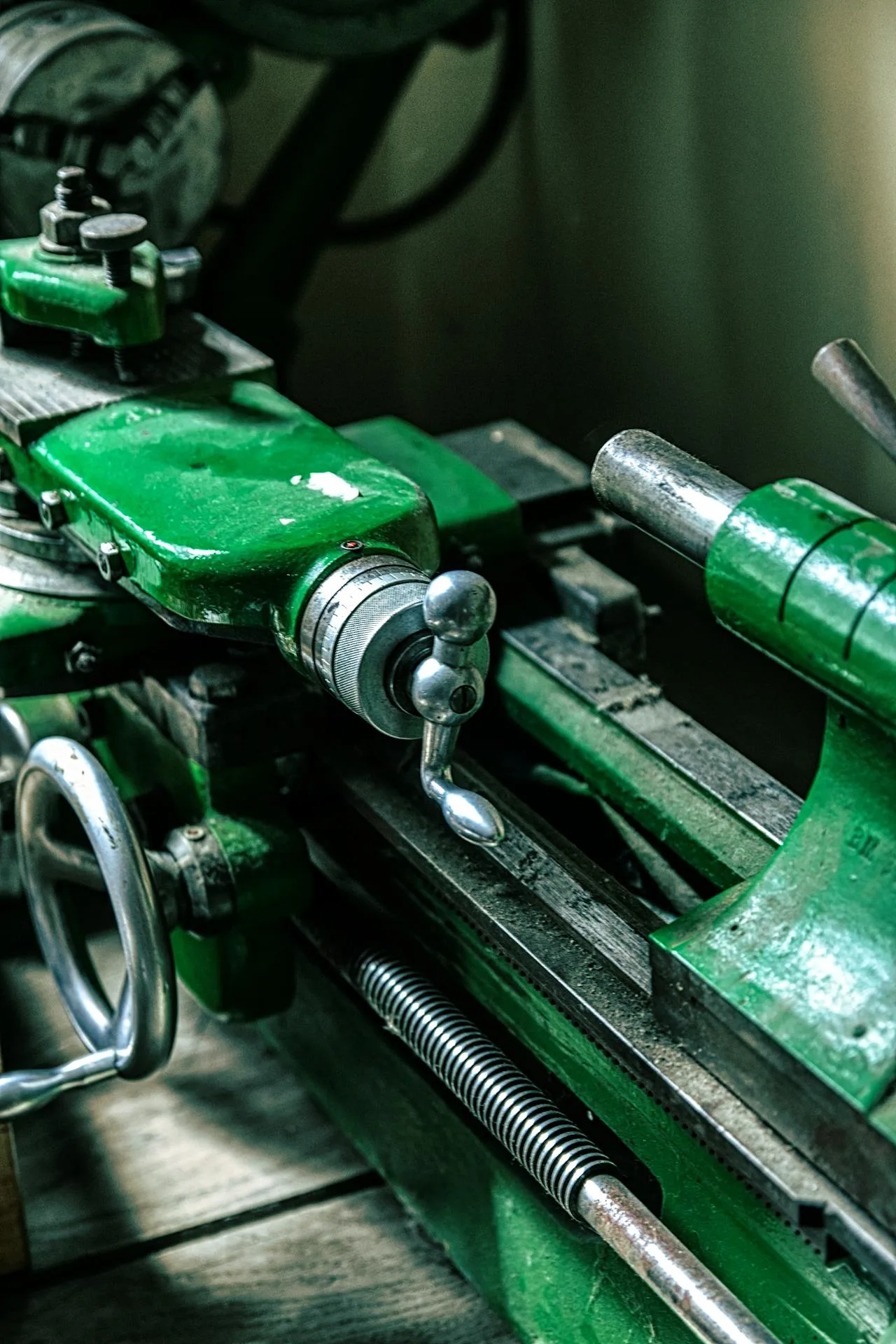
A hydraulic hose assembly workshop needs 4 stations: cut → skive → crimp → test. Each station handles one step. Here’s the minimum equipment for each, with specific TRC models.
Station 1: Cutting
You need a clean, square cut. Hacksaws don’t cut it — literally. Ragged hose ends cause fitting alignment problems and leaks.
The TRC cutting machine lineup starts with the C300 (up to 2″ hose) and goes up to the C520A (up to 4″). A C300 handles 90% of workshop demand for under $800.
| Model | Max Hose Size | Cut Type | Power |
|---|---|---|---|
| C300 | 2″ 4SP | Rotary blade | 380V / 220V |
| C400F | 2½″ 4SP | Rotary blade | 380V / 220V |
| C520A | 4″ 6SP | Rotary blade | 380V |
Most new shops can skip the cutting machine in month one if their supplier sells pre-cut hose lengths. Add it when your daily volume hits 20+ assemblies.
Station 2: Skiving (Optional)
Skiving removes the outer rubber cover from the hose end so the ferrule contacts the wire reinforcement directly. Not all fittings require skiving — many one-piece and interlock fittings crimp directly over the rubber.
Skip the skiving machine if you primarily use standard crimp fittings with pre-skived ferrules. Add the S50 skiving machine when you start handling 4SP or 6SP multi-spiral hose regularly. For more on the skiving process, see Wikipedia’s skiving article.
Station 3: Crimping
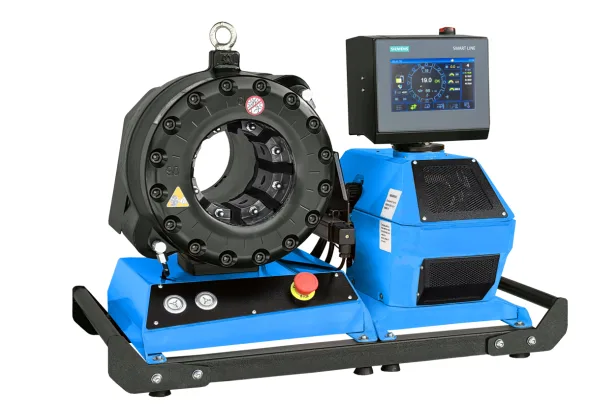
This is the core of your hose crimping equipment. Get this right, and everything else follows.
The crimping process deforms the ferrule past its yield point, creating a gas-tight cold-weld bond between the ferrule and the hose’s wire reinforcement. This joint is mechanically stronger than soldering and resistant to vibration and thermal shock. A proper crimp has zero voids — all wire strands compressed uniformly.
The crimping machine you choose depends on your target hose range. Most new workshops cover ¼″ to 2″ hose — that’s 80% of market demand.
| Model | Crimp Force | Hose Range | Best For | Price Tier |
|---|---|---|---|---|
| P32S | 200 ton | ¼″–2″ 4SP | New workshop standard | $$ |
| P32A | 200 ton | ¼″–2″ 4SP | Value pick with die cabinet | $$ |
| P32D | 200 ton | ¼″–2″ 4SP | CNC precision + data log | $$$ |
| P32E | 200 ton | ¼″–2″ 4SP | Compact budget option | $ |
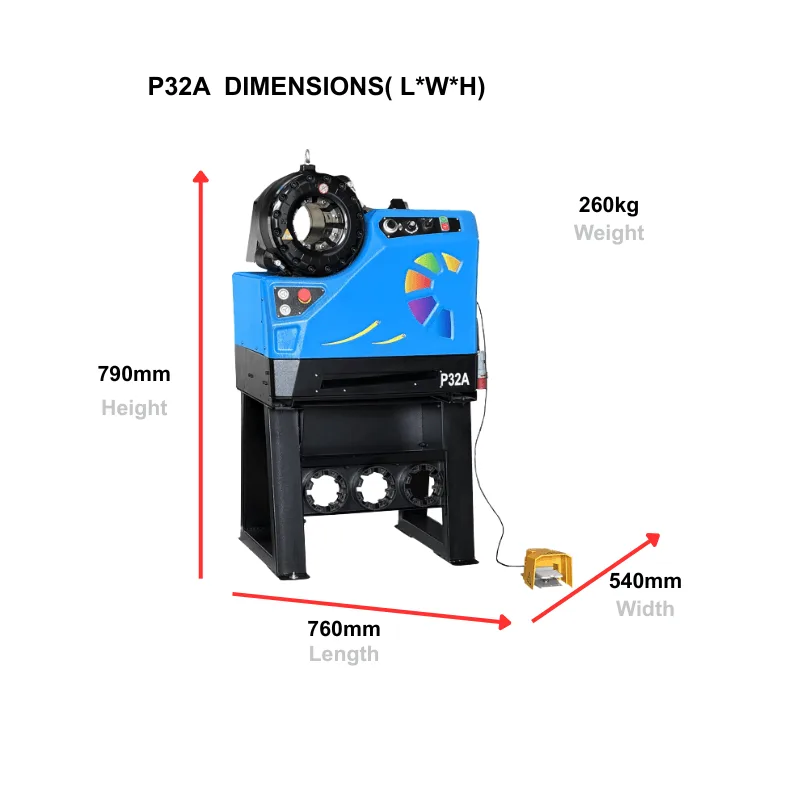
The P32A is the most popular choice for new workshops. It comes with 12 die sizes (P32 series), an auto-return mechanism, and a built-in die storage drawer. Crimp tolerance: ±0.04 mm per ISO 8434 requirements.
Key features to look for in your first crimper:
- Auto-return: Dies retract automatically after crimp. Saves 2–3 seconds per cycle.
- Die storage: Built-in cabinet keeps dies organized. Lost dies cost $30–80 each to replace.
- Motor voltage: Check your local power supply. TRC machines support 110V, 220V, and 380V.
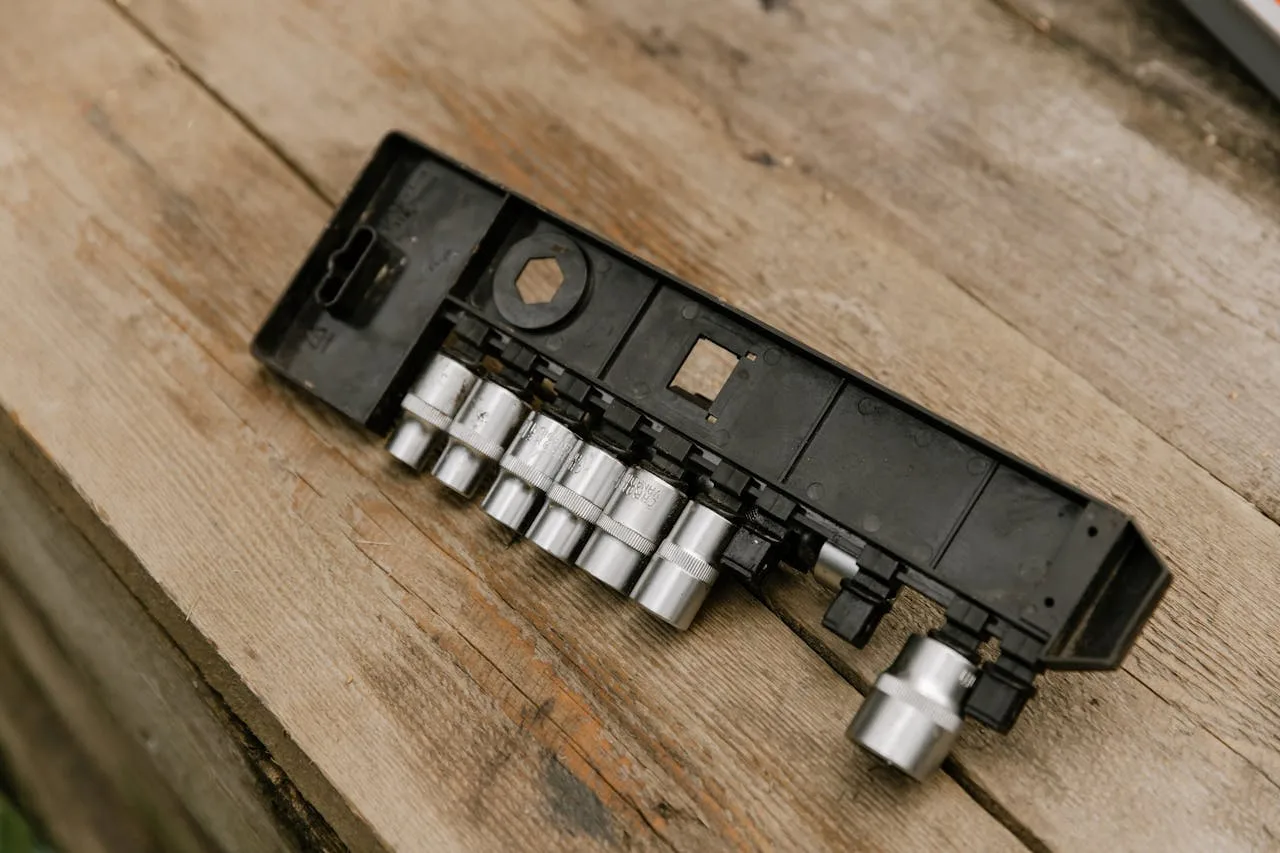
- Die compatibility: P32 dies cover 19 sizes from 6mm to 78mm — enough for SAE J517 standard hoses.
Station 4: Testing
Every assembled hose should be pressure-tested before delivery. A test bench pressurizes the hose to 1.5× or 2× working pressure and holds it for 30–60 seconds.
For a new shop, a portable hydraulic test pump ($200–400) is enough. You don’t need a full test bench until you’re doing 50+ assemblies per day or serving oil and gas customers who require certified test reports. For test pressure standards, refer to SAE standards testing guidelines.
What Salesmen Push vs What You Need
| What They Push | What You Actually Need (Month 1) | When to Buy |
|---|---|---|
| CNC crimper with data logging | Standard P32A with auto-return | Month 6+ (when ISO audit requires it) |
| Full die set (19+ sizes) | Top 8 die sizes cover 90% of jobs | Add sizes as orders come in |
| Cutting machine | Buy pre-cut hose from supplier | Month 3+ (when volume justifies it) |
| Skiving machine | Use non-skive fittings | Month 6+ (4SP/6SP volume) |
| Test bench with printer | Manual test pump | Month 4+ (when you need test certificates) |
| Bench with tool board | Workbench + shelf | Anytime |
Equipment Budget Reality Check
| Item | Needed Day 1? | Estimated Cost |
|---|---|---|
| Crimping machine (P32A or P32E) | ✅ Yes | $1,200–2,000 |
| Die set (8 most common sizes) | ✅ Yes | $300–500 |
| Hydraulic oil + caliper | ✅ Yes | $50 |
| Ferrule + fitting starter stock | ✅ Yes | $200–400 |
| Cutting machine (C300) | ❌ Later | $600–800 |
| Skiving machine (S50) | ❌ Later | $800–1,200 |
| Test bench | ❌ Later | $500–2,000 |
| Minimum Start Total | $1,750–2,950 |
You can start a hose assembly business for under $3,000 in hose crimping equipment. The crimping machine is 60–70% of that budget. Don’t cheap out on it — a bad crimper produces bad crimps, and bad crimps cause hydraulic failures.
Setting Up a Hose Workshop?
Tell us your target hose sizes and daily volume. We’ll build an equipment list with exact model recommendations.
FAQ
What’s the minimum equipment to start a hydraulic hose workshop?
A crimping machine, 8 die sizes, a vernier caliper, and fitting stock. That’s under $3,000 total. Add cutting, skiving, and testing equipment as volume grows.
Which crimper should I buy first?
The P32A is the best value pick for new workshops. 200-ton capacity, 2″ hose range, auto-return, and die storage.
It covers 90% of common hydraulic hose sizes. The 200-ton force comes from a 2.2 kW electric motor driving hydraulic fluid through a cylinder — the same Pascal’s Law principle that makes a hand pump work, but with motor-driven pressure instead of manual pumping.
Do I need a CNC crimper to start?
No. CNC machines like the P32D add data logging and multi-step crimp profiles. These matter for manufacturing and aerospace clients.
For general hose assembly, a standard machine is enough.
How many die sizes do I need at first?
Start with 8 sizes: 12, 16, 19, 22, 26, 39, 45, and 57. These cover SAE 100R1 through 100R12 hose sizes. Add specialty dies as customer demand requires.
Can I skip the cutting machine initially?
Yes. Buy pre-cut hose lengths from your supplier for the first 2–3 months. When you hit 20+ assemblies per day, the time savings from an in-house cutting machine justify the cost.
What voltage do TRC machines support?
Most TRC crimpers support 110V, 220V single-phase, and 380V three-phase. Specify your local voltage when ordering. The P32A motor is 2.2 kW — runs fine on standard 220V workshop power.
How much space do I need for a workshop?
A 4-station layout (cut, skive, crimp, test) fits in 25–30 m². If you skip cutting and skiving initially, a single crimper on a bench needs about 4 m².
What’s the ROI timeline for workshop equipment?
Most distributors recoup their equipment investment in 2–4 months at 10–15 assemblies per day. Each crimped hose assembly generates $15–40 in labor margin.
A $2,000 setup paid off in under 100 assemblies. For detailed ferrule specifications and fitting standards, refer to the relevant industry documentation.