Table of Contents
When Pneumatic Crimping Makes Sense
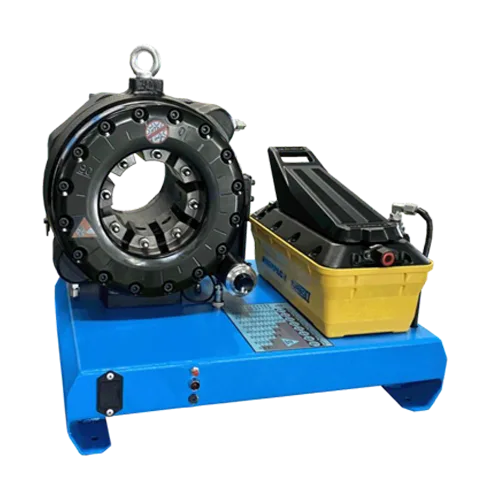
An air powered crimping tool uses shop compressed air to drive a hydraulic cylinder — giving you electric-level crimp force without an electric motor. If your workshop already has a compressor running, pneumatic is the fastest crimp cycle you can get for the money.
Shops that already run air tools (impact wrenches, die grinders, paint guns) have the infrastructure in place. Adding a pneumatic crimper means zero new power requirements. Plug into the existing air line and you are crimping in 8 seconds per cycle.
Where pneumatic does not make sense: remote field sites with no compressor, mobile service trucks without onboard air, and low-volume shops where a manual hydraulic hose crimper does the job for less money. Pneumatic systems use compressible gas — the air compresses during the stroke, which means the final crimp force can vary slightly if input pressure fluctuates. This is why a pressure regulator is important on the air line.
How Air Powered Crimping Tools Work
The principle is simple. Compressed air enters a pneumatic cylinder. The cylinder drives a small hydraulic intensifier.
The intensifier multiplies the air pressure (typically 90 PSI / 6.2 bar) into hydraulic pressure (up to 700 bar) using Pascal’s Law — a change in pressure at any point in a confined incompressible fluid transmits equally throughout the fluid.
Air pressure hits a large-area pneumatic piston. That piston connects to a small-area hydraulic piston. The area ratio multiplies the force: a 6:1 ratio at 90 PSI input gives you 540 PSI hydraulic output.
With a 12:1 intensifier, that jumps to 1080 PSI — more than enough to drive the crimper head to 95–137 tons of crimp force. Energy is conserved because the small piston moves a proportionally shorter distance.
The hydraulic hose crimper head itself is identical whether you power it by hand pump, electric motor, or air. The only difference is the power source. Dies, crimp heads, and ferrules are all interchangeable.
The result — a gas-tight, cold-formed bond — is the same regardless of how the force is generated. As crimping theory explains: an effective crimp deforms the metal past its yield point so that compressed material creates high static friction.
This produces a connection resistant to vibration and thermal shock.
Compressor Requirements: Do You Have Enough Air?
Before buying an air operated hydraulic hose crimper, check your compressor. The two numbers that matter: CFM (cubic feet per minute) and tank size.
| Crimper Model | Tonnage | Air Consumption (per cycle) | Min Compressor CFM | Recommended Tank |
|---|---|---|---|---|
| P16AP | 95 ton | 2.5 CFM @ 90 PSI | 4 CFM | 20 gallon |
| P20AP | 137 ton | 3.2 CFM @ 90 PSI | 5 CFM | 30 gallon |
| Typical shop impact wrench | — | 4–5 CFM @ 90 PSI | 5–8 CFM | 30 gallon |
If your compressor already runs an impact wrench without cycling constantly, it can handle the pneumatic crimper. The crimper only draws air during the 8-second crimp cycle. Between crimps, air consumption is zero.
Per OSHA guidelines, keep air pressure below 30 PSI for cleaning — but crimping tools operate at full shop pressure (90 PSI) safely because the air drives a sealed hydraulic intensifier, not an open nozzle.
One thing to watch: moisture in the air line. Compressed air contains water vapor. Over time, moisture rusts the pneumatic cylinder and contaminates the hydraulic oil.
Install a basic inline moisture trap ($20–40) between the compressor and the crimper. Replace it annually.
Pneumatic vs Battery vs Hand Pump: Real Comparison
| Feature | Pneumatic | Battery (18V) | Hand Pump (Manual) |
|---|---|---|---|
| Cycle time | 8 sec | 10 sec | 30–60 sec |
| Max tonnage | 137 ton | 120 ton | 137 ton |
| Consistency | High (pressure regulated) | High (motor controlled) | Operator-dependent |
| Power source needed | Compressor + air line | Battery charger | None |
| Noise level | 70–80 dB (hiss + click) | 60 dB (motor whine) | Quiet |
| Cold weather performance | Good (air does not freeze) | Fair (battery drains faster) | Good (oil thickens slightly) |
| Weight | 35–50 kg (bench mount) | 15–25 kg (portable) | 30–45 kg (bench mount) |
| Best application | Fixed shop with air | Mobile / field | Off-grid / low volume |
Key takeaway: pneumatic crimpers excel in shops that already have compressed air. They deliver electric-level speed without the electrical installation.
For mobile service, a portable hydraulic hose crimper with battery power is more practical. The National Fluid Power Association (NFPA) recommends matching the power source to the work environment — air for fixed shops, battery for mobile, hand pump for off-grid.
3 Shops Where Air Crimping Wins
1. Tire and Brake Shops
Tire shops run compressors all day for impact wrenches and inflation. An air powered crimper fits right into the existing air system.
No new wiring, no battery charging station. Crimp a brake hose in 8 seconds and move to the next job.
2. Heavy Equipment Repair Facilities
Mining and construction equipment repair bays have large compressors (60+ gallon tanks, 10+ CFM). These shops service hydraulic hoses daily.
A pneumatic hydraulic crimper at the workbench handles hose sizes from 1/4″ to 1-1/2″ without slowing down the crew. Mining equipment follows SAE J517 hose standards — the same standards your air powered crimper needs to meet.
3. Production Hose Assembly Lines
Facilities crimping 50+ assemblies per day need speed and repeatability. Pneumatic power gives consistent crimp force on every cycle — no operator fatigue, no variation.
The crimper dies wear at a predictable rate because every crimp hits the same pressure. Swaging and crimping both use radial compression, but pneumatic crimping applies the force through regulated air pressure for more repeatable results than manual swaging.
TRC Pneumatic Crimper Options
TRC offers pneumatic versions of its manual crimper line. The P16AP and P20AP share the same die sets as their manual counterparts (P16HP and P20HP) but replace the hand pump with an air-over-hydraulic power unit.
| Model | Tonnage | Hose Range | Die Series | Weight | Air Input |
|---|---|---|---|---|---|
| P16AP | 95 ton | 1/4″–1″ | P16 | 34 kg | 90 PSI / 6.2 bar |
| P20AP | 137 ton | 1/4″–1.5″ | P20 | 48 kg | 90 PSI / 6.2 bar |
Both models share dies with the HP hand-pump line, so you can start with a manual hydraulic hose crimper and upgrade to pneumatic later without buying new dies. The air conversion kit swaps the hand pump for an air-over-hydraulic unit in about 20 minutes.
For shops needing CNC precision, TRC also offers the electric hydraulic hose crimper line (P20D, P32D) with programmable crimp profiles. These use servo motors instead of air, which gives tighter control but requires 220V/380V power. For heavy-duty work beyond 2-inch hose, the heavy duty hydraulic crimper line handles up to 6-inch with 830 tons of force.
Maintenance Tips for Pneumatic Crimpers
Drain the moisture trap weekly. Compressed air carries water. If your inline trap fills up, moisture reaches the pneumatic cylinder.
Rust starts. Seal life drops. Weekly drain takes 10 seconds.
Check hydraulic oil level monthly. The air-over-hydraulic unit uses 68# anti-wear hydraulic oil (ISO VG 68, DIN 51502 HLP grade — contains ZDDP anti-wear additive).
System max pressure is 31.5 MPa. Low oil level means incomplete crimp strokes. Fill to 2/3 of the sight glass and top up through the reservoir port.
Skiving matters for fitting quality. Some fittings require outer skiving (removing the rubber cover so the ferrule grips the wire braid directly). No-skive fittings crimp over the rubber.
If your assembly requires skiving, do it before inserting the fitting — otherwise the ferrule cannot compress the wire reinforcement properly, regardless of how much force your air powered crimping tool applies.
Inspect air hoses for cracks. The air supply line flexes every time you move the crimper. Cracked air lines leak pressure, reduce crimp force, and waste compressor output.
Replace at the first sign of cracking — not when it bursts.
Lubricate the air inlet. Most pneumatic crimpers have an inline oiler port. Add 2–3 drops of pneumatic tool oil every 40 hours of operation.
This keeps the cylinder seals from drying out.
Verify crimp diameter with a caliper. Even with consistent air pressure, die wear shifts the final crimp diameter. Check every 500th crimp with a vernier caliper.
If the reading drifts more than ±0.05 mm from target, inspect the die set for wear.
Looking for a Pneumatic Crimper?
TRC P16AP and P20AP: air-over-hydraulic crimpers with 95–137 ton capacity. CE certified, ±0.03 mm tolerance. Same die sets as manual HP series.
FAQ
Do I need a special compressor for a pneumatic crimper?
No. Any shop compressor rated at 5+ CFM at 90 PSI with a 20+ gallon tank will run a pneumatic hydraulic hose crimper. If your compressor already runs an impact wrench, it has enough capacity.
Can I convert my manual crimper to pneumatic?
Yes. TRC manual crimpers (P16HP, P20HP) can be converted to pneumatic (P16AP, P20AP) by swapping the hand pump for an air-over-hydraulic power unit. The die sets and crimper head remain the same.
Is pneumatic faster than electric hydraulic?
Both cycle at about 8–10 seconds. Pneumatic wins on simplicity — no motor, no electronics, no electrical installation. Electric wins on precision control (CNC options) and in shops without compressed air.
What happens if air pressure drops during a crimp?
The crimp stroke may not complete fully. Most pneumatic crimpers have a pressure regulator that shows input air pressure.
If pressure drops below 80 PSI during the crimp cycle, stop and check the compressor. An incomplete crimp is an undercrimp — it will leak.
Can I use pneumatic crimpers in cold weather?
Yes, down to about −20 °F. Compressed air does not freeze. The hydraulic oil thickens in extreme cold, so cycle times may slow to 12–15 seconds.
Use ISO VG 32 oil for better cold-weather flow.
How does a pneumatic crimper compare to a battery crimper for field work?
Battery crimpers are more portable — no air hose tether. Pneumatic crimpers are better for fixed workshop use where air is already available. For field and mobile service, battery is the practical choice.
What maintenance does a pneumatic crimper need?
Weekly: drain moisture trap. Monthly: check hydraulic oil level.
Every 40 hours: add pneumatic tool oil to the air inlet. Every 500 crimps: verify crimp diameter with a caliper.
Are pneumatic crimpers louder than electric?
Pneumatic crimpers produce 70–80 dB during the crimp cycle (air hiss and mechanical click). Electric crimpers run at about 60 dB. Neither requires hearing protection for occasional use.


