Table of Contents
The best hydraulic hose crimper is not the most expensive one or the biggest one. It is the one that matches your hose sizes, your daily volume, and your work environment. We get this question constantly — Reddit threads like “We need a hose crimper, what should we get?” pop up every month in r/Hydraulics.
Instead of listing models, here are 3 questions that narrow the field fast.

Question 1: What Hose Sizes Will You Crimp?
This single question eliminates half the options. Hose size determines tonnage, and tonnage determines the machine class.
| Your Max Hose Size | Min Tonnage | Recommended Die Series | Example Model |
|---|---|---|---|
| 1″ 2SP (25mm) | 95 ton | P16 | P16HP manual |
| 1¼” 4SP (32mm) | 110 ton | P18 | P18HP manual |
| 1½” 4SH (38mm) | 137 ton | P20 | P20 electric |
| 2″ (50mm) | 200 ton | P32 | P32A / P32D electric |
| 4″ (100mm) | 500+ ton | P165/P175 | P175 heavy duty |
Undersizing the crimper is the most common mistake. A 95-ton hydraulic crimper physically cannot compress a 2″ spiral hose — the dies won’t close to spec diameter. Oversizing wastes money and bench space. Cross-reference your hose specs against SAE J517 ratings before buying.
Question 2: How Many Crimps Per Day?
Volume dictates whether you need manual, electric, or CNC.
| Daily Volume | Recommended Type | Why |
|---|---|---|
| 1–10 crimps | Manual hand pump | Low cost, no power needed, portable |
| 10–50 crimps | Electric semi-auto | Faster cycle, consistent pressure, less fatigue |
| 50+ crimps | CNC with data logging | Traceability, auto die ID, batch consistency |
One Reddit user doing occasional field repairs was perfectly happy with a budget hand-pump crimper. Another running a production line needed CNC traceability for ISO 8434 audits. Different jobs, different tools. If you are doing more than 10 crimps a day, the jump from manual to electric pays back in about 3 months based on labor savings alone. The hydraulic hose construction (wire braid vs spiral) also affects crimp force requirements — spiral needs 30–40% more tonnage.
Question 3: Workshop or Field?
This decides the form factor.
Workshop (Bench-Mounted)
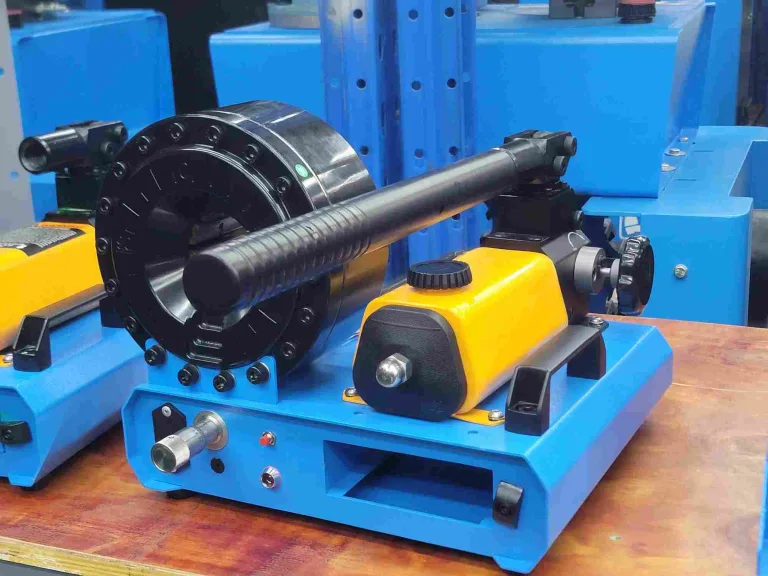
You want a bench-mounted electric unit like the P32A. It bolts to your workbench, plugs into 220V or 380V, and stays put. Heavier frame means better rigidity and longer die life.
Field (Portable)
You need a portable unit. Two sub-options:
- Hand pump — works anywhere, no power needed. The P16HP weighs 34 kg and crimps up to 1″ 2SP.
- Battery powered — 12V or 18V lithium battery. Faster than hand pump, but you need charged batteries. The P18CS delivers 80 ton on a cordless pack.
For off-grid sites with no power and no compressed air, hand pump is your only reliable option. A Reddit user working a remote mining camp confirmed: “Hand pump all the way — batteries die, air compressors are too heavy to haul.” For cold-weather operations, check that your hydraulic oil rating matches the ambient temperature — 68# anti-wear oil works above -10°C, but Arctic-grade fluid is needed below that.
Quick Reference: Model Selector
| Use Case | Best Pick | Tonnage | Hose Range | Power |
|---|---|---|---|---|
| Light field repair | P10HP | 10 ton | 1/4″ (6mm) | Hand pump |
| General field service | P16HP | 95 ton | 1″ 2SP | Hand pump |
| Heavy field/4SP | P18HP | 110 ton | 1¼” 4SP | Hand pump |
| Small workshop | P20 | 137 ton | 1½” 4SH | Electric 220V |
| Production workshop | P32A | 200 ton | 2″ (50mm) | Electric 380V |
| CNC traceability | P32D | 200 ton | 2″ (50mm) | Electric CNC |
| Mining/heavy industry | P175 | 830 ton | 4″ (100mm) | Industrial |
Every model above is built with Cr12MoV die steel at HRC 58–62 hardness and tested to ±0.03 mm crimp tolerance — well under the industry average of ±0.125 mm. That matters for high-pressure applications above 3000 PSI, where a loose crimp is a blowout waiting to happen. The cold-weld crimp bond between ferrule and fitting stem is what holds pressure — get the tonnage right or it fails.
Still unsure? Read our complete setup guide for the full workflow, or check the starter kit guide if you are building a hose assembly station from scratch. For hose pressure ratings and fitting compatibility, the SAE standards reference from Omni Services is worth bookmarking.


 English
  Español
  Русский