Hydro Crimping Tool: Why Hydraulic Force Beats Mechanical and Pneumatic
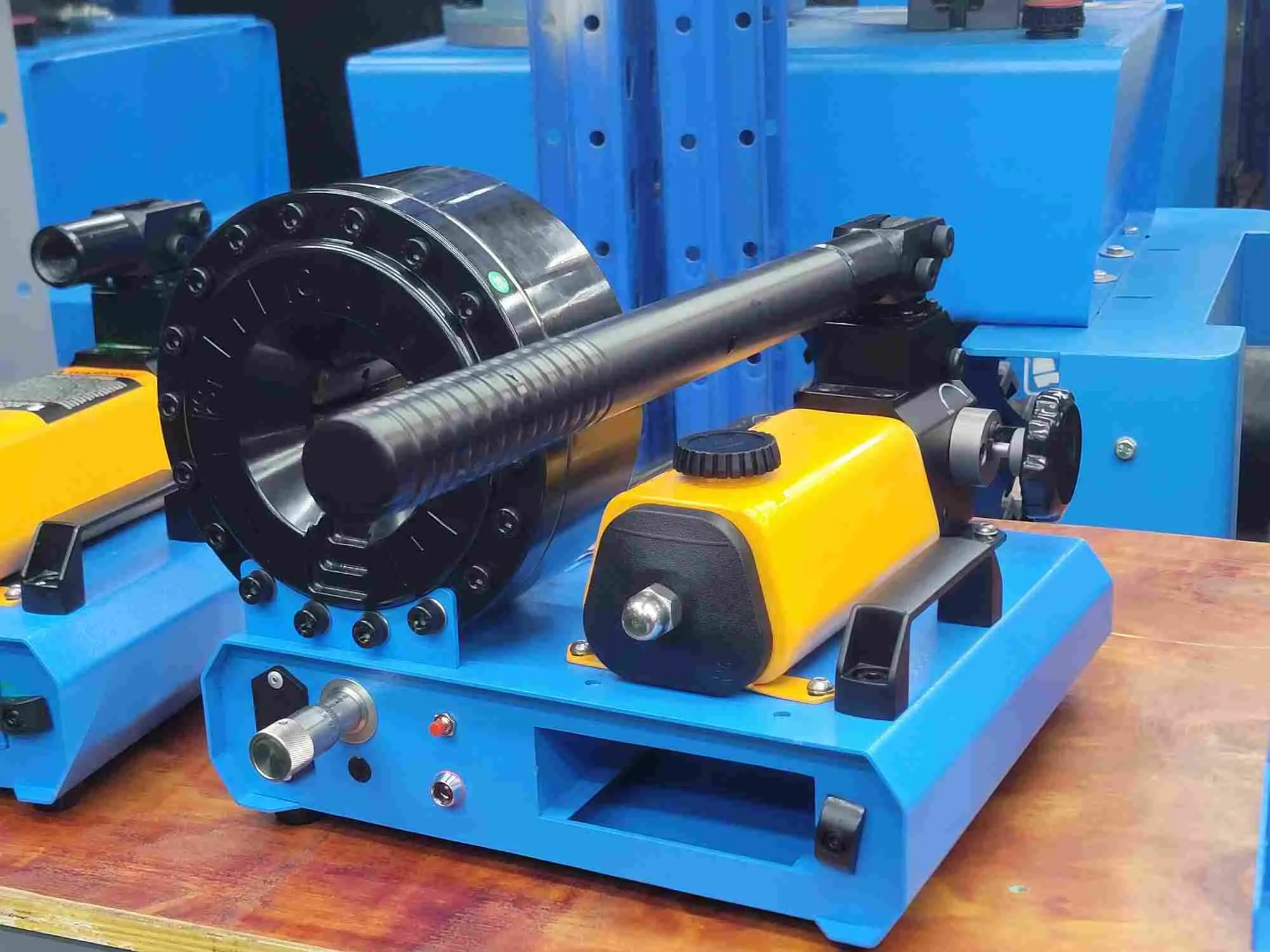
A hydro crimping tool uses hydraulic force — not muscle — to compress ferrules onto hose. That sounds simple enough, but the power source you choose changes everything: speed, cost, where you can work, and how consistent your crimps turn out. Here’s how the three main options compare in real workshop conditions.
What Is a Hydro Crimping Tool?
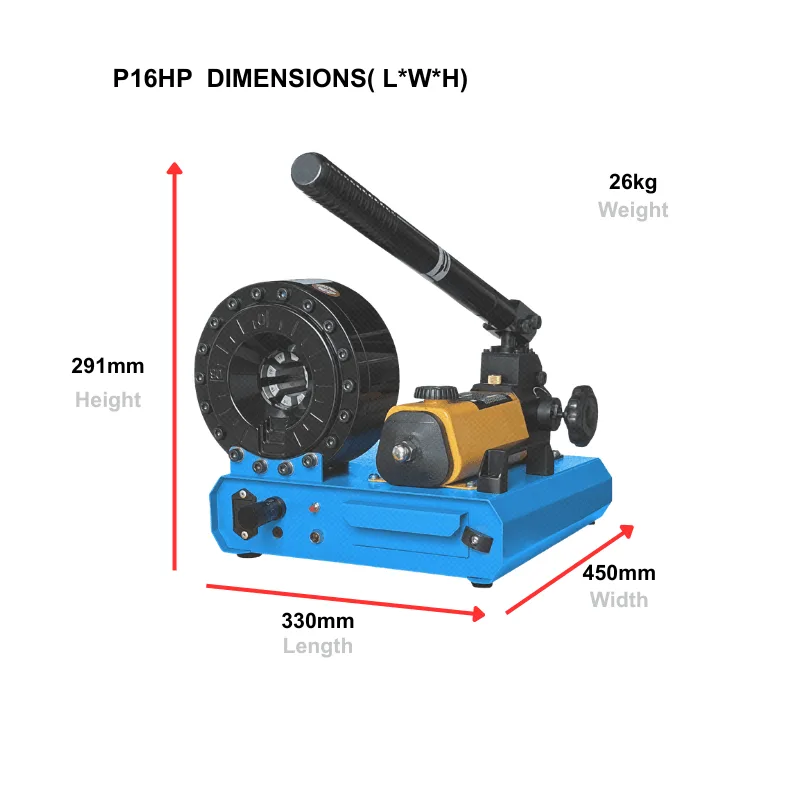
A hydraulic crimping tool (also called a hydraulic crimper tool or hydraulic compression tool) uses Pascal’s Law to multiply a small input force into enough pressure to deform metal ferrules around hydraulic hose. A 10 kg push on a hand-pump lever becomes 100+ tons of radial force at the die face.
That force multiplication is why hydraulic crimping replaced mechanical and pneumatic methods in professional hose shops. One crimp cycle takes 8-15 seconds and produces a permanent, leak-proof connection rated to 6,000 PSI working pressure.
Three Power Sources Compared
Every hydraulic crimping tool on the market uses one of three power sources. Each has specific advantages and limitations.
1. Hand Pump (Manual Hydraulic)
The operator works a lever to build hydraulic pressure. No electricity, no battery, no air compressor.
| Spec | Typical Range |
|---|---|
| Tonnage | 60–137 T |
| Cycles per charge/tank | Unlimited (human powered) |
| Weight | 8–35 kg |
| Cost | $300–1,200 |
| Best for | Field repair, remote sites, emergency service |
Real limitation: Operator fatigue. After 30-40 crimps in a day, your arms notice it. For daily production above 50 assemblies, hand pump is the wrong choice. But for a service truck that does 5-10 field repairs per week, it’s ideal — manual hydraulic hose crimpers never run out of power because the operator is the power source.
2. Electric Motor (Workshop Hydraulic)
An electric motor drives the hydraulic pump. The operator presses a button or foot pedal to start the crimp cycle.
| Spec | Typical Range |
|---|---|
| Tonnage | 60–1,750 T |
| Cycle time | 8–20 seconds |
| Power | 220V / 380V |
| Cost | $1,500–8,000 |
| Best for | Daily production, workshop environments |
Real limitation: You need electricity and a bench. An electric hydraulic hose crimping machine isn’t portable. But it crimps faster, more consistently, and handles larger hose diameters than any hand-pump unit.
3. Battery (Cordless Hydraulic)
A lithium-ion battery drives a small motor that builds hydraulic pressure. Same crimp force as a hand-pump unit, but without the pumping.
| Spec | Typical Range |
|---|---|
| Tonnage | 60–200 T |
| Crumps per charge | 80–150 |
| Charge time | 30–60 minutes |
| Cost | $2,000–5,000 |
| Best for | Mobile service trucks, multi-site maintenance teams |
Real limitation: Battery and cost. A battery-powered hydraulic clamping tool costs 3-5× more than an equivalent hand-pump unit. And in cold weather (-10°C and below), battery life drops 30-40%. Always carry a spare battery if you’re running one of these on a service truck.
Side-by-Side Comparison
| Factor | Hand Pump | Electric | Battery |
|---|---|---|---|
| Initial cost | $300–1,200 | $1,500–8,000 | $2,000–5,000 |
| Cost per crimp (500 crimps) | $0.60–2.40 | $3.00–16.00 | $4.00–10.00 |
| Daily volume capacity | 30–60 | 100–300+ | 60–120 |
| Max hose diameter | 2″ | 6″ | 2″ |
| Needs electricity | No | Yes (220V/380V) | No (battery) |
| Works in rain/mud | Yes | Risk | Yes (IP-rated) |
| Crimp consistency | Operator-dependent | Machine-controlled | Machine-controlled |
| Operator fatigue | High after 30+ crimps | None | None |
When Each Power Source Wins
Choose Hand Pump When:
- You do fewer than 50 assemblies per week
- You work off-grid: mines, farms, construction sites with no power
- Budget is under $1,500
- You need backup for when the electric machine is down
Choose Electric When:
- You do 20+ assemblies per day
- You work in a fixed workshop with power
- You need CNC control for ISO traceability
- You crimp hose larger than 2″ diameter
Choose Battery When:
- You’re running a mobile hose service truck
- You service multiple sites in one day
- You need speed without sacrificing portability
- Budget allows $2,000+ and you carry spare batteries
The Hydraulic Crimper Force Numbers
Understanding why hydraulic crimpers generate so much force comes down to basic fluid mechanics. Pascal’s Law states that pressure applied to a confined fluid transmits equally in all directions.
Here’s what that means in practice:
- A hand-pump lever applies roughly 30 kg of force to a 2 cm² piston
- That creates 150 bar (2,175 PSI) of hydraulic pressure
- A 200 cm² crimp cylinder converts that to 30,000 kg (30 tons) of crimp force
- A large CNC machine with a 1,000 cm² cylinder at 350 bar produces 350,000 kg (350 tons)
That’s why hydraulic force beats mechanical leverage every time. A mechanical toggle press of similar force would weigh 5× more and cost 3× more.
Maintenance: Keep the Hydraulic Crimping Working
Regardless of power source, every hydraulic crimping tool — whether a hydraulic crimper for daily production or a field unit — needs three things to stay reliable:
- Hydraulic oil changes — every 2,000 cycles or 12 months, whichever comes first. Old oil carries metal particles that score cylinder walls.
- Seal inspection — every 6 months. If you see oil weeping from the ram seal, replace it before it fails during a crimp.
- Die cleaning — after every use. Metal shavings between die segments cause uneven crimps and die damage.
Die Set Selection: The Part Most People Get Wrong
The die set is the part of the hydraulic crimping tool that contacts the ferrule. Get this wrong and no amount of machine quality saves you.
Die Compatibility Rules
- Match die series to machine model. A P16 die won’t fit a P32 crimper. The die holder geometry is different.
- Match die number to hose size + fitting type. A ¾″ one-piece fitting uses a different die than a ¾″ interlock fitting, even on the same hose.
- Check die wear every 5,000 crimps. Professional crimper dies are Cr12MoV or SKD11 tool steel, hardened to HRC 58-62. They last 5,000-10,000 crimps. Signs of wear: scoring on die faces, inconsistent crimp diameters.
Standard vs Non-Standard Dies
| Die Type | Availability | Lead Time | Use Case |
|---|---|---|---|
| Standard | Stock | 1-3 days | Common sizes: ¼″–2″ R1/R2 |
| Non-standard (*) | Custom order | 7-14 days | Oversize, specialty fittings |
Open Head vs Closed Head: When It Matters
The crimping head design determines what fittings you can crimp. This is a capability difference, not a performance upgrade.
Closed Head (Standard)
The die holder forms a complete ring. Dies close concentrically from all sides. Most consistent crimps with tightest tolerance (±0.03 mm with CNC). Trade-off: you can only crimp straight fittings. A 90° elbow won’t fit.
Open Head (Specialized)
The die holder opens horizontally. This lets you crimp pre-formed hoses — 90° elbows, 45° angles, S-bends. Open head machines like the P120C and P160C sacrifice concentricity for flexibility. Tolerance is ±0.05 mm.
| Factor | Closed Head | Open Head |
|---|---|---|
| Crimp accuracy | ±0.03 mm | ±0.05 mm |
| 90° elbow capable | No | Yes |
| Best for | High-volume straight assemblies | Custom shapes, field repair |
| Price premium | Base | +15-25% |
Pressure Testing After Crimping
Every new hose assembly must be pressure tested before service. SAE J517 and ISO 17165 both require proof testing at 2× working pressure.
Proof Test Procedure
- Connect the assembly to a hydraulic test pump.
- Fill with clean hydraulic fluid. Bleed all air.
- Pressurize to 2× rated working pressure (e.g., 3,000 PSI assembly → 6,000 PSI test).
- Hold for 5-30 seconds.
- Inspect for leaks at both fittings and along the hose body.
- Release pressure slowly. Record the result.
For more on tool selection, see our hydraulic crimp tool guide. If a fitting leaks during proof test, don’t re-crimp. Cut off the fitting, prep a new hose end, and crimp again. Re-crimping a ferrule that already leaked produces a connection with unknown integrity.
Real-World Cost Per Crimp
| Cost Factor | Hand Pump (P16HP) | Electric CNC (P32A) | Battery (P20CSZ) |
|---|---|---|---|
| Machine cost | $600 | $3,200 | $3,500 |
| Die sets included | 8 sets | 14 sets | 6 sets |
| Machine cost per crimp (5,000 crimps) | $0.12 | $0.64 | $0.70 |
| Labor per crimp (2 min @ $25/hr) | $0.83 | $0.83 | $0.83 |
| Materials (hose + fittings) | $8-15 | $8-15 | $8-15 |
| Total per assembly | $9-16 | $9-16 | $10-17 |
The machine cost per crimp is negligible compared to labor and materials. The real question is which one fits your work environment and daily volume.
What About Hybrid Solutions?
Some workshops run a bench-top CNC machine for daily production and keep a hand-pump portable as a backup. This isn’t as unusual as it sounds. The CNC machine goes down for maintenance once or twice a year — oil changes, seal replacements, die swaps. During those 4-8 hours, a $600 manual crimper keeps production running. If your shop does 50+ assemblies per day and can’t afford downtime, the hybrid approach costs less than one day of lost production.
Frequently Asked Questions
Is a hydraulic crimping tool the same as a hydraulic press?
No. A hydraulic press applies force in one direction (typically downward). A hydraulic crimping tool applies radial force inward from all sides simultaneously — that’s what creates the uniform crimp. Using a shop press as a crimper produces oval, uneven crimps that leak.
Can I use a hydraulic crimper on non-hydraulic hose?
Yes — for air lines, water hoses, and low-pressure applications. The crimper doesn’t know what’s inside the hose. But make sure the die size matches the ferrule, regardless of hose type.
How long does a hydraulic crimper last?
With proper maintenance (oil changes, seal replacements, die cleaning), 10-15 years of daily use is common. The hydraulic crimping mechanism itself rarely fails — it’s the seals and hydraulic oil that degrade over time. Budget $100-200 per year in maintenance parts.


