Hydraulic Hose Crimping Tool Types and Selection Conditions
A hydraulic hose crimping tool is not one product. It is five formats: manual hand-pump, pneumatic, electric workshop, battery-powered portable, and CNC production. All five do the same job — deforming a ferrule around a hose — but they sit at different points on the tonnage, workload, and cost spectrum. Picking the wrong format is the most expensive mistake a buyer can make, and it usually shows up three to six months after delivery.
This article compares the five formats on the variables that actually decide which one fits your work. The short version: the format follows the workload. Define your hose mix and monthly volume first; the format is a much shorter list after that.
Why All Five Formats Are “Hydraulic”
The five formats look different, but they share one physics. Each is a hydraulic machine: a device that uses liquid fluid power to perform work. The pump pressurizes hydraulic oil; the oil transmits the pressure to a cylinder; the cylinder converts the pressure into a mechanical force. The pressure develops according to the resistance present, and the oil is incompressible, so the pressure rise is transmitted instantly and undiminished throughout the closed system.
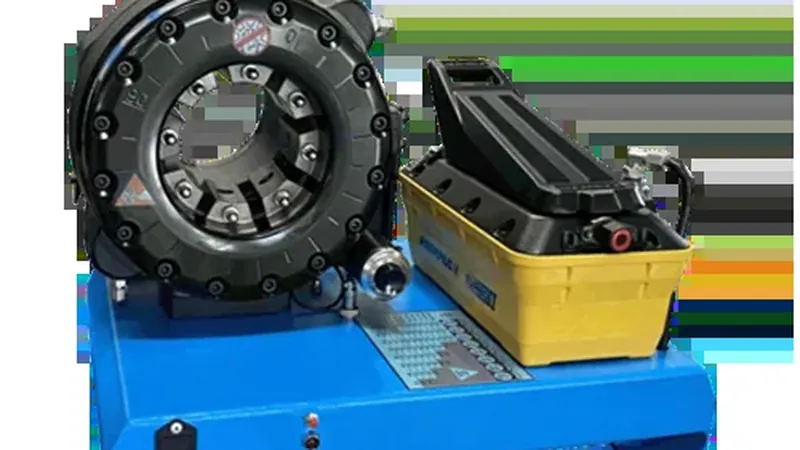
The defining advantage of hydraulic power is power density. A hydraulic actuator produces far more force per unit of volume than an electric motor of equivalent rating. That is why a workshop crimper with a 3 kW motor can deliver 137 ton of radial closure at the dies — an output that no direct-drive electric actuator of similar physical size could produce. The same principle explains why a battery-powered cordless unit running from a 12V vehicle outlet can deliver 80 ton at the dies for a full shift: the hydraulic multiplication does the work, and the battery only supplies the input power.
The force multiplication is independent of mechanical gears and levers. According to Pascal’s principle, any pressure applied to a fluid inside a closed system will transmit that pressure equally everywhere and in all directions. By altering the effective areas between the input cylinder (the pump piston) and the output cylinder (the master cylinder that drives the dies), the system multiplies force without any gear train. That is the engineering reason why every format in the list below — from a 6-ton hand-pump plier to an 830-ton industrial machine — uses the same hydraulic core.
Five Formats at a Glance
| Format | Typical tonnage | Typical hose range | Typical cycle | Where it fits |
|---|---|---|---|---|
| Manual hand-pump | 6–95 ton | Up to 1-1/4″ braided; some 1″ 4SH. | 30–60 s per crimp. | Field repair, low-volume shops, emergency standby. |
| Pneumatic (air-over-hydraulic) | 95–137 ton | Up to 1-1/4″ 4SH. | 8–12 s per cycle. | Workshops with shop air; medium-volume mixed production. |
| Electric workshop | 80–830 ton | Up to 2″ R13 on large machines; up to 4″ R13 on industrial. | 7–12 s; 3.6 s on fast-cycle models. | Workshop production; the default for a dedicated bench. |
| Battery / vehicle-powered | 80–200 ton | Up to 2″ on the largest cordless. | 8–10 s typical. | Service trucks, field crews, on-vehicle repairs. |
| CNC programmable | 137 ton and up | Same as the equivalent powered machine. | Same cycle, plus automatic die select and batch records. | Mixed production lines, traceable applications. |
These formats are not a quality ladder. A manual hand-pump unit produces the same crimp as a CNC machine, if the die is correct and the first piece is measured. The differences are how many assemblies per hour the operator can produce without fatigue, and whether the machine records what it did.
Pascal’s Law Applied to Each Format
The shared hydraulic core means the same equation — force equals pressure times area — describes every format. The difference between formats is what produces the input pressure.
| Format | Input pressure source | Typical system pressure | Output force |
|---|---|---|---|
| Manual hand-pump | Operator arm on a lever, mechanical advantage ~10:1 over a small pump piston. | 30–70 MPa at the master cylinder, depending on model. | 6 ton (P10HP) up to 137 ton (P20HP). |
| Pneumatic | Shop air at 6–8 bar drives an air-over-hydraulic intensifier that multiplies air pressure into oil pressure. | 30–70 MPa oil system pressure. | 95 ton (P16AP) up to 137 ton (P20AP). |
| Electric workshop | Three-phase or single-phase electric motor driving a hydraulic gear or piston pump. | 25–32 MPa system pressure, continuous duty. | 80 ton (P18X) up to 830 ton (P175). |
| Battery / vehicle | 12V or 24V DC motor driving a compact hydraulic pump. | 30–60 MPa, intermittent duty. | 80 ton (P20CS) up to 200 ton (P32CS). |
| CNC | Same electric pump as the equivalent powered machine, with a programmable pressure and position loop. | Same 25–32 MPa system pressure. | 137 ton (P20D) up to 245 ton (TRC120L). |
The shared pressure ceiling (~30–70 MPa oil system pressure) is what links the formats. A format that produces higher system pressure can use a smaller master cylinder for the same output force. A format that produces lower system pressure needs a larger master cylinder, which means more oil volume and a slower cycle. That is why a hand-pump unit feels slow at the top of the stroke: the operator is moving a large oil volume through a small pump piston to build pressure in a large master cylinder.
Manual Hydraulic Tools
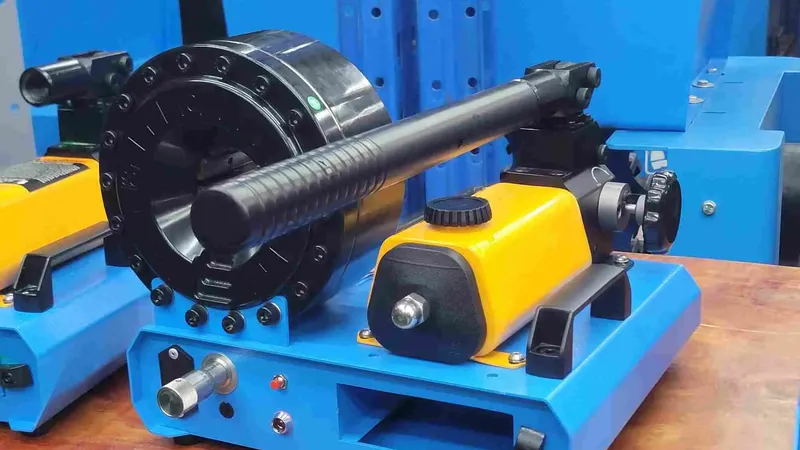
A manual tool uses a hand pump that drives a small hydraulic cylinder. The pump uses roughly a 10:1 area ratio, so a typical hand force at the pump lever translates to several tons at the dies.
| Attribute | Typical range |
|---|---|
| Tonnage | 6 ton for compact plier-type; up to 95 ton for bench-mounted hand-pump. |
| Hose range | Up to about 1-1/4″ braided; some bench units reach 1″ 4SH. |
| Cycle time | 30–60 seconds per crimp, including pump strokes. |
| Operator force | Up to about 20 kg per pump stroke on a bench unit. |
| Workload ceiling | About 15–20 assemblies per day before fatigue affects quality. |
TRC models in this format: the TRC P10HP is the compact entry point — zinc-nickel anti-corrosion alloy, 720-hour salt-spray tested, strong in Russia, the Middle East, and for mobile A/C service. The TRC P16HP (95 ton, 10-second cycle, lightweight, popular in Europe) and TRC P18HP (110 ton, larger range, popular in Poland and Eastern Europe) are the bench hand-pump standards. For the largest hand-pump range, the TRC P20HP reaches 1-1/2″ 4SH with its telescopic pole saving about 30% operator effort. See the manual crimper category.
Where they fit: field repair, small shops, low-frequency standby. Where they do not fit: any line producing more than about 20 assemblies per shift, or any application above 1-1/4″ braided hose.
Pneumatic-Powered Tools
Pneumatic tools use shop air driving an air-over-hydraulic pump. They remove the operator’s physical effort from the cycle, which raises the sustainable daily output.
| Attribute | Typical range |
|---|---|
| Tonnage | 95–137 ton typical. |
| Air supply | 90–150 PSI at the inlet; 2.5–3.5 CFM consumption typical. |
| Hose range | Up to about 1-1/4″ 4SH on a 137-ton pneumatic. |
| Cycle time | 8–12 seconds. |
| Workload ceiling | Sustainable 100–200 assemblies per shift without operator fatigue. |
TRC models in this format: the TRC P16AP (95 ton, portable pneumatic) and the TRC P20AP (137 ton, pneumatic kit). See the pneumatic crimper category.
Where they fit: workshops that already have compressed air and want to take the operator’s pump effort out of the cycle. Where they do not fit: field work (no shop air) or very-high-volume production where electric or CNC is more efficient.
Electric Workshop Machines
This is the default format for a dedicated hose assembly bench. An electric motor drives a hydraulic pump; the operator loads the hose, presses a button or foot pedal, and the machine runs the crimp cycle automatically.
| Attribute | Typical range |
|---|---|
| Tonnage | 80 ton compact (TRC P18X); 137 ton workshop sweet spot (TRC P20 family); 200 ton (TRC P32); up to 830 ton industrial (TRC P175). |
| Voltage | Typically 220V/380V three-phase for workshop; some compact models on 110V/220V single-phase. |
| Hose range | 3/16″ to 2″ on a 200-ton workshop machine; up to 4″ R13 on industrial. |
| Cycle time | 7–12 seconds standard; 3.6 seconds on fast-cycle variants. |
| Workload ceiling | 300+ assemblies per hour on a well-organized line. |
TRC models in this format, by workload:
- Compact entry: TRC P18X (80 ton, 2.2 kW motor, motor exposed, electric series’ cheapest, simple construction).
- Workshop 137 ton: TRC P20 (3 kW motor, classic, rare failure, strong in Vietnam/Southeast Asia); TRC P22 (auto-return, integrated design, popular in Poland); TRC P20S (compact, fast 3.6 s cycle).
- Workshop 200 ton: TRC P32 (3.7 kW three-phase, classic); TRC P32A (drawer-type die cabinet, caliper rack, value pick, strong in Malaysia / South America / South Africa); TRC P32E (compact, popular in Southeast Asia / Africa).
- Industrial 245 ton and up: TRC TRC120L/H (4 kW motor, 75 L tank, 245 ton); TRC P140 (320 ton, separate power unit); TRC P160; TRC P175 (flagship 830 ton, up to 15-inch industrial pipe).
See the electric hydraulic hose crimper category and the main crimper category.
Where they fit: any workshop with a defined production workload. Where they do not fit: field work (needs fixed power) or occasional-use applications where the capital cost cannot be justified.
Battery and Vehicle-Powered Systems
Battery-powered crimpers, and machines that run from a 12V or 24V vehicle electrical system, exist specifically for field work.
| Attribute | Typical range |
|---|---|
| Tonnage | 12V portable units around 80 ton; larger cordless units up to 200 ton. |
| Battery capacity | About 40–60 crimps per charge on a 12V system; up to about 200 on high-capacity lithium. |
| Cycle time | About 8 seconds typical. |
| Charging | From a vehicle outlet or a dedicated charger. |
| Workload ceiling | Field crews; typically 20–50 assemblies per day. |
TRC models in this format: the TRC P18CS and TRC P20CS (80 ton, 12 V, strong in Europe / North America / South America); the TRC P18XL (dual-power: workshop electric + battery backup, strong in Turkey / Eastern Europe / Russia); the TRC P20CSD (137 ton CNC cordless); and the TRC P32CS family (200 ton cordless). See the portable crimper category.
Where they fit: service trucks, mobile repair crews, on-vehicle field repairs. Where they do not fit: continuous workshop production (battery swap becomes the bottleneck).
CNC and Production Machines
CNC crimpers add a programmable control system on top of a powered hydraulic machine. The operator selects a stored crimp program; the machine sets the tonnage, runs the cycle, and records the result.
| Attribute | Typical range |
|---|---|
| Tonnage | Same as the equivalent powered machine: 137 ton (TRC P20D), 200 ton (TRC P32D), up to 245 ton (TRC TRC120L). |
| Programming | By target crimp diameter or by die ID + hose/fitting combination. |
| Records | Batch record with timestamp, die used, target and actual diameter. |
| Die handling | Some support automatic die selection; others require manual load with program selection. |
| Workload ceiling | Same as the powered equivalent; the gain is repeatability and traceability. |
TRC models in this format: the TRC P20D (137 ton CNC, multiple crimp modes including step crimping and pressure control, strong in Europe); the TRC P32D (200 ton CNC step crimping, strong in Europe); the TRC TRC120L (245 ton CNC, integrated design, electric backstop device, popular with European and large Chinese customers).
Where they fit: mixed production lines, traceable applications (OEM, mining, marine, aerospace), and any shop where operator changeover would otherwise cause setup drift. Where they do not fit: single-hose-type workshops with an experienced operator — the CNC premium does not pay back if the setup never changes.
Die Geometry and Why It Decides the Crimp Profile
Every format above depends on the die set to translate the master-cylinder force into the correct radial deformation pattern. The Wikipedia entry on crimping) treats the die as the part of the process that produces the final crimp profile. Die geometry is not arbitrary. Different crimp profiles are produced by different die shapes.
| Die geometry | Crimp profile produced | Typical use |
|---|---|---|
| Hexagonal segmented | Six flat facets around the ferrule; classic “hex crimp.” | Standard hydraulic hose fittings; most TRC P20 and P32 die series. |
| Square segmented | Four flat facets; deeper bite per facet. | Heavier wall ferrules on multi-spiral hose. |
| Trapezoidal segmented | Angled facets that produce a tapered crimp band; transitions smoothly along the ferrule length. | Step-crimp programs on CNC machines for high-pressure spiral hose. |
| Bowl / radius | Smooth concave profile; no sharp facets. | Low-pressure fluid and air-conditioning hose; avoids cover marking. |
| Flat | Two parallel flat dies; unidirectional compression. | Workshop press applications; not recommended for production hose. |
| Stepped | Multiple diameters along the die length; produces a multi-diameter crimp in a single stroke. | Interlock fittings with skive band and main crimp band on the same ferrule. |
The die geometry is the reason a “wrong die” produces a wrong crimp even when the tonnage is correct. The tonnage is set by the machine. The profile is set by the die. A hexagonal die run at the correct tonnage on a ferrule that requires a trapezoidal profile will produce a finished OD that measures correctly on a caliper but fails the impulse test, because the stress distribution in the ferrule wall is wrong.
Swaging vs Crimping: Two Die Kinematics
Buyers sometimes ask whether a hydraulic hose crimping tool is the same as a swaging tool. They are not. Both join by plastic deformation, but the die kinematics differ.
Swaging is a forging method in which the dies separate and close, often using centrifugal or roller action. A swager hammers or rolls the workpiece through a die to alter its dimensions. Crimping uses direct radial compression with segmented dies that close in a single, controlled stroke. Swaging is preferred for cable and wire rope terminations, where the workpiece can be drawn axially through the die. Crimping is standard for hydraulic hose, because the radial segmented-die action produces a concentric crimp diameter around an installed fitting that cannot be drawn through a die.
A workshop that needs to terminate both wire rope and hydraulic hose needs both machines. A swager will not produce a defensible hydraulic hose crimp, and a hose crimper will not produce a defensible wire-rope swage. The two processes look similar from the outside; the die kinematics make them different.
Five-Axis Comparison
| Axis | Manual | Pneumatic | Electric | Battery | CNC |
|---|---|---|---|---|---|
| Sustainable assemblies per shift | ~20 | ~150 | ~300+ | ~50 (field) | ~300+ (with records) |
| Hose range ceiling | ~1-1/4″ braided | ~1-1/4″ 4SH | Up to 4″ R13 | Up to 2″ | Same as powered |
| Site requirement | None | Shop air | Three-phase power | Vehicle outlet | Three-phase power |
| First-piece dependency | Critical | Critical | Critical | Critical | Critical (same process) |
| Repeatability across operators | Low | Medium | Medium | Medium | High |
| Batch record capability | Manual only | Manual only | Manual only | Manual only | Automatic |
| Typical acquisition cost | Lowest | Low-medium | Medium | Medium | Highest |
The most important row is “First-piece dependency.” No format removes the need to measure the first piece of every batch. A CNC machine automates the setting, but it does not automate the inspection.
Decision Matrix — Which Format Fits Your Workload
| If your workload is… | …the format that fits is… | …and the TRC class is… |
|---|---|---|
| Field repair, <15 assemblies/day, up to 1″ braided | Manual hand-pump | TRC P10HP / P16HP / P18HP |
| Field repair, 15–50/day, up to 2″ | Battery / vehicle-powered | TRC P20CS / P20CSD / P32CS |
| Workshop, 50–200/day, mixed hose | Pneumatic or powered electric | TRC P16AP / P20AP, or TRC P20 / P32A |
| Workshop, 200–800/day, frequent changeover | Powered electric workshop | TRC P32 / P32A / P32E |
| Production line, >800/day, traceable | CNC | TRC P20D / P32D / TRC120L |
| Mining, heavy equipment, 2″–4″ R13 | 200 ton and up; dedicated heavy-duty class | TRC P140 / P160 / P175 |
If you want help narrowing the list, send us your hose mix and monthly volume through the contact page. We will tell you which format fits, and which formats do not — so you do not pay for tonnage or automation you will not use. TRC ships from a 5,000 m² CE/SGS/UL+ISO certified factory to more than 300 customers across 50+ countries, with a four-hour response window on technical support.
Frequently Asked Questions
Is a manual hand-pump crimper reliable enough for production work?
Up to about 15–20 assemblies per day, yes — provided the first piece is measured. Beyond that, operator fatigue becomes the dominant quality variable, and a powered format is the right call regardless of brand. We explain the crossover in our manual vs powered comparison.
What is the advantage of CNC over a standard powered machine?
Repeatability across operators and an automatic batch record. CNC does not change the crimp itself; the die and the target diameter do that. CNC changes the workflow: setups are stored, changeover is faster, and every assembly is traceable. For single-hose-type workshops, the CNC premium usually does not pay back.
Can a battery-powered portable unit replace a workshop machine?
Only for field work. A cordless 80-ton unit handles the bulk of a service truck’s work, and larger cordless units up to 200 ton can do 2-inch hose. But continuous workshop production on a battery machine runs into battery swap time and cycle count limits.
Why does a small 3 kW motor produce 137 ton at the dies on a workshop machine?
Hydraulic power density. The 3 kW motor drives a pump that pressurizes oil to roughly 30 MPa. That pressure is transmitted unchanged to a master cylinder with a much larger effective area. Output force equals pressure times area, so a small motor driving a small pump piston produces a very large output force on a large master cylinder. Energy is conserved across the multiplication; the dies move a short distance, the pump piston moves a long distance.
Is a hydraulic hose crimper the same as a swager?
No. Crimping uses direct radial compression with segmented dies that close in a single stroke. Swaging uses dies that separate and close, often by hammering or rolling. Crimping is the standard for permanent hydraulic hose assemblies because the radial segmented action produces a concentric crimp around an installed fitting. Swaging is preferred for cable and wire rope terminations, where the workpiece can be drawn axially through the die.
Buyer question: which format do I need for mining or 4-inch R13 hose?
A heavy-duty class machine, typically 200 ton and up. None of the manual, pneumatic compact, or portable formats cover this range. Our heavy-duty category lists the models built for this workload — the TRC P140, P160, P165, and the flagship P175.
References and technical boundaries
- ISO 4413:2010 — General rules and safety requirements for hydraulic systems. Supports the general safety framework for hydraulic equipment.
- Wikipedia — Hydraulic machinery. Reference for the liquid fluid power principle, power density, and force multiplication without mechanical gears.
- Wikipedia — Pascal’s Law. Reference for F = P × A and the area-ratio multiplication principle.
- Wikipedia — Crimp (joining)). Reference for die geometry and crimp profile.
- Wikipedia — Swaging. Reference for the distinction between swaging and crimping die kinematics.