
The best rubber hose cutter is the one that cuts the specific hose construction squarely, at the required workload, while keeping the workpiece stable and controlling debris. A tool that works on unreinforced rubber may perform poorly on wire-braided or multi-spiral hydraulic hose.
The hardest normal hose should choose the cutter
A hose end looks acceptable immediately after cutting, yet loose wire and rubber debris complicate fitting insertion. The best cutter is the one that produces a repeatable, square end on the buyer’s hardest hose and fits the required cleaning workflow.
Match the cutting method to the hose
| Hose type or task | Main concern |
|---|---|
| Soft, unreinforced hose | Crushing or angled cuts |
| Wire-braided hose | Frayed reinforcement and heat |
| Multi-spiral hose | Blade power, stability and operator exposure |
| Repeated production | Feed control, length control and blade life |
| Field repair | Portability, safe mounting and cleanup |
A flexible hose cutter selected for occasional soft hose should not be assumed suitable for large reinforced hose.
TRC’s recorded range shows why a material label is too broad.
| Model | Recorded hose scope | Blade | Operating route |
|---|---|---|---|
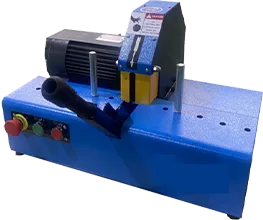
| C250AC | Up to 1 inch 4SH | 250 × 3.5 × 32 mm | Compact electric cutter |
| C300 | Up to 2 inch 4SH | 300 × 4 × 32 mm | Manual feed |
| C300A | Up to 2 inch 4SH | 300 × 4 × 32 mm | Pneumatic pusher |
| C400F | Up to 2 inch 4SH | 400 × 4 × 50 mm | Foot-pedal operation |
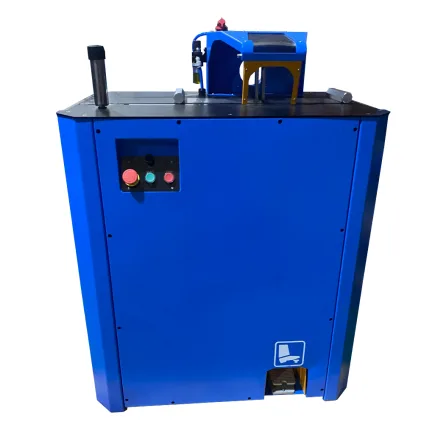
| C520A | Up to 6 inch industrial hose | 520 × 4 × 50 mm | Pneumatic pusher, 6 bar air |
These are product-file values. They do not prove that every hose at the stated nominal size will produce the required end condition.
Judge the finished end
The cut should support the next assembly step. Check squareness, loose wire, crushed bore and visible debris. The fitting insertion allowance and assembly drawing determine cut length; nominal finished length cannot be used without accounting for the fittings.
Parker’s hose technical handbook treats cutting, cleaning, marking and preparation as connected operations. That is the right way to evaluate a cutter: not as an isolated saw, but as the start of assembly.
| Defect | What the operator sees | First variables to review |
|---|---|---|
| Angled face | One side of the cut is longer | Hose support, twisting and blade entry |
| Flattened bore | Oval or crushed opening | Clamping and feed method |
| Pulled reinforcement | Loose or dragged wire | Blade condition, feed pressure and hose support |
| Glazed or burned rubber | Shiny face, heat or smoke | Blade match, blade wear and feed |
| Loose debris | Rubber or wire in the bore | Cutting condition and post-cut cleaning |
Engineering note: A cut is acceptable because it supports insertion and the downstream cleanliness requirement, not because it looks neat in one photograph.
Control debris after cutting
No cutting method should be advertised as automatically contamination-free. ISO/TS 18409:2018 describes methods for collecting samples to analyze solid-particle contamination in hydraulic hoses or assemblies. It does not prescribe one production cleaning method or universal acceptance class.
Set a defined cleaning and verification process for the application.
Use ISO/TS 18409:2018 only for its documented scope: methods for collecting samples to analyze solid-particle contamination in hoses or hose assemblies. It does not prescribe one cleaning machine or a universal cleanliness class.
Safety belongs in the selection
Guards, work holding and operating controls matter. OSHA 1910.212 provides general guarding requirements for points of operation, rotating parts and flying material. It is not proof that any specific machine is certified.
Do not choose a cutter that forces the operator to put a hand near the blade to control a coiled hose. Plan entry support, a defined holding position and a place for the cut part to land.
Buying rule
Send the supplier hose samples or exact construction data, maximum OD, cut frequency, available power and downstream cleanliness requirement. Ask for a cut sample before approving an unfamiliar application.
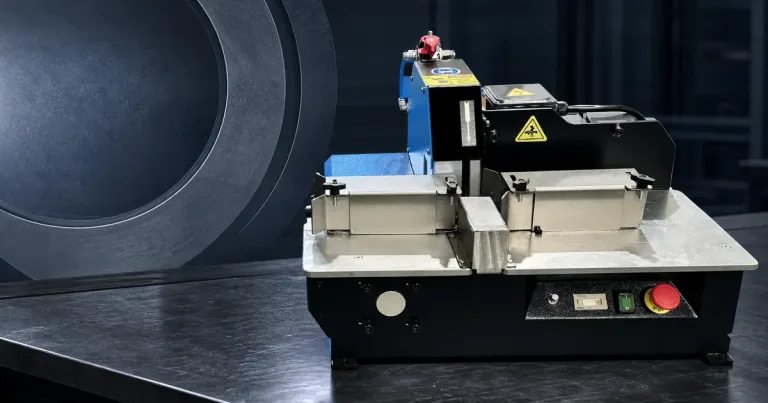
The TRC hydraulic hose cutter category covers workshop, pneumatic, portable and automatic routes. The best hose cutter is the smallest practical system that handles the hardest hose in your real work without compromising cut condition or safety.
For compact work, compare the C250AC 1-inch electric cutter with the service environment. For common 2-inch 4SH workshop work, review the C300 manual-feed cutter and the C300A pneumatic-feed alternative. Large industrial hose belongs on the C520A application route.
Calculate output from accepted cuts
Use accepted cuts per hour = 60 ÷ observed minutes per accepted cut. Include loading, aligning, cutting, end inspection, cleaning and handling.
If a trial records 45 seconds to load and align, 20 seconds to cut, 30 seconds to inspect and clean, and 25 seconds to clear and prepare the next piece, the complete cycle is 120 seconds. The calculated rate is 30 accepted cuts per hour. This is a worked example, not a TRC production claim.
Now repeat the trial after the blade warms and with hose from the coil’s inner layer. If quality or intervention changes, use the lower stable rate for planning.
Compare manual and assisted feed honestly
Pneumatic feed can reduce the need for the operator to push hose toward the blade. It does not automatically straighten a coil, support a long part or inspect the cut.
| Trial question | Manual feed | Pneumatic feed |
|---|---|---|
| Who controls feed pressure? | Operator | Regulated pneumatic system and operator setup |
| What utilities are needed? | Electrical supply for cutter | Electrical supply plus suitable air |
| Can it remove coil memory? | No | No |
| Does it verify cut quality? | No | No |
| Where can it help? | Mixed low-volume work | Repeated cuts with controlled setup |
Diagnose the cut instead of blaming the hose
An angled face often points to poor support, twisting during feed or uneven blade entry. A flattened bore suggests excessive clamping or a method that pushes rather than slices. Pulled wire, glazed rubber and smoke call for a review of blade condition, feed pressure and the match between blade and hose construction.
Photograph both the outside and bore of the trial cut. Record the hose identity, blade, machine and operator setup. That record lets a supplier distinguish a tooling problem from a handling problem.
A practical cut-sample report
Use at least three cuts from the same hose, not one photograph. Record whether the stock arrived straight or coiled, how it was supported and how much operator correction was needed. Inspect the first and last cut for the same defects. If quality changes as the blade warms or the hose feed changes, the machine has not yet demonstrated a stable process.
For a mixed workshop, repeat the trial on an unreinforced hose and the most difficult reinforced hose. The purpose is not to prove that one cutter handles every material. It is to define a normal range, an edge case and a material that needs another method.
Pro tip: Send three labeled cut samples to the buyer: first cut, warmed-up cut and final cut in the trial. One perfect sample can hide an unstable process.
Build a cut-quality SOP around visible defects
Write the acceptance criteria in language an operator can use at the machine. “Good cut” is too vague.
For the trial hose, photograph an accepted face and label the bore, reinforcement and outer cover. Photograph one rejected example for each defect that has appeared in the shop.
The operator should stop when the cut wanders, the bore collapses, reinforcement pulls, heat rises or loose material exceeds the normal controlled result. Stop rules protect the next assembly step and also tell maintenance when to inspect the blade.
Choose three reference hoses
A mixed shop can maintain a simple reference set:
- The smallest soft hose normally cut.
- The highest-volume reinforced hose.
- The hardest normal hose by OD, stiffness or reinforcement.
Use these references for commissioning and after blade changes. Record the hose identity so a later supplier or operator does not substitute a visually similar material.
If one cutter cannot pass all three, define its approved range and assign the edge case to another machine. That is better than forcing one machine to cover the whole catalog.
Work through a cutter choice
Assume a shop normally cuts 1-inch 4SH hose, occasionally cuts 2-inch 4SH and never handles six-inch industrial hose. C250AC reaches the recorded 1-inch 4SH scope, while C300 and C300A reach the recorded 2-inch 4SH scope.
C250AC is a compact starting point for the normal material. C300 provides extra recorded scope with manual feed. C300A adds pneumatic feed and a 6 bar air requirement.
The buyer should test the 2-inch edge case and calculate how often it occurs. If it appears twice a year, outsourcing may cost less than buying a larger machine. If it enters weekly production, C300 or C300A deserves the stronger trial.
Plan blade and service stock
Record the exact blade from the approved machine. Ask the supplier for replacement identity, ordering route and the wear parts needed for the feed system.
Do not buy a “universal” spare blade by outside diameter. Bore, thickness, material, direction and operating suitability matter.
Use shop data for spares:
reorder point = expected blade use during supplier lead time + buyer-defined safety stock
The calculation becomes meaningful after the shop has tracked blade changes. Before that, keep the assumption visible instead of claiming a universal blade life.
Protect the clean end
Cutting and cleaning are different operations, but the cut end can be recontaminated between them. Keep the piece off the floor, move it through a defined cleaning step and protect it if assembly is delayed.
For a high-cleanliness application, document the verification method with the system owner. Do not turn a cutter sample into a cleanliness certificate.
Put the buyer’s decision on one page
State the selected model, approved reference hoses, blade, feed route, utilities, accepted end condition and out-of-scope materials. Add normal and peak accepted cuts.
Attach trial photographs and timing behind the summary. The one-page decision keeps the sales team from shortening “tested on these three hoses” into “cuts all rubber hose.”
Recheck after the first blade change
The first replacement blade is a useful process audit. Confirm identity, installation, guard and reference-hose result.
If the accepted cut changes, compare blade, seating, feed and support with the commissioning record. Do not edit the shop criterion to make the new result pass.
Ask maintenance what will stop the machine
Review blade, motor, controls, pneumatic parts where used and service access. Record which parts can be stocked and which need supplier support.
A cutter with excellent sample quality can still be a poor production choice if one ordinary wear part has no identification.
Review accepted cost, not blade contact time
Add operator time, rejects, cleaning and blade use.
cost per accepted cut = total cutting-cell cost ÷ accepted pieces
Use one month of shop data after commissioning. That measure allows a fair comparison between a cheaper manual route and an assisted system without inventing a market-wide number.
Check the operator’s body position
During the sample trial, watch feet, hands and shoulders. The operator should not lean across the cutting plane or fight coil memory beside the blade.
Move supports and controls before approving the cell. A clean sample made with an awkward unsafe posture is a failed trial.
Keep an approved-material register
Record hose reference, OD, reinforcement, machine, blade, support and accepted end. Add the trial date.
When a supplier changes construction or the shop receives an unfamiliar hose, run another review. Similar appearance does not extend approval.
Make the recommendation specific
Write “C300A pneumatic-feed route for the documented 2-inch 4SH samples and repeated workshop batches,” not “best industrial cutter.”
Specific language helps search readers and buyers understand the reason, boundary and next evidence needed.
Review the first three rejects
For each, record defect, hose, blade condition and operator observation. Three rejects are not a statistical study, but they reveal whether the shop is labeling failures or merely throwing pieces away.
Use the findings to improve support, blade inspection or material identification.
Finally, ask whether the next assembly station accepts the cut without extra trimming. If technicians routinely recut or dress the end, the cutter trial overstated accepted output. Count that correction as rework and return the evidence to the cutting cell.
Keep the accepted sample, blade reference and material identity together. The next blade supplier should see the end condition the shop expects, not merely the machine model.
That reference also makes operator training faster and keeps purchasing from shortening the blade description.
The cheapest clean cut may come from better support
Shops often blame the blade first when braided hose frays. Blade condition matters, but poor support can produce the same symptom. If the hose hangs from the bench, twists during feeding or bends sharply beside the cutting zone, the reinforcement reaches the blade at an unstable angle.
We would run a short trial before buying a larger machine. Use the normal hose, the most difficult reinforcement and three repeat cuts. Hold the supply coil at a consistent height, support the offcut and use the same feed method each time. Record bore shape, squareness, pulled wire, cover damage, visible heat and loose debris.
If the cut improves when support is corrected, spend part of the budget on guides, rollers or a safer receiving table. If the defect remains, review blade specification, seating, wear, speed and feed with the machine supplier. Do not increase force until the cause is known.
An illustrative repair shop processing 40 short pieces in a batch might lose 20 seconds trimming and taping each poor end. That is more than thirteen minutes of avoidable handling, before counting rejected fittings or contamination control. The useful productivity number is accepted ends per hour, not blade cycles.
Shop-floor note: Keep one accepted and one rejected cut-end photograph beside the machine. Operators can compare bore deformation, wire pull-out and cover damage before the piece reaches fitting insertion.
Cleaning follows acceptance of the cut. A projectile, fluid flush, air method or combined process may be specified by the assembly system, but the shop must protect the cleaned end afterward. A perfect cleaning step loses its value if the hose sits open on a dusty bench.
Frequently asked questions
What is the best tool for cutting hydraulic lines?
For assembled pressurized lines, isolate and make the system safe before any work. For new hose stock, choose the cutter by reinforcement, OD, stiffness, workload and required end condition. A dedicated guarded saw route suits reinforced hydraulic hose better than a soft-hose hand cutter.
How should a hose be cleaned after cutting?
Follow the hose-system or end-use procedure. ISO/TS 18409 provides sampling methods for solid-particle analysis; it does not prescribe one production cleaning method.
Submit the hardest hose
Send TRC the hose construction, OD, monthly cuts and a photo of the required end condition. A sample cut is more informative than selecting a cutter from a broad material label.