Portable Hydraulic Line Crimper: Truck Power and Field Setup
A portable hydraulic line crimper is specified differently from a workshop crimper, because the word "line" changes the job. The workpiece is a hydraulic line on a vehicle or a piece of equipment, often one that cannot be removed and brought to a bench. The crimper has to come to the line, produce a defensible crimp in the field, and leave the assembly safe to return to service. Every specification decision flows from that single constraint.
This article covers what changes when the workpiece is a line on a vehicle, the power and mounting options, the cleaning step most field setups skip, the field verification protocol that protects the crew's warranty position, and the TRC models that fit this work.
"Line" Means On-Vehicle, Not In-Workshop
A workshop hose crimper and a portable hydraulic line crimper look similar from the outside. They are not the same tool. The workshop crimper is optimized for repeatability in a controlled environment. The portable line crimper is optimized for producing a defensible crimp in an uncontrolled environment, often on a workpiece the operator cannot move.
| Consequence of "line" work | What it requires of the tool |
|---|---|
| The workpiece cannot always be removed | The crimper has to be portable enough to reach the line, and the die head has to load over an existing assembly. |
| The work environment is uncontrolled | Dust, mud, poor lighting, weather, and limited access all affect crimp quality. |
| The equipment owner is watching | Crew is under customer observation; a failed crimp is a visible failure. |
| The line may carry fluid when cut | Crew has to catch and contain the fluid before the cut, and clean the system before reassembly. |
| The system downstream is the customer's | Contamination introduced at the cut becomes the customer's problem — and a warranty claim against the crew. |
| Return to service is on the clock | Every minute of downtime is billed against the operator; speed without shortcuts is the goal. |
Our opinion is straightforward: if your primary work is making new hoses on a bench in a shop, you need a workshop crimper. If your primary work is repairing lines on equipment in the field, you need a portable line crimper — even if the tonnage range overlaps. The two tools are not interchangeable.
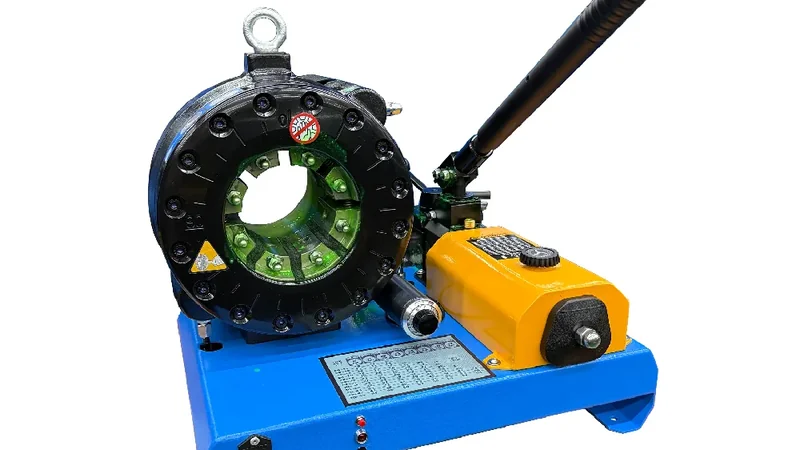
What On-Vehicle Crimping Demands
| Demand | What it means | Why it matters |
|---|---|---|
| Stability | Machine mounted or held stable during the cycle; on-vehicle crimping with a loose unit produces oval crimps. | An oval crimp grips tighter on one axis and looser on the other — a classic leak path. |
| Reachability | Crew can get the machine close enough to the line to load the hose into the die. | Lines buried inside equipment frames are the most common reason a portable cannot complete the job. |
| Cleanliness | Cut produces debris; debris must be removed before the fitting goes on. | Debris pushed into the line becomes pump and valve abrasive later. |
| Lighting | Crew can see the die-to-ferrule alignment and the insertion mark during loading. | Misloaded assemblies are the second most common field failure after contamination. |
| First-piece verification | First assembly of every hose size measured on site with a caliper. | Field work has no second chance; the first piece has to be right. |
| Return-to-service check | Repaired line leak-tested at working pressure before equipment returns to service. | The leak test is the crew's warranty position; without it, the next failure is the crew's failure. |
Power Source: Truck-Mounted Options
The power source is the most consequential specification on a portable line crimper, because it determines where the crew can work and how many crimps they can make in a shift.
| Power source | Suitability for line work | Strengths | Limits | TRC examples |
|---|---|---|---|---|
| 12V vehicle-powered | Most common on pickup and medium-duty service trucks; about 40–60 crimps per engine-running session. | No separate battery; draws from the truck's starter battery with the engine running. | Voltage sag in cold weather; tonnage ceiling around 80 ton. | TRC P20CS, TRC P20CSD |
| 24V vehicle-powered | Common on heavy trucks; higher tonnage class. | Higher sustained current; supports up to 200-ton cordless platforms. | Only available where the truck has a 24V system. | Heavy-truck fleets; pairs with TRC P32CS for 2" line work. |
| Battery-powered (cordless) | No vehicle dependency during the crimp; runs anywhere on site. | Highest flexibility; reaches lines the truck cannot get close to; about 200 crimps per charge on a high-capacity pack. | Battery management; electronics sensitive to heat and dust; spare pack required. | TRC P32CS, TRC P32CSD |
| Hand-pump | Backup or very-low-volume option. | No electricity of any kind; works in any environment. | Slow cycle; operator fatigue limits daily volume. | TRC IN2 (non-electric, moderate weight, portable) |
Mounting: Bench, Vise, or Portable Stand
| Mounting | Pros | Cons | When to choose |
|---|---|---|---|
| Fixed bracket on truck bed | Rigid; always ready; shortest setup time. | Limits where the crew can work; the line has to come to the truck. | Lines that can be removed and brought to the truck bed. |
| Slide-out tray | Rigid when extended; compact when stowed. | More complex; adds weight; mechanical maintenance. | Mixed work — some lines removed, some repaired in place near the truck. |
| Portable stand (tripod) | Can be set up next to the equipment. | Heavier to carry; setup time per job. | Lines repaired in place but away from the truck. |
| Vise-mounted | Maximum flexibility; clamps to any solid surface. | Slow to set up; needs a suitable mounting point. | Occasional field work where a tripod is not justified. |
We recommend fixed-bracket mounting for crews whose work is mostly "remove the line, bring it to the truck." We recommend a portable stand or vise mount for crews whose work is mostly "the line stays on the equipment." The choice is about where the work happens, not about preference.
Cleanliness: The Step Most Field Work Skips
A hydraulic line repair has three operations: cut, clean, crimp. Field crews routinely treat the second operation as optional. The cost of that skip does not show up in the field. It shows up weeks or months later as a pump failure or a valve stall on the customer's equipment.
ISO/TS 18409:2018 defines the cleanliness sampling method for hydraulic hose assemblies. It does not tell a field crew how to clean a hose. It tells them how to verify, by sampling, that the cleanliness level is acceptable for the system. For field work, the practical cleaning protocol is the steps below; ISO/TS 18409 sampling is reserved for assemblies where the downstream system demands documented cleanliness.
| Step | What it does | Field practice |
|---|---|---|
| Cut the hose square | Clean end for the fitting to seat against; prevents ferrule tilt. | Use a purpose-built hose cutter, not an angle grinder (angle grinder produces hot debris and loose wire). |
| Catch the fluid | Pan and absorbents under the cut. | Position the catch before the cut; confirm the line is depressurized first. |
| Cap or plug the open end | Prevents dirt entry between cleaning and crimping. | Cap every open end, every time, even for a few minutes. |
| Clean the inside of the hose | Air blast (filtered) or projectile cleaning. | Projectile cleaning is more reliable than air blast for spiral hose; verify the projectile comes out clean. |
| Verify cleanliness if required | Per ISO/TS 18409:2018 sampling. | Reserved for systems with documented cleanliness targets; not required for every field assembly. |
Field crews skip cleaning because it is slow, or because the equipment is not carried. The cost shows up later in the customer's pump life and valve wear. We tell every new line-repair buyer to budget for a cleaning kit — filtered air nozzle or projectile kit, caps, plugs, absorbents — at the same time they budget for the crimper.
Field Verification: What to Check Before Returning to Service
| Check | Method | Acceptance | Frequency |
|---|---|---|---|
| Crimp diameter | Caliper at three positions, 120° apart. | Within manufacturer's published target for the hose + fitting combination. | First assembly of every hose size on every job. |
| Ovality | Two perpendicular caliper measurements; compare. | Difference within about 0.1 mm. | First assembly of every hose size. |
| Visual | Operator inspection. | No cracks in ferrule; no exposed wire at the crimp edge; no cover damage. | Every assembly. |
| Insertion mark | Paint marker applied before crimp. | Mark has not moved relative to the ferrule edge. | Every assembly. |
| Working-pressure leak test | Pressurize to operating pressure with the system fluid. | No leak at the crimp; no weep at the fitting stem. | First assembly of every hose size on every job; sample thereafter. |
| Functional check | Cycle the equipment through its normal range. | No sluggishness; no fluid loss; no abnormal heat at the crimp. | Every job before handover. |
The working-pressure leak test is the single most important verification step for a field line repair. It is also the step most often skipped. Our position is firm: a line repaired in the field that has not been leak-tested at working pressure is not a completed repair.
TRC Models for Line Work
For most line work, the practical choice is a 12V vehicle-powered unit or a cordless unit. The decision between the two comes down to where the work happens — at the truck or at the equipment.
| Use case | Recommended TRC model | Why it fits |
|---|---|---|
| Pickup service truck, 1/4"–1" 2SN | TRC P20CS (80 ton, 12V) | Simple construction; covers the majority of line repair lists; strong market feedback from Europe, North America, South America. |
| Mixed field work with CNC records | TRC P20CSD (137 ton CNC cordless) | Full crimp data logging; step crimping and offset correction for reproducible field crimps. |
| Compact cordless for tight access | TRC P18CS (80 ton, 12V) | Lightest cordless option in the lineup; reaches lines the larger units cannot. |
| Heavy truck, up to 2" hose | TRC P32CS (200 ton cordless) | Reaches 2" 4SH on a cordless platform; for mining and heavy construction line repair. |
| Non-electric backup | TRC IN2 | No power required; backup for power loss or remote sites. |
| Workshop + field (dual-power) | TRC P18XL (95 ton) | Workshop mains for bench work; battery for field calls without changing machines. |
See the portable category for the full range.
Frequently Asked Questions
Can I crimp a hydraulic line without removing it from the equipment?
Sometimes, if the machine can be positioned close enough to the line and the hose can be fed into the die opening with the fitting in place. For lines that cannot be removed, a portable unit on a stand or vise mount is usually required. Confirm the die-head opening depth and segment side clearance before attempting an in-place crimp.
What power source do I need for a portable line crimper?
Most line work runs from a 12V vehicle outlet, a 24V heavy-truck system, or a cordless battery pack. The choice depends on the truck. Pickups and medium-duty trucks typically run 12V; heavy trucks run 24V; cordless works anywhere but requires battery management.
Why do field repairs fail more often than workshop assemblies?
Mostly because of skipped steps — cleaning, insertion-depth marking, and the working-pressure leak test. Each skip has a measurable cost in contamination, push-back failures, and callbacks. Field work does not lower the acceptance standard; it raises the cost of skipping steps.
What cleanliness standard applies to field line repairs?
ISO/TS 18409:2018 defines the sampling method for verifying hydraulic hose assembly cleanliness. It is not a production cleaning procedure; it is a verification method for assemblies where the downstream system has a documented cleanliness target. For most field line repairs, the practical protocol is square cut, fluid catch, cap, projectile or filtered-air cleaning, then crimp.
Buyer question: how much does a working portable line crimper setup cost?
The total cost is the machine plus the die set, mounting hardware, carried inventory, cleaning and inspection tools, and verification equipment. Quoting a single number is misleading. Specify the items against your repair list and request a structured quote through the contact page.
References and technical boundaries
- ISO/TS 18409:2018 — Hydraulic hose assembly cleanliness sampling. Defines the sampling method used to verify field-fabricated assembly cleanliness. It does not define a production cleaning procedure.
- Wikipedia — Hydraulic machinery. Reference for the underlying hydraulic principle and the power-density constraints that govern portable line work.