
Manual Hose Crimper Tool for Field and Fitting Work
A manual hose crimper tool is not a single item. It is a minimum working system — the machine, plus the dies, the measuring tools, the support, and the documentation that make the finished crimp defensible. Buyers who order just the machine usually discover the missing pieces on the first day of production.
This article covers what a working manual hose crimper tool setup actually contains, how the hand-pump mechanics produce force, the field limitations, and the TRC models that fit low-volume and field work. The framing is field-first: a hand-pump unit exists to make assemblies where there is no power, no bench, and no second chance.
A Manual Hose Crimper Tool Is a System, Not a Machine
The machine is the most visible part, but it is only one of five components. Each component has to be present, matched, and verified, or the crimp is not defensible.
| Component | Minimum requirement | Why |
|---|---|---|
| Hand-pump machine | Tonnage class matched to your maximum hose and fitting. | Produces the radial force. |
| Die set | Matched to your hose/fitting system, with published target crimp diameter. | Sets the crimp geometry. |
| Caliper | 0.02 mm resolution, calibrated. | Measures the finished crimp. |
| Bench or mounting fixture | Stable, bolted down. | Holds the machine still during the cycle. |
| Crimp data | Printed target diameters for your hose + fitting combinations. | Without it, the operator cannot verify the crimp. |
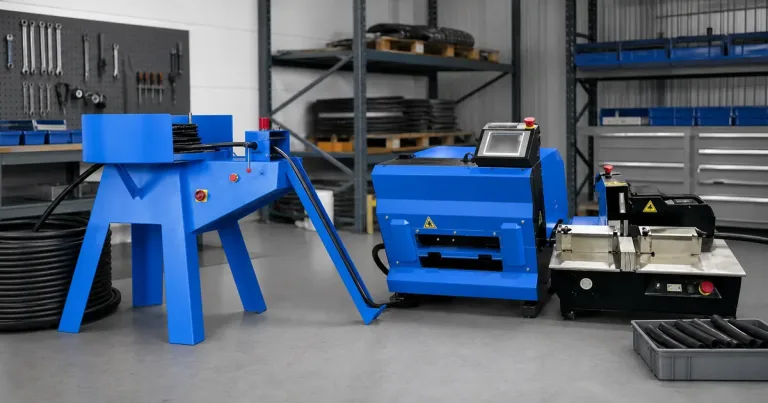
Two more items are required to produce an assembly at all: a hose cutter and a cleaning method. See our hose crimping equipment article for the full bench.
The honest answer on system buying: a machine without a matched die set is a paperweight. A die set without a published target diameter is a set of metal shapes. The crimp data sheet is what turns the metal shapes into a tool, and the crimp data sheet comes from the hose and fitting manufacturer, not the machine maker.
Hand-Pump Mechanics: How the Force Gets Made
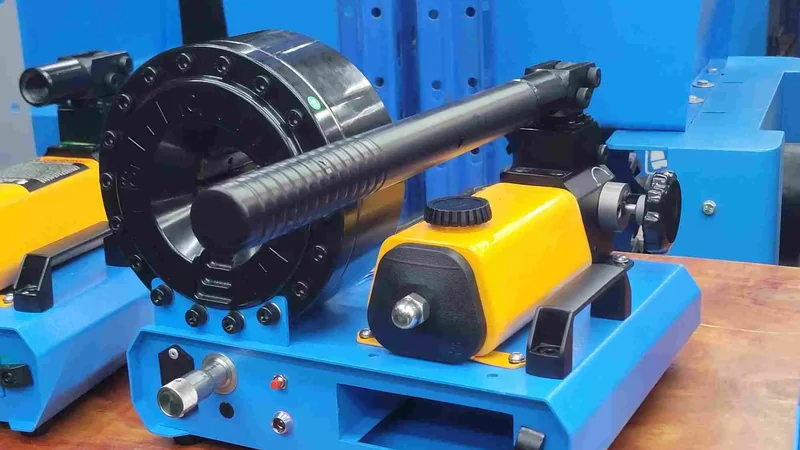
A hand-pump hose crimper uses a small hydraulic cylinder driven by a manual pump. The pump uses an area ratio of about 10:1 to amplify the operator's input force — the same Pascal's Law principle that powers every hydraulic machine. A 20 kg force at the lever becomes about 200 kg at the pump piston. That piston drives hydraulic fluid into a larger cylinder, multiplying force again to reach tonnage at the dies.
| Variable | Typical value |
|---|---|
| Area ratio (lever to pump piston) | About 10:1. |
| Operator force at the lever | Up to about 20 kg per stroke on a bench unit. |
| Hydraulic pressure | Up to about 700 bar at full stroke. |
| Output force at the dies | 60–95 ton on a compact unit; up to about 137 ton on a larger bench unit. |
The trade-off is that the operator has to pump many times per cycle. A typical 1-inch 2SN crimp requires 15–25 pump strokes. That is where the 30–60 second cycle time comes from. Energy conservation holds: the high-force output piston moves a short distance for each long stroke of the low-force input piston, so the operator pumps many times to advance the dies through the full crimp stroke.
This is the same physics that lets a 2 kW electric motor on a workshop machine generate 137 ton of force. The motor supplies the input energy continuously; the operator on a hand-pump unit supplies it in discrete strokes. The hydraulic multiplication is identical.
TRC Hand-Pump Lineup
TRC builds hand-pump crimpers from compact field units up to bench units that reach 1-1/2" 4SH. Equipment is built in a roughly 5,000 m² facility behind TRC's overseas projects, with CE, SGS, and UL+ISO certification, serving 300+ customers across 50+ countries.
| Model | Tonnage | Key selling points | Strong markets |
|---|---|---|---|
| TRC P10HP | Compact, 10 ton | Cheap, simple, light. Zinc-nickel alloy, 720-hour salt-spray tested, 3.5 kg net. | Russia, Middle East, mobile A/C service. |
| TRC P16HP / P16HPZ | 95 ton | Light, simple, stable quality. Telescopic pole saves 30% effort. Separate-pump version available (P16HPZ). | Europe (global dealer sales). |
| TRC P18HP / P18HPZ | 110 ton | Same simplicity as P16HP, larger range (up to 1-1/4" 4SP). | Poland, Eastern Europe. |
| TRC P20HP / P20HPZ | 137 ton | Largest range in the manual/pneumatic series (up to 1-1/2" 4SH); 100 kg gross, requires two people to lift. | Global; mobile service and emergency repair. |
| TRC IN2 | Non-electric | No power required, moderate weight, simple construction, low failure rate, portable. | Workshops and individuals with large-pipe needs. |
See the manual category for the full lineup.
We recommend the P10HP for small-bore field service where corrosion resistance and weight matter more than tonnage. We recommend the P16HP or P18HP for the workshop sweet spot — 95 to 110 ton covers most 1" braided and small spiral work at a sustainable operator effort. The P20HP is the ceiling of the manual range; it reaches 1-1/2" 4SH, but only at low daily counts. The IN2 is a different category — non-electric, designed for large-pipe work where a hand-pump unit is not enough but a powered industrial machine is not justified.
Field Reality: Stability, Cleanliness, Lighting
A manual unit in a workshop has a stable bench, controlled lighting, and a clean environment. The same unit in the field has none of those guarantees. The table below covers the field factors that turn a good workshop setup into a bad field setup.
| Field factor | What it costs you |
|---|---|
| Unstable mounting | Machine shifts during the pump cycle; crimp goes oval. |
| Poor lighting | Operator cannot see the die witness marks clearly. |
| Dust and contamination | Debris enters the hose after cutting. |
| No reference documentation | Operator cannot look up the target diameter. |
| No bench vise | Hose is not held square to the machine. |
A field setup has to engineer around these factors. The machine has to be mounted to a service truck bed or a portable stand rigid enough to resist the pump torque — because every pump stroke torques the machine against its mount, and any movement shows up as ovality in the crimp. The operator has to carry a caliper, printed crimp data, and a hose cutter. The hose has to be cleaned after cutting, especially on spiral constructions where wire braid filings contaminate the inner tube.
We recommend building a field kit as a single load: the machine, a die case, a caliper in a sleeve, printed crimp data laminated for weather, a hose cutter, and a cleaning brush. A field kit that lives in the truck in pieces gets used in pieces, and the missing piece is usually the caliper or the crimp data — the two items that make the crimp defensible.
Operating Discipline for Repeatable Crimps
The hand-pump format puts more responsibility on the operator than any powered format. The setting is judged by feel, not by a stored program, so the operating discipline is what makes the crimp repeatable.
| Step | What the operator does | What it prevents |
|---|---|---|
| Position the assembly | Hose and ferrule square in the die band. | Oval crimp from tilt. |
| Close the dies | Pump until the dies contact; do not over-pump. | Over-crimp that damages wire reinforcement. |
| Measure the first piece | Caliper at three positions around the ferrule. | Wrong setting producing a bad batch. |
| Mark insertion depth before crimping | Paint marker line on the hose cover. | Confirms hose did not push back during crimp. |
The first-piece check is the single most important discipline on a manual unit. It compensates for the variability in the operator's judgment of die-to-die contact. Measure at three positions, 120 degrees apart, average the readings, and compare to the published target. If the average is off by more than 0.1 mm, re-set and re-run.
What a Hand-Pump Unit Cannot Do
| Limitation | Why |
|---|---|
| Hose size above 1-1/4" braided | Tonnage requirement exceeds sustainable hand-pump operation. |
| Any 4SH / 4SP / R13 spiral hose above about 1" | Tonnage too high; ferrule too heavy wall. |
| Daily count above ~20 assemblies | Operator fatigue becomes the dominant quality variable. |
| Applications requiring batch records | Paper records workable for low volume; not defensible for production. |
The honest answer on limits. A hand-pump unit is a field and low-volume tool. It is not a production machine. If the workload looks like production — same hose, same fitting, 30+ assemblies per shift — a powered machine does the same work in a third of the time, with consistent quality across the shift, and without operator fatigue as a quality variable.
When to Move Up to Powered Equipment
| Signal | What it means |
|---|---|
| Daily count crosses about 20 assemblies | Fatigue is about to become the dominant quality variable. |
| You start quoting hose sizes above 1-1/4" braided | Hand-pump tonnage ceiling approaching. |
| Customer requires batch records | CNC is more defensible. |
| Operator reports wrist, elbow, or shoulder pain | RSI is setting in. |
| First-pass yield drops below about 90% | Quality drift is happening. |
See our manual vs powered comparison for the full crossover analysis. When the time comes, the TRC P20 (137 ton, classic, rare failure) is the natural step up from a hand-pump unit. For field service that has outgrown hand-pump cycle time, the TRC P20CS (80 ton, 12V battery) is the natural step up — same portability, powered cycle.
Frequently Asked Questions
What is included in a working manual hose crimper tool setup?
Five items at minimum: the hand-pump machine, a die set matched to your hose/fitting system, a 0.02 mm caliper, a stable bench or mounting fixture, and printed crimp data with target diameters. A hose cutter and a cleaning method are also required to produce an assembly at all.
Can I do production work on a manual hand-pump unit?
Up to about 15–20 assemblies per day, yes. Above that count, operator fatigue becomes the dominant quality variable, and a powered machine is the right call. A hand-pump unit is a field and low-volume tool, not a production machine.
How does a hand-pump hose crimper produce high tonnage from operator effort?
Through hydraulic amplification. The pump uses an area ratio of about 10:1, so a 20 kg force at the lever becomes about 200 kg at the pump piston. That piston drives hydraulic fluid into a larger cylinder, multiplying force again to reach tonnage at the dies. The trade-off is that the operator has to pump many times per cycle.
Buyer question: when should I upgrade from a manual unit?
When any of the following is true: daily count above about 20 assemblies, hose sizes above 1-1/4" braided, customer batch-record requirement, or operator reports of repetitive-strain pain. For workshops, the TRC P20 is the natural step up. For field service, the TRC IN2 covers large-pipe work that a hand-pump unit cannot reach.
References and technical boundaries
- Wikipedia — Hand pump. Reference for the general principle of manually driven hydraulic pumps.
- Wikipedia — Pascal's Law. Reference for the force-multiplication principle behind hydraulic crimpers.
- Wikipedia — Crimp (joining)). Reference for cold-weld mechanics and gas-tight crimp criteria.