Hose Crimp Tools and Shop-Press Die Checklist
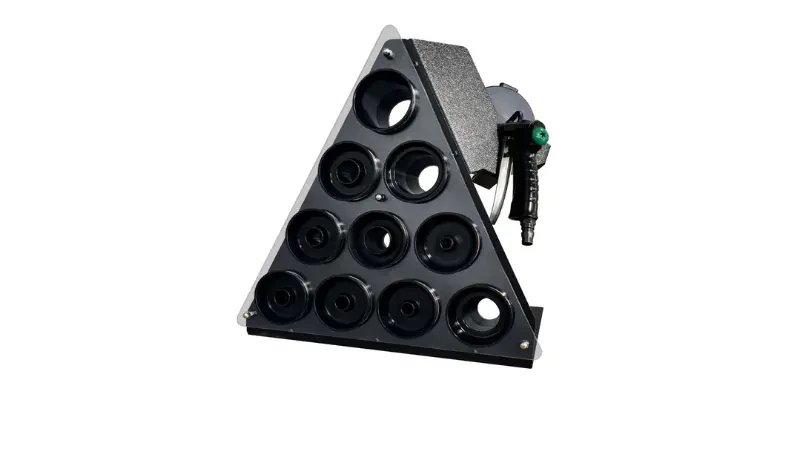
“Hose crimp tools for a shop press” sounds like a cheap way to start making hose assemblies. The reality is that a working setup requires engineered radial dies, a precision alignment fixture, calibrated tonnage control, OSHA-compliant guarding, and validation data — and by the time those items are in place, the cost usually exceeds a dedicated entry-level crimper.
This article explains the engineering difference between a shop press and a dedicated radial hose crimper, the stored-energy risk, and the TRC entry-level models that are a safer and cheaper call.
The Engineering Difference — Uniaxial vs Radial Force
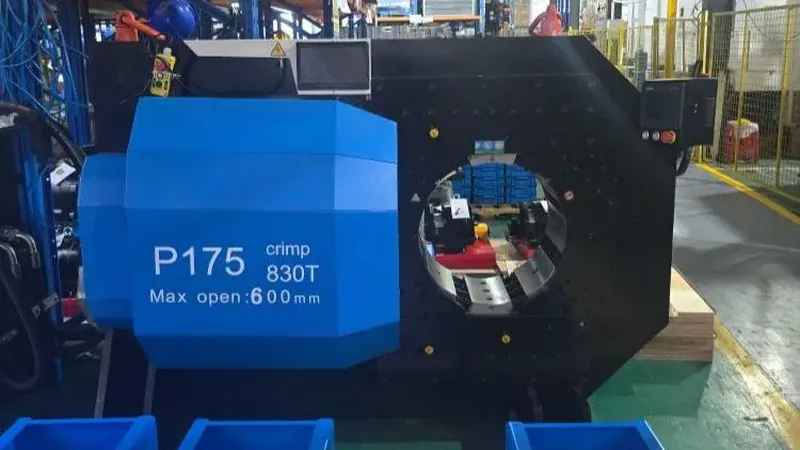
Wikipedia defines a hydraulic press as a “machine press using a hydraulic cylinder to generate a compressive force.” The press applies force in one direction — uniaxial. It is engineered for operations like forging, clinching, molding, blanking, punching, and metal forming, where the workpiece is compressed between two flat or shaped surfaces.
A dedicated hose crimper does something different. It uses a ring of segmented dies that close inward simultaneously, surrounding the ferrule from every direction at once. That is radial closure, and it is the only way to produce a concentric crimp diameter on a hose ferrule.
| Attribute | Shop press | Dedicated radial hose crimper |
|---|---|---|
| Force direction | Uniaxial (one axis) | Radial (all directions at once) |
| Crimp concentricity | Poor; typically oval | Excellent; within ovality tolerance |
| Tooling | Flat or V-block; custom or improvised | Factory-calibrated segmented die set |
| Setting control | Ram pressure or stroke | Die-to-die contact, pressure, or CNC target |
| Result | Oval crimp; uneven compression | Concentric crimp; even compression |
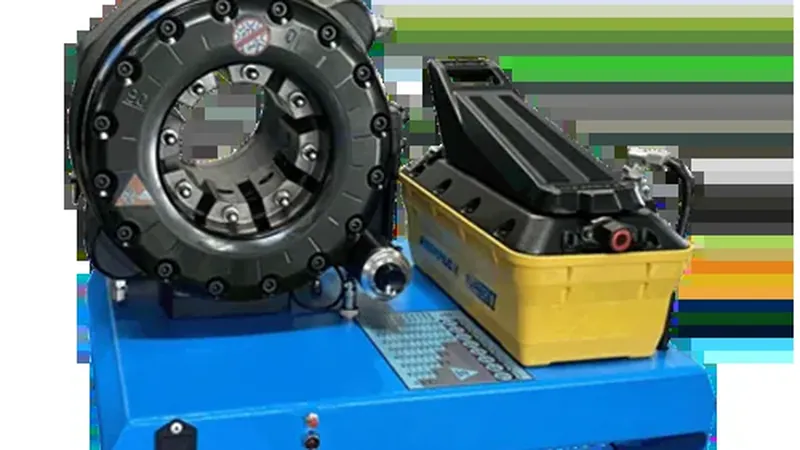
Both machines use Pascal’s principle — a pressure change at any point in a confined incompressible fluid is transmitted throughout the fluid. The difference is not how the force is generated; it is how the force is applied to the workpiece. A shop press pushes. A hose crimper squeezes radially.
Why an Oval Crimp Is Not a Defensible Crimp
Ovality matters because it directly affects the mechanical lock between the ferrule, the hose reinforcement, and the fitting stem. An oval crimp grips tighter on the narrow axis and looser on the wide axis, producing a leak path on one side and over-compression on the other.
| Crimp geometry | What it means for the assembly |
|---|---|
| Concentric (round) | Even compression; mechanical lock is uniform; seal is consistent around the circumference. |
| Oval (aligned to press direction) | Over-compression on the press axis; under-compression perpendicular to it. Leak path on the under-compressed side; wire damage on the over-compressed side. |
A shop press, without engineered radial tooling, produces an oval crimp. The crimp may look acceptable visually, but under pressure or impulse, the under-compressed side leaks or fails.
What a Shop-Press Hose Setup Actually Requires
| Requirement | What it means |
|---|---|
| Engineered radial die set | Custom-machined segmented dies that close around the ferrule from multiple directions; not a flat V-block. |
| Precision alignment fixture | A fixture that holds the die set concentric to the press ram, every time, with the tolerance a dedicated crimper’s head provides. |
| Calibrated tonnage control | A way to stop the press at a defined tonnage or position, not just “until it feels done.” |
| Guarding | OSHA 1910.212-compliant point-of-operation guards; interlocked operation. |
| Validation data | Published or self-developed target crimp diameter; burst, impulse, and pull-off testing for the specific combination. |
| Documented setup per die | So the next operator can reproduce the crimp. |
If any of those is missing, the shop-press setup is not defensible. The first two — engineered radial dies and a precision alignment fixture — are where most attempts fail.
The Stored-Energy Risk
Hose crimping stores energy in the ferrule during the cycle. The ferrule is under compression, and the hose reinforcement is under load. If a die cracks, a fixture shifts, or the ram releases unexpectedly, the stored energy can eject a die segment or a fitting with significant force.
OSHA 1910.212 explicitly covers flying chips and parts from power presses. The standard requires point-of-operation guards, two-hand tripping, or electronic presence-sensing devices. Most shop presses are open-frame, with no point-of-operation guard. Adapting a shop press for hose crimping requires adding the guarding that the press manufacturer did not provide.
| Guarding element | OSHA 1910.212 reference | What it requires |
|---|---|---|
| Point-of-operation guard | 1910.212(a)(3)(ii) | Barrier guards, two-hand tripping, or electronic presence-sensing. |
| Flying chips and parts | 1910.212(a)(1) | Covers or shields. |
| Anchoring | 1910.212(b) | Machine anchored against tipping or walking. |
Why Most Shops Should Stop Trying
| Reason | What it means |
|---|---|
| Engineering cost exceeds machine cost | Designing and validating a shop-press setup costs more than a compact dedicated crimper. |
| Setup is fragile | Fixture alignment drifts; every operator may set up differently. |
| Safety risk is real | Stored-energy ejection; OSHA 1910.212 applies. |
| Validation is on you | No published crimp data; workshop has to develop and defend its own. |
The Real Cost Comparison
Using the TCO framework, the comparison is not just acquisition price.
| Cost component | Shop-press setup | TRC entry-level crimper |
|---|---|---|
| Press (existing or purchased) | Capital and time | — |
| Engineered radial die set | High; custom machining | Included with machine |
| Alignment fixture | High; custom engineering | Built into machine |
| Tonnage control | Calibration work | Built into machine |
| Guarding | Custom; OSHA-compliant | Built into machine |
| Validation | Burst, impulse, pull-off testing | Done by hose and fitting manufacturer |
| Operator time per crimp | 3–5 minutes | 7–12 seconds |
| Defensible across operators | No | Yes |
| Total cost over 3 years | Usually higher | Usually lower |
TRC Entry-Level Alternatives
For most shops considering the shop-press route, the right alternative is a TRC entry-level crimper.
| Model | Tonnage | Why it beats a shop press | Strong markets |
|---|---|---|---|
| TRC P10HP | Compact hand-pump | Purpose-built radial dies; factory-calibrated; zinc-nickel anti-corrosion; 720-hour salt-spray tested; lowest-cost TRC entry point. | Russia, Middle East, mobile A/C. |
| TRC P16HP | 95 ton hand-pump | Much larger tonnage than a typical shop press; matched die set; stable quality. | Europe (global dealer sales). |
| TRC P18X | 80 ton electric | Simplest powered entry point; electric motor; simple construction. | Global (mostly dealers). |
See the manual category and electric category for the full entry-level range.
A Working Scenario — Not a Customer Case
An illustrative scenario. A workshop set up a shop press with V-block tooling to crimp 1-inch 2SN hose. The crimps looked acceptable visually. Under proof pressure at 2× working pressure, one assembly bulged visibly at the ferrule and developed a slow seep. On inspection, the crimp was oval by about 0.4 mm across the minor axis, and the ferrule had over-compressed the wire reinforcement on the press-axis side.
The workshop had skipped two things: engineered radial dies, and first-piece measurement. The setup was retired after the failure and replaced with a 137-ton TRC P20, which produced concentric crimps from the first piece.
Frequently Asked Questions
Can I crimp hose on a shop press?
With significant engineering, yes — engineered radial dies, precision alignment fixture, calibrated tonnage control, OSHA-compliant guarding, and validation data are all required. For most shops, the engineering cost exceeds the cost of a dedicated compact crimper like the TRC P10HP or P16HP.
Why does my shop-press hose crimp come out oval?
Because force direction is wrong. A shop press applies force in one axis (uniaxial); a hose crimper applies force radially from every direction at once. Without engineered radial dies and a precision alignment fixture, the press cannot produce a concentric crimp.
Is shop-press hose crimping safe?
Only with proper guarding, interlocks, and engineered tooling. Hose crimping stores energy in the ferrule; a die crack, fixture shift, or unexpected ram release can eject a die or fitting. OSHA 1910.212 covers power-press guarding for exactly this reason.
Buyer question: when does shop-press hose crimping make sense?
Only in a narrow case: low-volume (under about 20 assemblies per month), simple braided hose, the shop already has a press, and the shop has the engineering capability to design, machine, align, guard, and validate the setup. Outside that case, a TRC entry-level crimper is cheaper, safer, and produces better crimps.
References and technical boundaries
- Wikipedia — Hydraulic press. Reference for the uniaxial force principle and Bramah’s 1795 patent.
- Wikipedia — Pascal’s Law. Reference for the hydraulic force-multiplication principle shared by both press and crimper.
- OSHA 1910.212 — General requirements for machine guarding. Covers power presses and flying-chip hazards.
- ISO 12100:2010 — General risk assessment and risk reduction for machinery. Supports the general safety framework.