Hydraulic Hose Crimper for Shop Press: DIY Conversion Guide with Safety Warnings
Table of Contents
Hydraulic hose crimper for shop press conversions is one of the most searched DIY topics in hydraulic hose repair forums. The idea: take a 20-ton H-frame shop press, add a set of crimper dies, and crimp hoses for a fraction of what a dedicated machine costs. This guide covers how these conversions work, what you need, and the safety risks most YouTube tutorials skip.
Before you start welding die holders, understand what happens when a crimp fails at 5,000 PSI. A poorly crimped hose doesn’t just leak — it can blow off the fitting like a whip.
What Is Shop Press Hose Crimping?
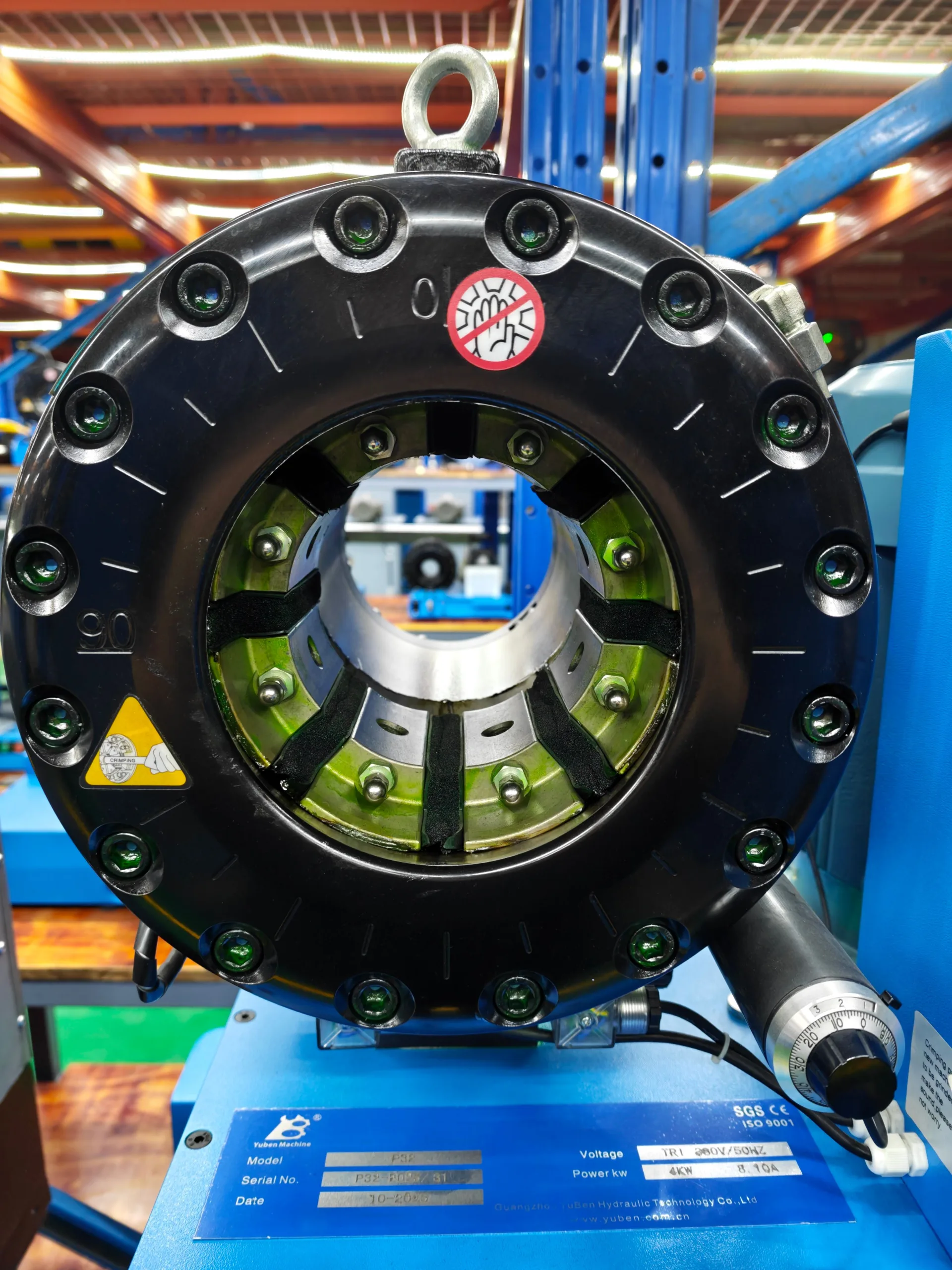
A shop press hose crimper uses the ram of an H-frame press to push hydraulic crimper dies together around a hose fitting. The press provides tonnage; the dies form the crimp. Same mechanical principle as a purpose-built crimper — just less controlled.
The ram pushes a center cone into segmented dies, compressing the fitting ferrule onto the hose. This deforms the metal past its yield point, creating a gas-tight cold-weld bond between the hose’s steel reinforcement and the fitting.
What You Need to Build One
| Component | Specification | Typical Cost |
|---|---|---|
| H-frame shop press | 20-ton minimum | $200–$600 |
| Die set (P16 or P20 series) | Must match your fittings | $150–$400 |
| Die holder (custom machined) | 30–40mm steel plate | $50–$150 |
| Centering cone | Hardened steel | $40–$80 |
| Safety guard | Polycarbonate shield | $40–$80 |
The die set is the part you can’t improvise. TRC P20 dies are made from Cr12MoV tool steel hardened to HRC 58-62. Softer steel deforms under load and produces inconsistent crimps within 20-30 cycles.
Step-by-Step Assembly
1. Prepare the Press Bed
Clean the bed and center the die holder directly under the ram. Any offset causes uneven crimps.
2. Machine the Die Holder
Steel plate (30–40mm thick), bored to die OD with 0.05mm tolerance. Weld or bolt to the bed.
3. Attach the Centering Cone
Mount on the ram with hardened steel. Mild steel mushrooms after repeated use.
4. Test and Calibrate
Run 5-10 dry cycles. Check for die misalignment or ram wobble. Then crimp a scrap hose and measure the ferrule diameter at 3 points with a vernier caliper.
Compare against the fitting manufacturer’s spec. Industry crimp tolerance is ±0.05mm — adjust the die position or pump stroke if out of spec.
Safety Risks: What Can Go Wrong
⚠️ Read This Before You Build
Inconsistent tonnage. A shop press jack has no calibrated stroke stop. One extra pump can over-crimp and cut the hose inner tube.
No die retention. Purpose-built crimpers have die locks. A shop press relies on gravity and friction — a die segment can lift and launch under load.
Fitting blow-off. A bad crimp at 3,000–5,000 PSI can separate under pressure. People have died from this.
Every crimped assembly should be proof-pressure tested to 1.5× working pressure (143–167% of rated pressure) per SAE J517 and hydrostatic testing practice. Most DIY setups can’t do this.
ISO 8434 also specifies crimp quality requirements that a shop press can’t reliably meet.
Shop Press DIY vs Purpose-Built Crimper
| Factor | Shop Press DIY | Purpose-Built (Manual) |
|---|---|---|
| Initial cost | $200–$600 | $500–$2,000 |
| Repeatability | Low — operator feel | High — calibrated stop |
| Max tonnage | 12–20 ton | 50–830 ton |
| Hose size | Up to ~1″ | Up to 2″ 4SP / 6″ |
| Safety | None (DIY) | Die locks, guards |
| Speed | 5–10 crimps/hr | 600–850 crimps/hr |
A TRC P10HP hand pump crimper costs about the same as a fully equipped shop press conversion — with calibrated dies, die retention, and warranty. A Reddit user on r/Hydraulics noted that after bending two sets of homemade dies, buying a proper manual crimper was “the best $500 I ever spent.”
For hobby use (a few hoses per month for personal equipment), a careful conversion can work. For commercial use — charging customers — the liability of a non-certified crimp is hard to justify. More background from QC Hydraulics and Omni Services SAE guide.
Need a Crimper That Won’t Get You Sued?
TRCrimp offers manual, electric, and battery-powered hydraulic hose crimpers from 10 to 830 ton. CE/SGS/ISO certified.
FAQ
Can I use a 12-ton shop press to crimp hydraulic hoses?
A 12-ton press handles small hoses (1/4″ to 1/2″ 2-wire). A 1″ 2SP fitting needs 50–80 ton. Under-tonnage crimps look fine outside but don’t achieve the cold-weld bond inside.
What dies fit a shop press?
P20 series dies from TRC work in a custom holder. Match the die set to your fitting brand and hose type — mixing brands produces unreliable crimps.
Is a shop press crimper safe for 3,000 PSI hoses?
Only if proof-tested to 1.5× working pressure using a hydrostatic test pump. Without a calibrated stroke stop, you can’t guarantee repeatable crimps.
How much does it cost to build?
Parts total $400–$800: press ($200–$600), die set ($150–$400), die holder ($50–$150), safety guard ($40–$80). At that price, a purpose-built manual hydraulic hose crimper is worth comparing.
Why do my shop press crimps leak?
Wrong die size, inconsistent stroke, or misaligned dies. Industry crimp tolerance is ±0.05mm (±0.03mm for brake/steering lines). Measure with a vernier caliper.
Can I crimp 4-wire hose on a shop press?
No. 4-spiral hose (4SP/4SH) requires 95–185 ton. Most H-frame presses max out at 20 ton — not enough to deform four layers of steel spiral wire.
Do I need to proof-test crimped hoses?
Yes. SAE J517 requires proof-testing to 1.5× working pressure (143–167%). You’ll need a separate hydrostatic test pump — shop presses have no test capability.
Shop press or manual hand pump crimper?
For most users, a manual hand pump crimper wins. Proper die alignment, calibrated stroke, similar price.


 English
  Español
  Русский