Hand-Held Hose Crimper vs Portable Hydraulic Machine
"Hand-held hose crimper" is a search term that hides two very different products. The first is a small manual plier-type tool, typically rated at 6–14 ton, designed for small-diameter low-pressure hose and cable work. The second is a genuine portable hydraulic machine — battery-powered, vehicle-powered, or hand-pump — that happens to be small enough to carry, rated at 60 ton and up, and capable of real hydraulic hose assemblies. The two products are not on the same performance axis.
This article separates the two formats, explains why a manual plier-type tool cannot do hydraulic hose work above about 1/4", and shows which TRC models fit each case. The goal is to stop buyers from ordering the wrong category and being disappointed when the box arrives.
"Hand-Held" Has Two Very Different Meanings
The category splits cleanly at about 15 ton. Below that threshold, the tool is a pair of reinforced pliers with a small interchangeable die set, powered entirely by the operator's grip. Above that threshold, the tool is a hydraulic power unit in a carryable package, powered by a battery, a vehicle outlet, or a hand pump.
| Format | Tonnage | Form factor | Typical application | Price band |
|---|---|---|---|---|
| Manual plier-type | 6–14 ton | Pistol-grip or scissors; one or two hands; 1–3 kg. | Small cable, wire, automotive low-pressure hoses, battery lugs, copper terminals. | Low |
| Portable hydraulic (battery, 12V, hand-pump) | 60–200 ton | Bench-top, briefcase, or truck-mounted; 15–50 kg. | Real hydraulic hose assemblies, 1/4" to 2" braid and spiral. | Mid to high |
A buyer who searches "hand-held hose crimper" expecting a portable hydraulic machine and receives a manual plier-type tool will be disappointed. The reverse is also true: a buyer who only needs to crimp battery lugs and orders a 60-ton portable has spent ten times the necessary budget.
The Manual Plier-Type Tool: What It Can Crimp
A manual plier-type tool produces force through a mechanical linkage or a small inline hydraulic cylinder. The operator's grip is the only power source. The tool is engineered for low-tonnage, repetitive work on soft materials.
| Attribute | Typical range |
|---|---|
| Tonnage | 6–14 ton, depending on model and handle length. |
| Application | Cable terminals, copper lugs, wire connectors, small-diameter low-pressure fluid hose. |
| Hose range for fluid applications | Up to about 1/4" or 5/16" low-pressure rubber hose (fuel, vacuum, washer). |
| Die system | Small interchangeable hex or point dies; typically 4–8 die positions. |
| Production use | Not for hydraulic hose assemblies above 1/4" or above a few hundred psi. |
| Cycle time | A few seconds per crimp; limited by operator grip endurance. |
Where it fits: electrical work, battery cable, automotive low-pressure hose, cable termination, small-bore control cable. Where it does not fit: any hydraulic hose assembly for a pressurized fluid circuit above about 1/4". A 1/4" SAE 100R1 hose at 3,000 psi requires about 30 ton of radial crimping force — more than twice what any manual plier-type tool can produce.
The Portable Hydraulic Machine: A Different Class
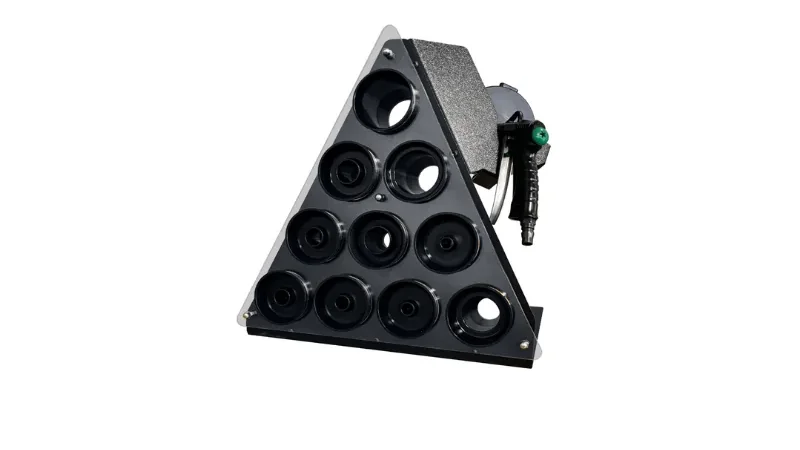
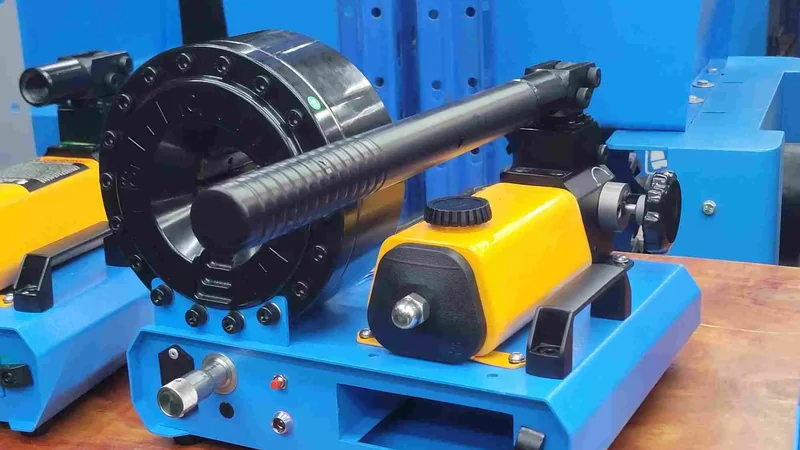
A portable hydraulic machine is a real hose crimper in a carryable package. It uses a hydraulic cylinder to drive a ring of segmented radial dies, the same die architecture used on workshop machines, scaled down into a format one person can carry.
| Attribute | Typical range |
|---|---|
| Tonnage | 60 ton (compact portable) up to 200 ton (large cordless). |
| Application | Real hydraulic hose assemblies, 1/4" to 2" braid and spiral. |
| Die system | Full-size radial segmented dies, matched to a hose and fitting system. |
| Weight | 15–50 kg depending on format and tonnage class. |
| Cycle time | 5–15 seconds per crimp, depending on power source and tonnage. |
| Power source | 12V vehicle, 24V vehicle, lithium battery, or hand pump. |
Where it fits: field repair, service trucks, mobile hose repair businesses, small workshops with limited space, individual operators building a hose repair side business. Where it does not fit: cable termination work, where a manual plier-type tool is faster and cheaper.
Weight Comparison: Why The Number On The Spec Sheet Is Misleading
Manufacturer spec sheets quote bare machine weight. The number that matters is total carried weight — machine, die set in its rack, hydraulic oil, hose and fitting inventory, cutting and cleaning tools, and the case or mounting hardware.
| Configuration | Machine weight | Total carried weight |
|---|---|---|
| Manual plier-type tool | 1–3 kg | 2–5 kg |
| Compact hand-pump (TRC P10HP, 10 ton) | 3.5 kg N.W., 5 kg G.W. | 8–12 kg |
| Compact vertical (TRC US18, 56 ton) | 80 kg N.W. | 95–115 kg with dies and bench mount |
| Compact 12V portable (TRC P20CS, 80 ton) | 55 kg G.W. | 80–110 kg |
| Cordless portable (TRC P32CS, 200 ton) | 350 kg G.W. | 400+ kg (typically slide-mounted) |
The jump from "hand-held" (2–5 kg total) to "portable hydraulic" (80+ kg total) is not a small step. It is a category change. A buyer moving from a plier-type tool to a portable hydraulic machine needs to plan for storage, transport, and a mounting solution — none of which the plier-type tool required.
Why Hand-Held Tools Cannot Do High-Pressure Hose
High-pressure hose — SAE 100R2 and up, anything above about 1,000 psi — requires radial crimping tonnage that manual plier-type tools cannot produce. The reason is mechanical, not a matter of build quality. The operator's grip can only supply a few hundred newtons of handle force. A linkage multiplies that force, but the multiplication ratio is limited by handle length and die travel. The result is a hard ceiling around 14 ton.
A hydraulic hose assembly does not care about the tool's convenience. It cares about the radial force applied to the ferrule, and whether that force produces a concentric crimp that meets the hose and fitting manufacturer's published target diameter.
| Hose size | Approximate tonnage required | Can a manual plier-type tool do it? |
|---|---|---|
| 1/4" low-pressure fuel/vacuum hose | <6 ton | Yes |
| 1/4" SAE 100R1 (3,000 psi) | ~30 ton | No |
| 3/8" SAE 100R2 | ~40 ton | No |
| 1/2" SAE 100R2 | ~60 ton | No |
| 1" SAE 100R2 | ~110 ton | No |
| 1" 4SH spiral | 100+ ton | No |
| 1-1/2" 4SH spiral | 137+ ton | No |
| 2" 4SH spiral | 200 ton | No |
The tonnage column is the reason a portable hydraulic machine exists. Every row below the first one is a job that a manual plier-type tool cannot do, regardless of brand or build quality.
TRC Models That Fit Each Case
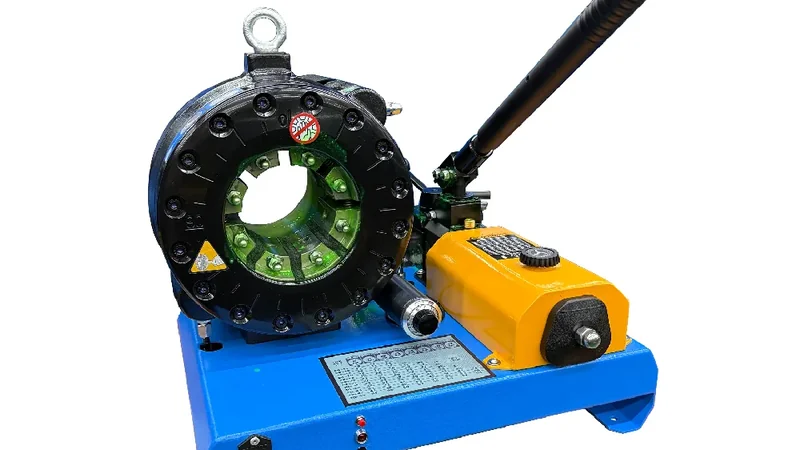
TRC's catalog focuses on the portable hydraulic machine class and the vertical compact class, not the manual plier-type tool class. If your work is cable terminals or low-pressure hose and you need a manual plier-type tool, that is a different product category and we do not supply it. If your work is real hydraulic hose assembly in a carryable format, we can match a TRC model to your hose mix.
| If your work is… | …the TRC model that fits is… | Why it fits |
|---|---|---|
| Small-diameter hose and tube, hand-pump, ultra-portable | TRC P10HP (10 ton, hand pump, 3.5 kg N.W.) | Compact hand pump for small-diameter hose and tubes; zinc-nickel alloy plating; 720-hour salt-spray tested; lightest and most affordable in the TRC lineup. |
| Real hydraulic hose assemblies, field, 1/4"–1" 2SN | TRC P20CS (80 ton, 12V) | Simple construction; vehicle battery powered; strong market feedback from Europe, North America, South America. |
| Compact vertical, bench-mount, elbow-friendly | TRC US18 (56 ton vertical) | Open-frame column design; pressure column adjusts horizontally for long elbow fittings and 90° short elbow connectors; simple construction, low cost; strong in USA/Canada. |
| Dual-power (workshop + battery) | TRC P18XL (95 ton, workshop electric + battery) | Workshop mains for normal work; battery for emergency field work without changing machines. |
| Cordless CNC with crimp data logging | TRC P20CSD (137 ton CNC cordless) | Full CNC control; step crimping and offset correction; for professional mobile service with short-batch production needs. |
| 1-1/2" to 2" spiral hose, cordless | TRC P32CS (200 ton cordless) | Reaches 2" 4SH on a cordless platform; for mining and heavy construction line repair. |
See the portable category and the vertical category for the full range.
How To Decide Which Format You Need
The decision is driven by the workpiece, not by preference. Three questions resolve it.
1. What is the largest hose size you will crimp more than once a month? If the answer is battery cable or low-pressure fuel hose, a manual plier-type tool is correct, and TRC does not supply that category. If the answer is 1/4" SAE 100R1 or larger, you need a portable hydraulic machine.
2. What working pressure does the assembly see? Anything above a few hundred psi requires a radial die system and the tonnage to drive it. That rules out every manual plier-type tool.
3. Where does the work happen? If the work is on a bench in a shop, a vertical compact like the TRC US18 may be the best fit. If the work is in the field, a 12V or cordless portable like the TRC P20CS or P20CSD is the right format.
Frequently Asked Questions
Is a hand-held hose crimper the same as a portable hydraulic crimper?
No. "Hand-held" usually refers to a manual plier-type tool rated at 6–14 ton, used for cable and low-pressure hose. A portable hydraulic crimper is a larger unit rated at 60 ton and up, capable of real hydraulic hose assemblies but weighing 15–50 kg. The two products are in different categories.
Can a hand-held hose crimper do production work?
Only for its intended application — cable terminals, copper lugs, wire connectors, and small-diameter low-pressure hose. For pressurized hydraulic hose above about 1/4", a portable or workshop hydraulic machine is required, and no amount of operator effort changes that.
Why does tonnage matter more than form factor?
Because the tonnage required to produce a defensible crimp is decided by the hose and fitting, not by the tool's convenience. A 1/2-inch 2SN assembly requires about 60 ton of radial crimping force. A manual plier-type tool cannot produce that force, no matter how well it is built. The workpiece decides the tonnage; the tonnage decides the tool category.
Can I use a hand-held tool on a hydraulic line if I'm in a hurry?
You can physically attempt it, but the crimp will not be defensible. The tool cannot produce the required tonnage, the assembly will likely leak or blow off under pressure, and the safety risk is real. Use a tool rated for the workpiece — even if it means referring the work to a workshop or a mobile hose service.
What is the lightest TRC model that can do real hydraulic hose?
The TRC P10HP at 3.5 kg net weight is the lightest TRC model that uses a radial die system, but its 10-ton capacity limits it to small-diameter hose and tube. The lightest model rated for general 1/4"–1" hydraulic hose assemblies is the TRC US18 vertical (56 ton, 80 kg) for bench work, or the TRC P20CS portable (80 ton, 55 kg G.W.) for field work.
References and technical boundaries
- Wikipedia — Hydraulic machinery. Reference for why hydraulic force multiplication is required above the few-ton ceiling of manual plier-type tools.
This reference supports the general format comparison above. It does not certify any specific TRC machine for any specific application, and it does not replace the crimp instruction published by the hose and fitting manufacturer.