Hose Crimping Equipment: A 7-Station Assembly Line From Cut to Test
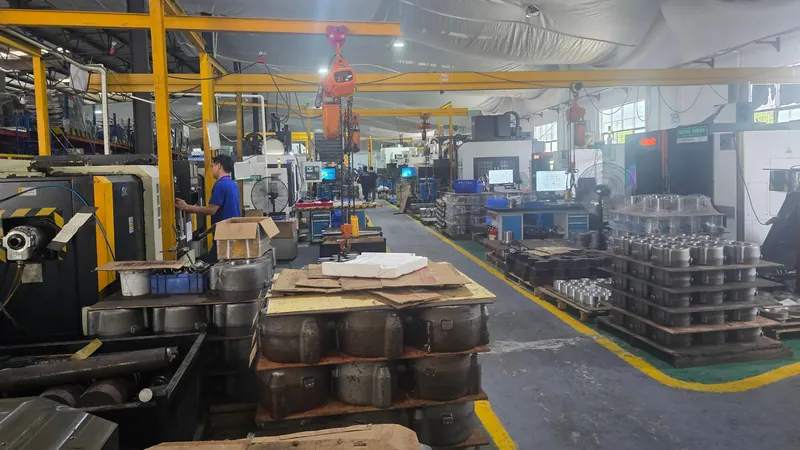
Hose crimping equipment is not a machine. It is a seven-station assembly line: storage, cutting, cleaning, fitting insertion, crimping, measurement, and records. The crimper is the most visible station, but it is not where most defects are born. Most defects come from upstream — from a hose stored too long, from a cut that contaminated the inner tube, from a cleaning step that was never installed — and they only get caught downstream, at measurement or in the field.
This article walks through the seven stations a working hose assembly line needs, in the order material flows through them. For each station we cover the job, the acceptance check, and the TRC equipment that fits. Read it as a blueprint for auditing an existing workshop or specifying a new one.
Why an Assembly Line, Not a Single Machine
The seven-station view comes straight from assembly line theory. An assembly line is a manufacturing process in which the unfinished product moves in a direct line from workstation to workstation, with components joined sequentially as the product advances. The two operating principles are division of labor and line balancing. Division of labor means each station performs one operation, repeatedly, with the minimum of motion and decision. Line balancing means assigning tasks across stations so that the work content at each station fits within the cycle time, respecting the precedence graph — the sequence in which operations must occur.
A hose assembly line is a textbook case. The precedence graph is fixed: hose must be cut before it is cleaned, cleaned before it is fitted, fitted before it is crimped, crimped before it is measured. You cannot reverse that order. Division of labor puts each operation at its own bench, with its own tooling and its own check. Line balancing matches the cycle time of each station to the planned throughput, so no station waits and no station starves.
The single most important concept in line theory is the bottleneck. The bottleneck is the slowest station in the precedence graph, and it sets the maximum output of the entire line. Adding capacity anywhere except the bottleneck does not raise throughput. The classic historical example cited in the Wikipedia article is automotive paint drying: it does not matter how fast the body shop and trim shop work if the paint oven sets the pace. In a hose shop, the bottleneck is usually crimping at low volume (a single manual machine on a mixed hose mix) and usually changeover or cleaning at higher volume (multiple die swaps per shift, or a cleaning step that was never properly engineered).
Station 1 — Hose Storage and Measuring
The line starts before the hose is cut. Hose comes on reels or in coils, and the storage condition decides whether the first cut is clean and whether the material is still within its shelf life.
| Item | Requirement | Why |
|---|---|---|
| Storage location | Dry, away from UV and heat. | Rubber cover and inner tube age; UV and heat accelerate ageing. |
| Reel or coil condition | No crushing, no tight bends, no kinks. | Kinked hose has already damaged reinforcement. |
| Hose identification | Reel tagged with part number, manufacturer, date received. | Confirms the hose is what the crimp data thinks it is. |
| Length measurement | Bench rule or clean floor strip, calibrated. | Cut length includes fitting insertion allowance; error propagates. |
| Shelf life check | Within the manufacturer’s published shelf life. | Old hose looks fine, crimps fine, then fails early. |
A common user concern in our question library is whether hose stored indoors for years is still safe to use. The honest answer is that shelf life depends on storage conditions and the hose specification, and the only defensible practice is to check the manufacturer’s published shelf life and scrap hose that is out of window.
Station 2 — Cutting
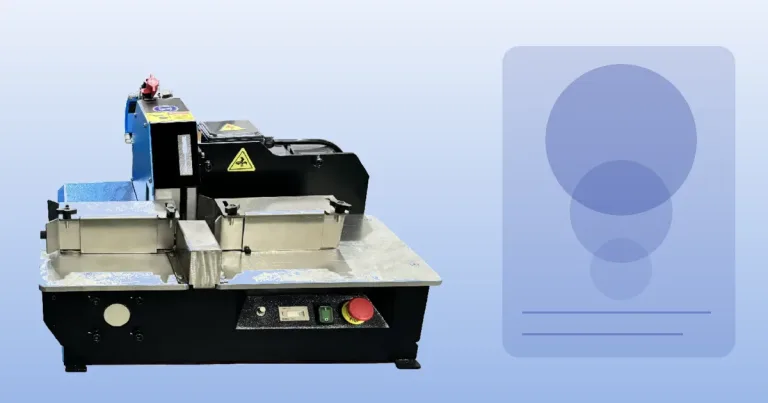
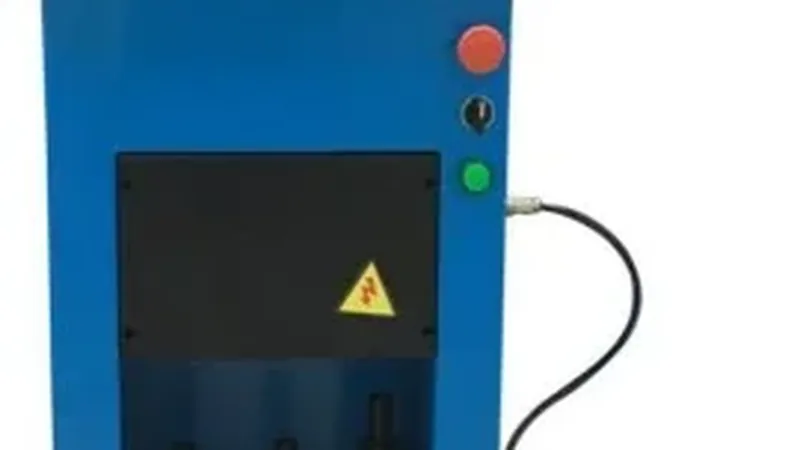
The cut produces the square end the fitting seats against. A purpose-built cutter is not a luxury; it is the difference between a clean, low-debris cut and a cut that contaminates the hose.
| Method | Cleanliness | Squareness | Typical use |
|---|---|---|---|
| Flying knife / guillotine cutter (purpose-built) | Cleanest; minimal debris. | Excellent, typically ±0.5° or better. | Workshop production; braided and light spiral hose. |
| Band saw with proper blade | Acceptable if blade is sharp. | Good with a fixture. | Heavy multi-spiral hose. |
| Abrasive wheel | Worst — abrasive particles inside the hose. | Variable. | Not recommended. |
| Improvised (hack saw, grinder) | Poor; variable debris. | Poor. | Field emergency only. |
TRC’s cutter line covers every station size. The TRC C250AC handles small braided hose up to 1 inch — popular in Southeast Asia and New Zealand for its simple construction and low price. The TRC C300 is our best-seller, covering up to 2-inch braided and spiral hose; it is strong globally, especially in Brazil and South America. For automatic production, the TRC C300D is our only CNC cutter, ideal for small-hose batch production with a 0.2 mm length accuracy; for large industrial hose up to 6 inches, the TRC C520A is the answer. Browse the full line in the hydraulic hose cutter category.
Station 3 — Cleaning
After cutting, the inside of the hose contains debris: rubber dust, wire fragments, and — if an abrasive cutter was used — abrasive particles. This debris will travel into the hydraulic system when the assembly is put into service.
| Cleaning method | How it works | When to use |
|---|---|---|
| Air blast with filtered air (per BFPA P111, <5 µm filter) | Blows loose particles out. | Light contamination; braided hose. |
| Foam projectile cleaning | A high-density sponge projectile is fired through the hose; scrapes the inner wall. | Standard production step; reaches particles air alone cannot. |
| Flushing with filtered fluid | Circulates clean fluid through the assembly. | High-cleanliness applications (servo, marine, aerospace). |
| Water wash | Uses a dedicated washing machine. | Batch production where ISO 4406 cleanliness is verified. |
ISO/TS 18409:2018 defines the sampling method for verifying hose assembly cleanliness. It does not set a universal pass/fail level, but it gives you a defensible way to measure the result. Published manufacturer data shows projectile cleaning reaching ISO 4406 codes around 13/10 on properly prepared assemblies.
The catch. A cleaning step missed here cannot be recovered later. Once the fitting is crimped on, the inside of the hose is sealed, and any debris inside is committed to the customer’s hydraulic system.
Station 4 — Fitting Insertion
With a clean, square-cut hose end, the fitting goes in. Two operations belong at this station.
| Operation | Why it matters |
|---|---|
| Skiving (where required by the fitting system) | Removes a controlled length of outer cover so the ferrule grips the wire reinforcement directly. Required for most 4SP, 4SH, R12, R13, and R15 interlock fittings. |
| Fitting insertion to full depth, marked on the cover | Confirms the stem is bottomed. The mark is used again after crimping to check for hose push-back. |
Skiving is non-negotiable when the fitting system calls for it. TRC’s skiving line covers both manual and powered formats: the TRC SH50 is a low-cost manual unit popular in Eastern Europe and Africa; the TRC S50 is the powered workshop unit, simple construction and low failure rate, sold globally. See the hose skiving machine category for details.
Station 5 — Crimping
This is the station everyone focuses on. It is also the shortest cycle on the line.
| Element | What it requires |
|---|---|
| Crimper sized for the hose range and tonnage | 1-inch 2SN crimps on a 60-ton compact; 1-inch 4SH needs ~100+ ton; 2-inch R13 needs 200+ ton. |
| Die set matched to the hose and fitting system | Die ID, length, profile, and machine interface all match the crimp data. |
| Setting method matched to the machine | Manual die-to-die contact, set hydraulic pressure, or CNC target diameter. |
| First-piece verification | Crimp diameter measured at three positions and compared to the published target. |
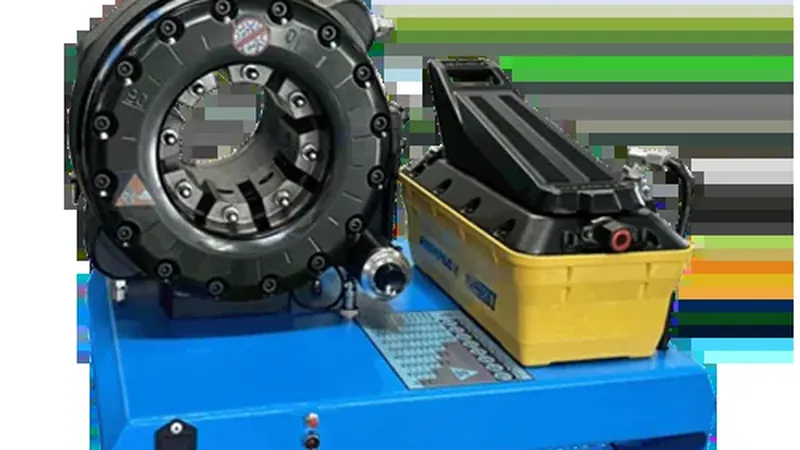
The crimper is the heart of the line, and TRC builds it across the full range. For compact field use, the TRC P10HP and TRC P16HP cover small braided hose. For the workshop sweet spot up to 1-1/2″ 4SH, the TRC P20 (classic, simple, rare failure) and TRC P20S (compact, 3.6 s cycle) are the standards. For up to 2-inch R13, the TRC P32 family — including the value-pick TRC P32A with drawer-type die cabinet — is the right class. Browse the hydraulic hose crimper category for the full list.
From a line-design perspective, the key point is that the crimping station is only as good as the stations upstream of it. A crimper with a worn die and a dirty hose will produce a bad batch that looks identical to a good batch until it fails in service. For the eight-step crimp workflow itself, see our how to use a hydraulic hose crimper walkthrough.
Station 6 — Measurement and Validation
This station is where the assembly is accepted, rejected, or sent back for rework.
| Check | Tool | Acceptance |
|---|---|---|
| Crimp diameter at the ferrule flat band | Caliper (0.02 mm) or micrometer. | Within the manufacturer’s published target window. |
| Ovality | Same, three positions around the circumference. | Within the manufacturer’s limit. |
| Visual | Operator inspection. | No cracks, no exposed wire, clean ferrule back edge, insertion mark unmoved. |
| Proof pressure test | Hydrostatic test bench at 2× WP for 30–60 s. | No leak, no bulge, no movement. |
| Impulse test (when required) | Impulse test bench per SAE J343. | 200,000+ cycles at ~133% WP without failure for SAE 100R2-class assemblies. |
| Cleanliness verification (when required) | Per ISO/TS 18409:2018 sampling, analyzed to ISO 4406. | Within the limit set by the customer’s system specification. |
For high-pressure, safety-critical, or impulse-heavy service, a proof test and (in some cases) an impulse test on a sample basis are the only way to catch the remaining defects — those that pass dimensional inspection but will fail under fatigue.
Station 7 — Records and Flow
The last station is the one most shops do not build, and the one that separates a defensible assembly operation from a “we think it was fine” operation.
| Record | What it captures | Why |
|---|---|---|
| Batch record | Hose lot, fitting lot, die ID, machine setting, operator, date. | Traceability if a field failure comes back. |
| First-piece record | Crimp diameter readings and pass/fail. | Evidence that the setup was verified before the batch ran. |
| Functional test record (when applicable) | Proof pressure, impulse cycles, result. | Evidence that the assembly was validated, not just dimensionally checked. |
| Labeling | Assembly tag with part number, date, pressure class. | Lets the customer’s maintenance team identify the assembly in service. |
ISO/TS 17165-2:2018 expects hose assemblies to be selectable, traceable, and replaceable. Without a records station, none of those three properties survive an audit.
The Lean View: The Seven Wastes on a Hose Line
Lean manufacturing defines seven categories of waste — activities that consume resources without adding customer value. Every waste maps cleanly to a fault on a hose assembly line, and every fault has a station-level fix.
| Waste (muda) | How it appears on a hose line | Station-level fix |
|---|---|---|
| Inventory | Hose reels and fittings stacked beyond short-term need; aged stock; obsolete die sets. | Pull-from-reel kitting at the cutting station; date-marked stock; first-in-first-out racks. |
| Waiting | Operator idle while the crimper finishes a 10-second cycle; changeover between die sets eating 5 minutes per shift. | Parallel crimping stations for the dominant hose size; quick-change die cones; CNC stored programs. |
| Motion | Operator walking between bench, cutter, and crimper; dies stored across the room. | U-shaped cell layout; die racks at the crimper; tool boards at each station. |
| Defects | Under-crimp, over-crimp, oval crimp, dirty hose, exposed wire. | First-piece measurement at the crimp station; cleaning station engineered into the line. |
| Overproduction | Cutting hose to length “in advance” and stockpiling uncrimped ends that then age or get contaminated. | Cut-to-order based on a Kanban pull signal; never cut without a fitting allocated. |
| Overprocessing | Re-measuring assemblies that already passed; skiving hoses that the fitting system does not require skived. | One acceptance check per station; clear skiving rules per fitting system. |
| Transportation | Moving assemblies between buildings; carrying dies between machines. | Linear or U-shaped layout; matched die sets per machine. |
The lean principle that pulls it all together is pull production (Kanban). Work is driven by actual consumption — a customer order, a Kanban card from downstream — rather than by forecast. A hose shop that cuts hose in advance “to keep the operator busy” is overproducing, and the overproduction creates inventory that ages, gets contaminated, and becomes scrap. Pull production puts a Kanban signal at each station: do not start work until the downstream station is ready, and do not start work that is not yet ordered.
How to Identify the Bottleneck on an Existing Line
The bottleneck is the station whose cycle time exceeds the cycle time of every other station in the precedence graph. Identifying it takes three measurements, not opinions.
- Time each station on a representative assembly. Use a stopwatch on ten consecutive assemblies of the dominant hose size. Record the work content time at each station, excluding queue time.
- Identify the longest average time. That station is the candidate bottleneck.
- Check for queue buildup. If work-in-process accumulates upstream of the candidate and starves downstream of it, the candidate is confirmed as the bottleneck.
| Observation | Diagnosis | Action |
|---|---|---|
| Inventory piles up before the crimper | Crimper is the bottleneck | Add a parallel crimping station for the dominant hose size; upgrade to a faster model (e.g. P20 to P20S). |
| Inventory piles up before cleaning | Cleaning is the bottleneck | Engineer a dedicated cleaning station; add projectile or water-wash equipment. |
| Inventory piles up before measurement | Measurement throughput is the bottleneck | Use go/no-go gauges for first-pass; reserve caliper for first-piece only. |
| Operators idle, inventory flat | Bottleneck is upstream supply or downstream demand | Check reel supply, die changeover, or order flow. |
The historical example from automotive assembly — paint drying as the bottleneck — has a hose-shop equivalent. In low-volume shops, the bottleneck is often the operator’s walking time between stations. In high-volume shops, it is usually die changeover. The fix is layout (U-shaped cell for low volume, parallel stations for high volume), not a bigger crimper.
Total Cost of Ownership Applied to the Line
The total cost of ownership (TCO) of a hose assembly line is dominated by ownership costs, not by acquisition costs. The TCO framework breaks the cost of a capital asset into five categories: acquisition, operating, maintenance, downtime, and disposal. On a hose line, the acquisition cost of the equipment is typically the smallest of the five over a five-year horizon.
| TCO category | What it costs on a hose line | How to minimize it |
|---|---|---|
| Acquisition | Crimper, cutter, skiver, cleaning station, test bench, initial die sets. | Buy to the workload, not above it; standardize on one die series where possible. |
| Operating | Electricity for the crimper motor, consumables (projectiles, blades, fluid), operator labor. | Match motor size to the work (a 3 kW workshop crimper, not a 7 kW industrial unit, for braided hose); pull production to eliminate idle labor. |
| Maintenance | Die reconditioning, hydraulic oil changes, seal kits, blade sharpening. | Scheduled PM per machine-hour; track die drift at 10,000-crimp intervals. |
| Downtime | Line stoppage for die changeover, machine failure, missing components. | Parallel crimping station for the dominant hose size; four-hour response window on technical support. |
| Disposal | End-of-life decommissioning; resale value; cost of scrapping worn tooling. | Standardized platforms that hold resale value; modular die sets that transfer to the next machine. |
A shop that buys a 200-ton CNC crimper for a workload that never goes above 1-inch 2SN is paying acquisition cost without any offsetting benefit in operating, maintenance, or downtime cost. A shop that buys a 95-ton hand-pump unit for a workload of 200 assemblies per day is paying the savings back in downtime and operator fatigue. The right answer is almost always to match the crimper class to the dominant hose size, then size the supporting stations to the same cycle time.
Acceptance Points at Each Station
| Station | Pass condition | Fail response |
|---|---|---|
| 1. Storage | Hose in date, correctly identified, no kinks. | Quarantine and verify. |
| 2. Cutting | Square within ±0.5°, clean edge, correct length. | Re-cut. |
| 3. Cleaning | Debris removed; cleanliness verified if required. | Re-clean; reject if abrasive contamination cannot be removed. |
| 4. Fitting insertion | Stem bottomed; insertion mark in place; skive correct if required. | Re-insert or re-skive. |
| 5. Crimping | First-piece diameter within tolerance; setting locked. | Adjust and re-run first piece. |
| 6. Measurement | All dimensional, visual, and functional checks pass. | Cut off and remake; do not re-crimp over a finished crimp. |
| 7. Records | Batch record completed and labeled. | Do not release without records. |
Layout: Material Flow Decides Output
| Layout | Material flow | Bottleneck | Typical fit |
|---|---|---|---|
| Linear | Storage → cut → clean → insert → crimp → measure → record, in a straight line. | The slowest station (usually crimping on a low-volume line). | Workshops with a defined mix and steady throughput. |
| U-shape | Same stations, but the line folds back so the operator can reach multiple stations. | Operator walking time; changeover. | Small workshops; mixed hose types; one-operator cells. |
The bottleneck is usually not the crimper. It is either changeover between die sets, or the cleaning step if it has not been engineered into the line. We have seen real workshops double their output by adding a parallel crimping station for the dominant hose size, leaving the original machine for the rest of the mix.
Configuring a TRC Line by Workload
| Workload profile | Crimper | Cutter | Cleaning | Skiving |
|---|---|---|---|---|
| Field / low volume | TRC P10HP or P16HP | TRC C250AC portable | Air nozzle with filter | SH50 manual |
| Workshop, mixed 1/4″–1″ | TRC P20 or P20S | TRC C300 | Projectile kit | TRC S50 |
| Production, mixed 1/4″–2″ | TRC P32A or P32D | TRC C400F | Water wash | TRC S50 |
| Heavy industrial, 2″–4″ R13 | TRC P140 / P160 / P175 | TRC C520A | Flushing bench | TRC S50 |
If you are specifying a new line, send us your hose mix, your monthly volume, and the space you have available. We can map the seven stations to your actual workload and propose equipment that fits the bottleneck — rather than adding tonnage where the line does not need it. TRC equipment is built in a 5,000 m² CE/SGS/UL+ISO certified factory and serves more than 300 customers across 50+ countries, with a four-hour response window on technical support. Start at the contact page or the hydraulic hose crimper starter kit resource.
Frequently Asked Questions
Do I really need a separate cleaning station if I use a blade cutter?
It depends on the cleanliness class the customer’s system requires. A blade cutter produces far less debris than an abrasive wheel, but it still produces some. For low-pressure return lines, filtered air may be enough. For servo, marine, or mining applications, projectile cleaning, water wash, or flushing is usually required. The decision belongs to the system specification, not to the cutter type.
Can I combine stations to save space?
Yes, up to a point. Cutting and cleaning are often combined on a single bench. Measurement can be done at the crimping station for the first piece. But the seven functions still have to happen — combining stations means the same operator does more steps, which is fine for low-volume work and a bottleneck for high-volume work.
Is a CNC crimper required for a production line?
Not always. A CNC crimper like the TRC P20D or P32D gives you repeatability across operators and an electronic batch record, which matters for mixed production and traceable applications. For a single hose type produced by an experienced operator, a powered hydraulic machine produces equivalent quality at lower cost. The decision is about workflow and records, not about the crimp itself.
How do I find the bottleneck on my existing line?
Time each station on ten consecutive assemblies of your dominant hose size. Identify the station with the longest work content time. Check whether inventory piles up before that station and starves downstream of it. If both are true, that station is your bottleneck, and adding capacity anywhere else will not raise throughput.
Buyer question: how much space does a seven-station line need?
A one-operator U-shaped cell can fit in roughly 25–40 square meters for low-volume work. A linear two-operator line with parallel crimping stations typically needs 60–100 square meters. The dominant space consumer is usually hose storage, not the processing equipment.
References and technical boundaries
- ISO/TS 17165-2:2018 — Hydraulic hose assemblies, practices. Supports the requirement for selectable, traceable, replaceable hose assemblies.
- ISO/TS 18409:2018 — Hydraulic hose assembly cleanliness sampling. Defines the sampling method used to verify the cleaning station output.
- SAE J343 — Test procedures for SAE 100R series hose assemblies. Defines proof and impulse test conditions for the validation station.
- Wikipedia — Assembly line. Reference for division of labor, line balancing, and bottleneck theory.
- Wikipedia — Lean manufacturing. Reference for the seven wastes and pull production.
- Wikipedia — Total cost of ownership. Reference for the five TCO categories applied to capital equipment.