
Hydraulic Hose Crimper Manual: Buying, Setup and Operating Checklist
"Hydraulic hose crimper manual" is a search with two different intents. The first is finding the operating manual for a machine you already own — the document that tells you how to set the tonnage, change the dies, and maintain the pump. The second is buying a manual hydraulic hose crimper — a hand-pump-operated machine, as opposed to a powered electric or pneumatic unit.
This article covers both. If you already own a machine and need the manual, start with the first section. If you are shopping for a hand-pump unit, jump to the buying section. The two intents share a common thread: both depend on Pascal's Law, the principle that turns a 20 kg pull on a lever into 95 tons of force at the dies.
If You Are Looking for an Operating Manual
The manual for a hydraulic hose crimper is not a generic document. It is specific to the model and the die system. A manual for a 95-ton machine does not apply to a 137-ton machine of the same brand, because the pump displacement, the cylinder bore, and the die ring geometry all differ.
| Information you need | Where to find it |
|---|---|
| Manufacturer and model | Nameplate on the machine head or frame. |
| Serial number | Usually next to the model nameplate. |
| Die system ID | Stamped on each die; also on the machine's die chart. |
| Year of manufacture | Sometimes on the nameplate. |
| Crimp data (target diameters) | Published by the hose and fitting manufacturer, not the machine maker. |
With the manufacturer, model, and serial number, you can request the operating manual from the manufacturer's service department. If you bought a TRC machine and the manual is missing, contact us through the contact page with the model and serial number, and we will provide the document.
The honest answer on third-party manuals: a downloaded PDF that "looks close" is not a substitute for the manual that matches your serial number. Pump displacement, seal kits, and die-ring dimensions change across revisions, and a wrong manual produces wrong torque values and wrong die-set instructions.
What the Manual Should Contain
A complete operating manual for a hydraulic hose crimper should cover, at minimum, the sections below. If the manual that came with your machine is missing any of them, ask the manufacturer for the complete document.
| Section | What it tells you |
|---|---|
| Safety | Stored-energy hazards, guarding requirements, die-change procedure, emergency stop. |
| Specifications | Tonnage, hose range, voltage or air supply, cycle time, weight, dimensions. |
| Installation | Power connection, bench mounting, leveling. |
| Die installation | How to load and remove dies; cone angle matching; die-length verification. |
| Setting | How to set the crimp position or tonnage; first-piece verification procedure. |
| Operation | Step-by-step crimp cycle; what to do if the die sticks. |
| Maintenance | Oil level, filter change, seal inspection, lubrication, die inspection. |
| Troubleshooting | Symptom → cause → response table. |
If You Are Buying a Manual (Hand-Pump) Hose Crimper
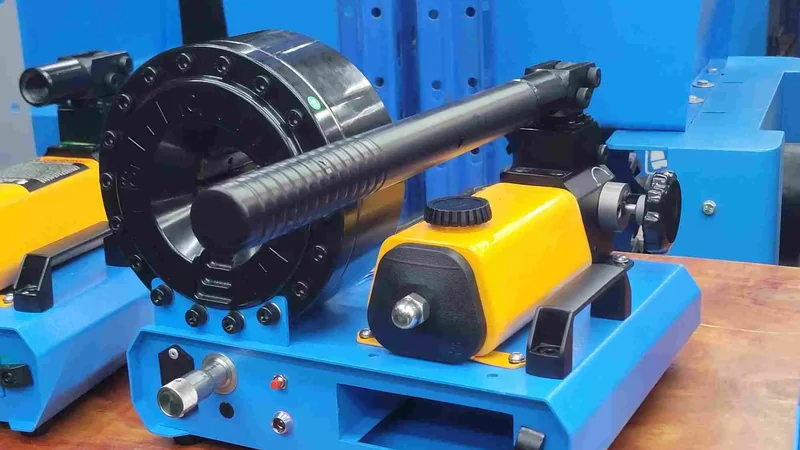
A manual hose crimper uses a hand-operated hydraulic pump. The operator pumps a lever, which drives a small hydraulic cylinder. The cylinder uses an area ratio of about 10:1 to amplify the force at the dies. The same principle turns a 20 kg pull at the lever into roughly 200 kg at the pump piston, and the larger crimp cylinder multiplies that again to reach tonnage at the die ring.
This is Pascal's Law in action: pressure applied to a confined incompressible fluid transmits equally in all directions, and force multiplication equals the area ratio between the input and output pistons. The trade-off is distance. The operator pumps many times per cycle because the high-force output piston moves a short distance for each long stroke of the low-force input piston.
| Attribute | Typical range for a TRC manual crimper |
|---|---|
| Tonnage | Compact portable 10 ton (TRC P10HP) up to about 137 ton (TRC P20HP). |
| Hose range | Up to 1-1/4" braided; bench units up to 1-1/2" 4SH. |
| Cycle time | 30–60 seconds per crimp, including pump strokes. |
| Operator force per stroke | Up to about 20 kg on a bench unit. |
| Sustainable daily output | About 15–20 assemblies per day before fatigue affects quality. |
| Power required | None; fully manual. |
Where a manual unit fits: field repair, small workshops, low-frequency standby, emergency repairs on remote sites. Where it does not fit: any line producing more than about 20 assemblies per shift.
Fatigue Data: Why 20 Assemblies per Day Is the Ceiling
Manual crimping is physical work. The operator pumps a lever 15–25 times per crimp, against up to 20 kg of resistance, for a 1-inch 2SN assembly. That is 300–500 kg of cumulative effort per assembly, sustained across a shift.
| Shift count | What happens to quality |
|---|---|
| 1–10 assemblies | Operator fresh; quality stable; first-piece check passes |
| 10–20 assemblies | Operator tiring; setting judgments drift slightly |
| 20–30 assemblies | Operator fatigued; under-crimp and over-crimp both appear |
| 30+ assemblies | Repetitive strain injury risk; quality not defensible |
We recommend the 20-assembly ceiling as the practical limit for a hand-pump unit. Above that count, the operator's judgment of die-to-die contact becomes inconsistent, and the first-piece check is the only thing catching the drift. Past 30 assemblies per shift, the operator is at measurable risk of wrist, elbow, and shoulder repetitive strain injury — conditions documented across hand-tool industries.
TRC Manual Crimper Lineup
TRC builds manual hand-pump crimpers across several tonnage classes, each matched to a different workload and market. TRC equipment is built in a roughly 5,000 m² production facility, with CE, SGS, and UL+ISO certification, serving 300+ customers across 50+ countries.
| Model | Tonnage | Key selling points | Strong markets |
|---|---|---|---|
| TRC P10HP | Compact, 10 ton | Cheap, simple, light, durable. Zinc-nickel alloy anti-corrosion, 720-hour salt-spray tested. 3.5 kg net weight. | Russia, Middle East, mobile A/C service. |
| TRC P16HP / P16HPZ | 95 ton | Light, simple, stable quality. Telescopic pole saves about 30% effort. P16HPZ has a separate pump. 34 kg gross. | Europe (global sales, popular with dealers). |
| TRC P18HP / P18HPZ | 110 ton | Same as P16HP but larger crimp range (up to 1-1/4" 4SP). 55 kg gross. | Poland, Eastern Europe. |
| TRC P20HP / P20HPZ | 137 ton | Largest crimp range in the manual/pneumatic series (up to 1-1/2" 4SH). No power required; 100 kg gross, requires two people to lift. | Global; mobile service and emergency repair. |
See the manual hydraulic hose crimper category for the full lineup.
We recommend the P10HP for AC and fuel-line field service where the hose is small and corrosion resistance matters. We recommend the P16HP or P18HP for the workshop sweet spot — 95 to 110 ton covers most 1" braided and small spiral work. We recommend the P20HP only when the largest manual range is required, because the 137-ton hand-pump effort is sustainable for low counts only.
Setup and First-Piece Workflow
A manual hand-pump unit uses the same eight-step controlled crimping workflow as any powered machine. The setup differs only in how the setting is made.
| Step | Powered machine | Manual hand-pump unit |
|---|---|---|
| Setting | CNC target diameter, or die-to-die contact at a set pressure. | Die-to-die contact by feel, then verified by first-piece measurement. |
| Cycle | Automatic; 7–12 seconds. | Operator pumps until the dies contact; 30–60 seconds. |
| First-piece check | Caliper at three positions. | Same — caliper at three positions. |
The first-piece check is more important on a manual unit than on a powered one, because the setting depends on the operator's judgment. The operator pumps until the dies contact, measures the crimped ferrule at three positions 120 degrees apart, and compares the average to the published target diameter. If the average is off, the operator adjusts the stop and re-runs the first piece.
When Manual Stops Making Sense
| Condition | What it means |
|---|---|
| Daily count above ~20 assemblies | Operator fatigue becomes the dominant quality variable. |
| Hose size above 1-1/4" braided or above 1" spiral | Tonnage requirement exceeds sustainable hand-pump operation. |
| Application above 1,000 psi with impulse cycling | Requires a powered machine for repeatable setup and batch records. |
| Need for batch records or traceability | Manual records on paper are workable for low volume; for production, CNC is more defensible. |
If any of those conditions apply, the next step up is a powered electric machine like the TRC P20 (137 ton, classic workshop model) or the TRC P32A (200 ton, value pick with drawer-type die cabinet). Browse the electric category when you are ready to move up.
Frequently Asked Questions
Where can I find the operating manual for my hydraulic hose crimper?
From the manufacturer's service department, using the machine's model name and serial number. For TRC machines, contact us through the contact page with the model and serial number, and we will send the document. A generic PDF that "looks close" is not a substitute; revisions change pump displacement, seal kits, and die-ring dimensions.
What is the difference between a manual hose crimper and a powered one?
A manual unit uses a hand-operated pump; a powered unit uses an electric motor or an air-over-hydraulic pump. The crimp quality is the same if the die is correct and the first piece is measured. The difference is operator effort, cycle time, and sustainable daily output. Both formats use Pascal's Law to amplify force; the difference is where the input energy comes from.
How many hose assemblies per day can I do on a manual hand-pump unit?
About 15–20 per day before operator fatigue starts to affect quality. Below that count, a manual unit produces equivalent quality to a powered machine. Above it, quality drifts measurably, and above 30 the operator is at repetitive strain injury risk.
Buyer question: which TRC manual crimper should I buy?
For the smallest hose and lowest budget, the TRC P10HP — compact, anti-corrosion, 720-hour salt-spray tested, 3.5 kg. For the workshop sweet spot, the TRC P16HP (95 ton) or TRC P18HP (110 ton). For the largest manual range up to 1-1/2" 4SH, the TRC P20HP — but only for low daily counts.
References and technical boundaries
- Wikipedia — Pascal's Law. Reference for the force-multiplication principle behind hand-pump hydraulic crimpers.
- Wikipedia — Hand pump. Reference for manually driven hydraulic pump mechanics.