Harbor Freight Hydraulic Crimper: Capability, Tooling and Support Checklist
A Harbor Freight hydraulic crimper occupies a specific place in the market: it is an inexpensive way to start making hose assemblies, and for some buyers, it is exactly the right choice. For others, it is a false economy that shows up as drift, rework, and replacement within the first year. The difference is not the retail channel; it is the workload and the tool specification.
This article explains what a Harbor Freight-class machine is actually built for, where the low purchase price shows up later, and the TRC entry-level models that offer stronger construction, matched die sets, and published crimp data.
What a Harbor Freight-Class Machine Is Built For
| Attribute | Typical for this class |
|---|---|
| Tonnage | 12–20 ton typical for the hydraulic hose crimper SKU; some shop-press attachments rated higher. |
| Hose range | Up to about 1/2" or 3/4" 2SN braided. |
| Die system | A small set of dies, usually matching a generic fitting profile; rarely matched to a specific hose and fitting system with published target diameters. |
| Cycle time | Variable; often 30+ seconds. |
| Workload design intent | Occasional, light use — DIY, small farm, emergency standby. |
A tool designed for occasional use is the right choice for occasional use. The problem is using it for daily production, where the design assumptions stop being valid.
Why the Low Price Shows Up Later
The acquisition price of a low-cost tool is only one part of its total cost of ownership. Wikipedia defines TCO around the principle that "ownership costs are significantly greater than the cost of purchasing or acquiring a product," with categories including acquisition, operating, maintenance, downtime, and disposal. For a low-cost crimper, the hidden costs concentrate in three areas.
| Hidden cost | What it looks like in practice |
|---|---|
| No published crimp data | The operator has no target diameter; visual inspection only. Visual inspection misses a significant share of crimp defects — under-crimp, over-crimp, and wrong die do not show up in the appearance of the ferrule. |
| Generic die profiles | The dies are not matched to a specific hose + fitting family. Wikipedia notes that coupling systems "rely on highly specific mating geometries," and a generic die cannot reproduce those geometries across systems. |
| Light construction | The machine wears faster under repeated use; crimp diameter drifts. A die that produced an in-tolerance crimp at assembly #50 may drift out of tolerance by assembly #500. |
| Limited die range | The shop outgrows the machine quickly and has to buy a larger one anyway. |
| Spare parts unavailability | A worn seal or a broken die may not be replaceable; the whole machine is scrapped. |
| No service network | When something goes wrong, the operator is on their own. |
Each of these is a real cost. For a shop producing five assemblies per month, the costs are small. For a shop producing fifty per day, the costs accumulate quickly and exceed the acquisition saving within months.
The Engineering Reason a Generic Die Cannot Produce a Defensible Crimp
A hose coupling, in its permanent crimped form, is a metal component physically deformed into the hose structure to secure it against pull-off force. That deformation has to reach a specific target crimp diameter, at a specific measurement position, within a specific tolerance window — values published by the hose and coupling manufacturer for one exact combination.
A generic die — one that physically fits the machine but was not engineered for the specific hose + fitting combination — cannot reliably reach that target. The die profile may be close, but "close" in crimping is not a defensible standard. The crimp may look identical to a validated one and still fail under pressure or impulse, because the mechanical lock between the ferrule and the wire reinforcement is not correctly formed.
| What the operator sees | What is actually happening |
|---|---|
| The die fits the machine and closes around the ferrule. | Physical fit is not engineering validation. |
| The crimp looks clean — straight witness marks, no cover damage. | Visual inspection misses under-crimp and over-crimp. |
| The first few assemblies hold under pressure. | One passing proof test is not statistical validation. |
| After 50–100 assemblies, crimp diameter starts to drift. | Light construction and die wear combine; no calibration reference. |
TRC Entry-Level Alternatives
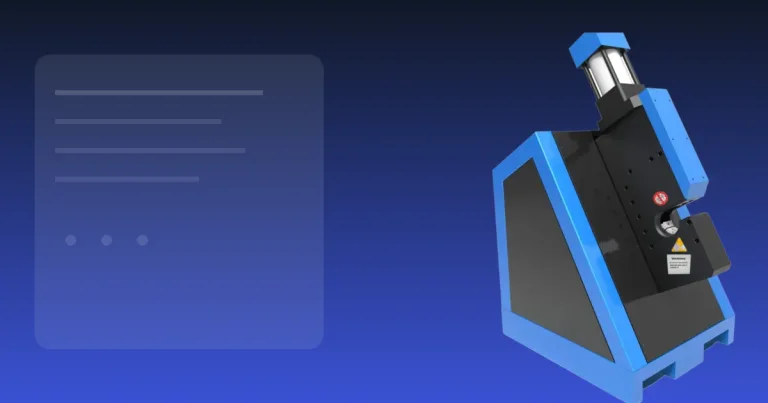
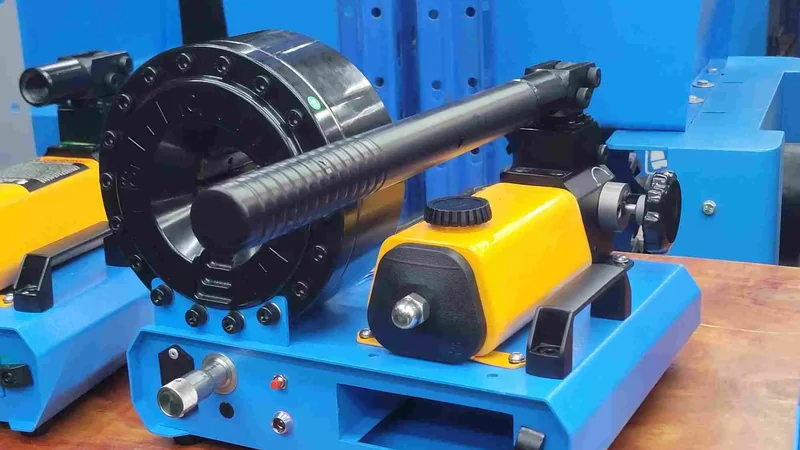
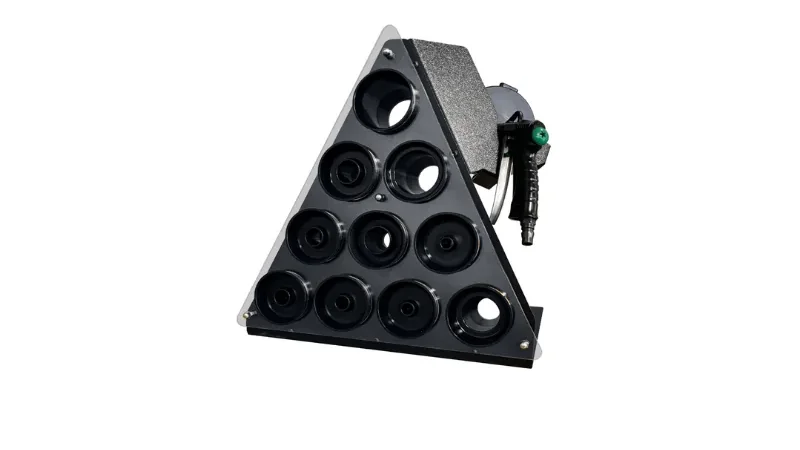
TRC builds entry-level crimpers that address each of the gaps above. The construction is purpose-built, the die sets are matched to the machine family, and the machines come with documented die series.
| Model | Tonnage | Key advantages over Harbor Freight-class | Strong markets |
|---|---|---|---|
| TRC P10HP | Compact hand-pump | Purpose-built radial die system; zinc-nickel anti-corrosion alloy; 720-hour salt-spray tested; simple and durable construction. Lowest-cost TRC entry point. | Russia, Middle East, mobile A/C service. |
| TRC P16HP | 95 ton hand-pump | Much larger tonnage and hose range; matched die set; stable quality; global dealer network. | Europe (global dealer sales). |
| TRC P18X | 80 ton electric | Simplest powered entry point; electric motor; simple construction; covers up to 1" braided. | Global (mostly dealers). |
See the manual hydraulic hose crimper category and the electric category for the full entry-level range.
Can a Harbor Freight Hydraulic Crimper Do Production Work?
The decision is driven by workload, not by channel.
| Workload | Is a Harbor Freight-class machine appropriate? |
|---|---|
| Occasional DIY or farm use, <10 assemblies per month | Yes. |
| Small repair shop, 10–50 assemblies per month, up to 1/2" 2SN | Borderline; acceptable if the operator measures every crimp. |
| Small repair shop, 50–100 assemblies per month | No; a compact workshop machine is more cost-effective. |
| Production workshop, >100 assemblies per month | No; the machine is not engineered for the workload. |
| Any high-pressure application (>1,000 psi) | No; the tonnage and the die system are inadequate. |
When to Move Up
| Signal | What it means |
|---|---|
| Daily count crosses about 5 assemblies | The light-use design assumption is being exceeded. |
| Hose sizes above 1/2" 2SN appear in the mix | Tonnage is becoming marginal. |
| First-pass yield drops below about 90% | Quality drift is happening. |
| Customer requires batch records or traceability | A production-class machine with documented setup is needed. |
| The same hose + fitting combination is being crimped repeatedly | A dedicated setup saves setup time and improves consistency. |
Any one of those signals is a reason to evaluate a workshop machine. The crossover is usually within the first year for a shop that is growing.
The Real Cost Comparison
Using the TCO framework, the comparison is not just acquisition price.
| Cost component | Harbor Freight-class | TRC entry-level (e.g., P10HP or P16HP) |
|---|---|---|
| Acquisition | Lowest | Higher, but still entry-level |
| Die system | Generic; no published crimp data | Matched die series; documented targets |
| Construction | Light; drifts under repeated use | Purpose-built; stable over thousands of crimps |
| Spare parts | Often unavailable; machine scrapped | Stocked; individual parts available |
| Service network | None | Global dealer network; technical support |
| Rework cost from defects | High (visual inspection misses defects) | Low (first-piece measurement with documented target) |
| Three-year TCO | Usually higher for any real workload | Usually lower |
For a shop producing more than about 20 assemblies per month, the TRC entry-level machine is cheaper on a three-year TCO basis, and it produces better crimps with less operator skill.
Frequently Asked Questions
Is a Harbor Freight hydraulic crimper good enough?
For light, occasional use — DIY, small farm, emergency standby — yes. For production work above about 50 assemblies per month, or for any hose size above 1/2" 2SN, no. The machine is engineered for occasional use, and using it for production produces measurable quality drift and early replacement.
Why is a Harbor Freight hydraulic crimper so much cheaper than a workshop machine?
Because it is built to a different specification. Lighter construction, smaller tonnage, generic dies, no published crimp data, limited spare parts, and no service network. Those savings are real, and for occasional use they are justified. For production, they translate into drift, rework, and replacement cost that exceeds the acquisition saving.
Can I use a Harbor Freight hydraulic crimper for high-pressure hydraulic hose?
Not above about 1/2" 2SN, and not for any 4SH, 4SP, R13, or R15 spiral hose. The tonnage is inadequate, the die system is not matched to high-pressure fittings, and there is no published crimp data to verify the result.
Buyer question: which TRC model should I buy to replace my Harbor Freight unit?
For the smallest hose and lowest budget, the TRC P10HP — compact, anti-corrosion, 720-hour salt-spray tested. For the workshop sweet spot, the TRC P16HP (95 ton hand-pump) or TRC P18X (80 ton electric). For sustained production, the TRC P20 (137 ton, classic workshop model, simple construction, rare failure).
References and technical boundaries
- Wikipedia — Hose coupling. Reference for coupling mating geometries and the engineering basis for matched die systems.
- Wikipedia — Total cost of ownership. Reference for the TCO framework applied to the cost comparison.