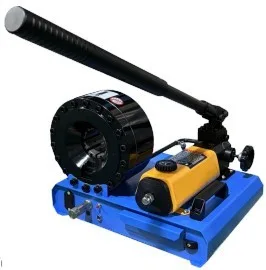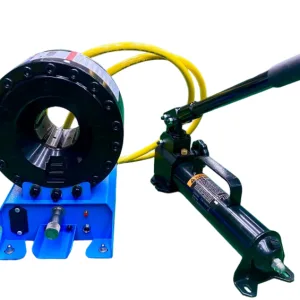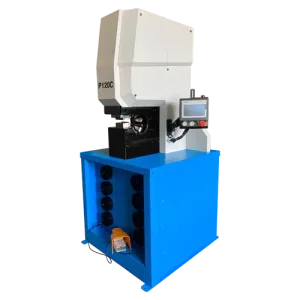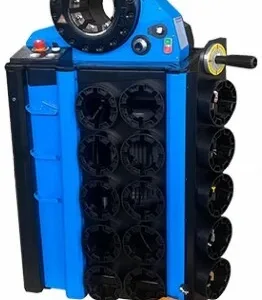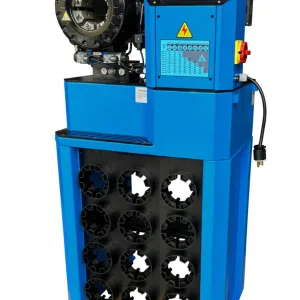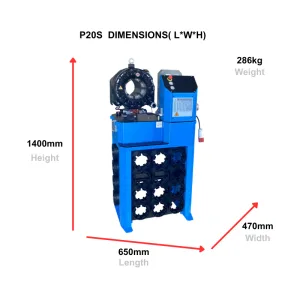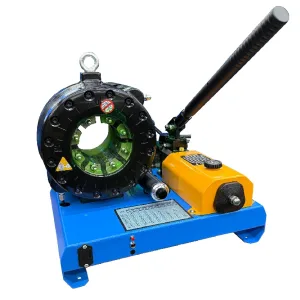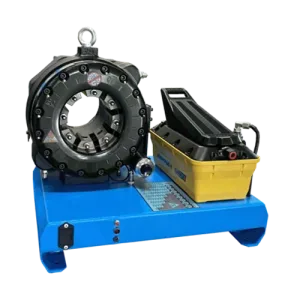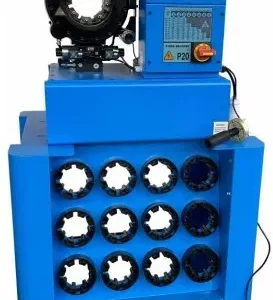
Electric Hydraulic Crimper
Motor-driven precision from 80 to 830 ton. Standard, auto-return, and CNC programmable — the backbone of every professional hose workshop and production line.
What Is an Electric Hydraulic Hose Crimper?
An electric hydraulic hose crimper uses an electric motor to drive a hydraulic pump, generating consistent crimping force cycle after cycle. Unlike manual models that rely on hand-pump pressure, electric crimpers deliver uniform compression every time — making them the standard for workshops, production lines, and any environment where repeatability matters.
The technology evolved rapidly: mechanical limit switches gave way to PLC controllers in the 2000s, and then to CNC systems in the 2010s, bringing ±0.02 mm precision — critical for SAE and DIN standard compliance. Today, CNC electric crimpers with 20+ stored crimp profiles dominate professional workshops worldwide.
How the Double Hydraulic Circuit Works
Electric crimpers use a double hydraulic circuit: the motor drives the pump to advance the piston and close the dies, then a separate retraction circuit pulls the piston back fast — no spring-lock delay. This means faster cycle times and no die sticking.
Source: Hydraulic Machinery — Wikipedia
How an Electric Hydraulic Crimper Works
Choose the crimp profile on the CNC controller — or set the target diameter manually.
Place the hose assembly into the die cavity with the ferrule centered.
Press the foot pedal or start button. The motor runs the hydraulic pump.
Hydraulic pressure pushes the piston forward, closing the die segments radially.
Dies compress the ferrule to the programmed diameter — CNC stops at ±0.02 mm.
The retraction circuit pulls the piston back. Remove the finished assembly.
Key Parameters — 4 Representative Models
| Parameter | P20 (Standard) | P32A (Auto-Return) | P32D (CNC) | P175 (Industrial) |
|---|---|---|---|---|
| Max Force | 137 ton | 200 ton | 200 ton | 830 ton |
| Hose Range | up to 1½” 4SP | up to 2″ 4SP | up to 2″ 4SP | up to 6″ |
| Precision | ±0.1 mm | ±0.1 mm | ±0.02 mm | ±0.1 mm |
| Motor | 2.2 kW | 2.2 kW | 2.2 kW | 5.5 kW |
| Cycle Time | 10 sec | 8 sec | 10 sec | 15 sec |
| Control | Manual switch | Auto-return | CNC multi-profile | PLC |
| Weight | 85 kg | 95 kg | 98 kg | 680 kg |
Three Control Types — Which One Fits Your Shop?
Standard — P20
Manual start/stop, operator watches dial. Simple, reliable, lowest cost. For low-volume shops and developing markets.
137 ton up to 1½” ±0.1 mm
Auto-Return — P32A
Crimp → hold → auto retract. Timer-controlled hold time. Mid-volume consistency without CNC price.
200 ton up to 2″ ±0.1 mm
CNC — P32D
Digital controller stores 20+ profiles. Crimps to exact diameter. Multi-step crimping for complex assemblies.
200 ton up to 2″ ±0.02 mm
Industrial — P175
830 ton force for hose up to 6″. PLC control, separate power unit. For mining, shipbuilding, and heavy industry.
830 ton up to 6″ PLCAll 19 models: P18X, P20, P20D, P22, P32, P32A, P32D, P32E, P32S, P33, TRC120L, P120, P120C, P140, P160, P160C, P165, P175, TRC120LH
Real Problems, Real Answers
Questions from r/Hydraulics, r/IndustrialMaintenance, and field reports — with solutions based on workshop experience.
“What crimper for gas and hydraulic hoses?”
For mixed hydraulic + industrial work, a 200-ton electric like the P32A handles 95% of needs. Gas hoses need special dies — confirm die compatibility before ordering.
Source: r/IndustrialMaintenance, 11 comments
“Are dies universal across brands?”
No. Die taper angle, seat diameter, and segment count vary. TRC P32 dies fit all P32-series machines (P32/P32A/P32D/P32E/P32S). Cross-brand mixing risks cone error and uneven crimps.
Source: r/Hydraulics, 11 comments
“Chinese crimping machines — has anyone tried them?”
Check three things: (1) Die seat hardness HRC60+, die hardness HRC50+; (2) No vibration during empty cycle; (3) Crimp cone error <0.1 mm. Always request a test crimp with caliper measurement.
Source: r/Hydraulics, 20 comments
Hose blows off fitting under pressure
Under-crimping is the cause. The ferrule doesn’t compress enough to grip the hose. Always verify crimp diameter against the manufacturer’s chart using calipers — ±0.1 mm for standard, ±0.05 mm for CNC.
Source: Baidu Baike — 扣压机 (Crimping Machine)
Crimp cone error — big end vs small end
Poor-quality machines have cone error: the front of the crimp is wider than the back. Front is under-crimped (can slip), back is over-crimped (cracks inner rubber). Quality machines use zero-cone-error die machining.
Source: Baidu Baike — “大小头”
How to clean hoses after cutting before crimping
Deburr the cut end, blow out metal particles and rubber dust with compressed air. Some shops use foam projectiles. Contamination inside the hose is a top cause of hydraulic system failure downstream.
Source: r/Hydraulics, 24 comments
Electric vs Manual Hydraulic Crimper
When does an electric crimper justify the investment? Compare the key differences:
| Factor | Electric Crimper | Manual Crimper |
|---|---|---|
| Force Range | 80–830 ton | 95–137 ton |
| Precision | ±0.02 mm (CNC) to ±0.1 mm | ±0.2 mm (operator dependent) |
| Cycle Time | 8–15 seconds | 20–60 seconds (hand pump) |
| Volume/Day | 50–500+ crimps | 10–50 crimps |
| Consistency | Every crimp identical | Varies with operator fatigue |
| Power Required | 110–380V outlet | None (hand pump) |
| Weight | 60–680 kg | 15–40 kg |
| Best For | Workshop, production, fleet service | Field repair, off-grid, emergency |
Bottom line: If you crimp more than 20 hoses per day in a fixed location, an electric crimper pays for itself in consistency and speed. Keep a manual unit for field calls and backup.
Where Electric Crimpers Work Hardest
🔧 Hose Repair Shops
50–200 crimps/day. The P32A auto-return saves 2–3 seconds per cycle — that adds up to hours saved per week.
🏭 Manufacturing
Production line crimping demands CNC profile storage. The P32D stores 20+ hose/fitting combinations for instant recall.
🚛 Fleet Maintenance
Truck and bus hydraulic systems. The P20 or P22 covers 95% of fleet hose sizes — compact enough for a service bay.
⛏️ Mining
Large bore hose (2″–4″). P140/P160/P175 deliver the force needed for high-pressure mining hydraulics.
🚢 Shipyard
Marine hydraulic systems need reliable crimps. The P160C side-opening head handles bent tubes and tight engine rooms.
🏗️ Construction Equipment Dealer
Service center for excavators, loaders, and dozers. The P32A is the best all-round choice — 200 ton, auto-return, die cabinet included.
How to Choose Your Electric Crimper
Daily volume? <20/day → Standard control | 20–100 → Auto-return (P32A) | 100+ → CNC (P32D)
Workshop space? Bench-top → P18X/P20 | Floor-standing → P32+ | Separate power unit → P120/P140
Power supply? 110–240V single phase → P18X through P33 | 380V three phase → P120 and above
Related Guides
Hydraulic Hose Crimping Machine: 7 Types Compared
Side-by-side comparison of manual, electric, portable, CNC, and production crimpers — with cost and capability analysis.
Read GuideHydraulic Hose Fittings Types Guide
SAE, DIN, JIC, BSP — understand fitting standards and how they affect die selection and crimp specifications.
Read GuideCNC vs Standard Crimper: When Precision Matters
When does ±0.02 mm matter? Production volume, mixed hose sizes, and SAE/DIN compliance requirements explained.
Read GuideAlso see: Manual Hydraulic Hose Crimper Hub | Portable Hydraulic Hose Crimper Hub
Frequently Asked Questions
What voltage do electric crimpers need?
Most models run on 110–240V single phase (standard outlet) OR 380V three phase (industrial). P18X, P20, and P22 work on standard household outlets. P120 and above require three-phase power for their larger pumps.
How accurate is a CNC hydraulic crimper?
CNC models like the P32D deliver ±0.02 mm crimp diameter — this exceeds SAE/DIN requirements for hose assembly testing. Standard models achieve ±0.1 mm, which is sufficient for most applications.
Can an electric crimper handle 2″ hose?
What’s the difference between P32, P32A, and P32D?
P32 = standard manual control (start/stop). P32A = auto-return + die cabinet + caliper holder. P32D = CNC with 20+ stored profiles and ±0.02 mm precision. Same 200-ton force, different control sophistication.
How long do dies last on an electric crimper?
With proper lubrication and normal use, 50,000+ crimps. HRC50+ hardness dies resist wear. Replace when crimp diameter drifts more than 0.1 mm from specification — check with calipers every 10,000 crimps.
Do I need a separate hydraulic pump?
P18X through P33 have integrated motor+pump units — plug in and go. P120 and above use separate power units for the higher flow rate needed by larger cylinders.
Can I crimp different hose brands on the same machine?
Yes — change dies and adjust crimp diameter per the hose manufacturer’s specification. CNC models store multiple profiles, so you can switch between brands and sizes with one button press.
What maintenance does an electric hydraulic crimper need?
Daily: Lubricate cone surface with hydraulic oil. Yearly: Change hydraulic oil (68# per specification). Every 10,000 crimps: Check die wear with calipers. Keep dust cover on when not in use to protect the die seat.
Need an Electric Hydraulic Crimper?
19 models from 80 to 830 ton. Standard, auto-return, and CNC options. TRC dies guaranteed zero cone error.
Contact Us for Pricing →