Hydraulic Hose Press vs Crimper: Force, Tooling and Applications
A hydraulic hose press and a dedicated hose crimper both produce hydraulic force. To a buyer who has a shop press already sitting in the corner of the workshop, the temptation is obvious: buy a set of hose dies, set up a fixture, and start crimping hose without buying a dedicated machine. Some shops make this work, briefly, for low-volume work on simple hose. Most shops eventually stop trying, because the result is inconsistent, slow, and — above about 1,000 psi working pressure — genuinely unsafe.
There is also a legitimate industrial hose press category: dedicated high-force machines built for large-bore industrial pipe and mining hose, where the term “press” describes the format rather than implying a shop-press conversion. This article covers both — the shop-press comparison and the dedicated industrial press — and explains which TRC model fits which job.
How A Hydraulic Press Works: Pascal’s Law And The Bramah Press
Every hydraulic press and every hydraulic hose crimper runs on the same principle. Pascal’s Law, established by French mathematician Blaise Pascal in 1653 and published in 1663, states that a pressure change at any point in a confined incompressible fluid is transmitted throughout the fluid, undiminished and in every direction. The fluid must be incompressible — that is why a hydraulic press uses oil, not compressed air.
In 1795, the English engineer Joseph Bramah used Pascal’s principle to patent the first hydraulic press — known in its early years as the Bramah press. The Bramah press was the first machine to apply Pascal’s principle to industrial force multiplication. A small force on a small input piston produces the same pressure throughout the system, and that pressure acting on a larger output piston produces a proportionally larger force. Bramah’s patent is the foundation of every hydraulic press, every hydraulic hose crimper, every hydraulic jack, and every vehicle braking system in service today.
The governing equation is short. Force equals pressure times area, written F = P × A. A small hand pump producing high pressure on a small piston can drive a large output cylinder at very high force, because the pressure is the same at both ends of the system. That is how a 3 kW electric motor and a hand-sized pump can generate 830 ton of crimping force on a TRC P175. The principle multiplies force; it does not multiply energy. Energy is conserved across the multiplication, which is why the ram moves slowly at high tonnage — the pump trades flow rate for pressure, so a small input force moving a long distance produces a large output force moving a short distance.
| Property | What it means for a hose press or crimper |
|---|---|
| Pressure is uniform throughout the fluid | One pump drives every cylinder at the same pressure. |
| Force = Pressure × Area | Larger cylinders produce more force at the same pressure. |
| Energy is conserved | High force comes with low speed; the pump trades flow for pressure. |
| Fluid is incompressible | The ram position is predictable and the system is stiff. |
| Distance moved is inversely proportional to area ratio | A small piston moving 100 mm lifts a large piston 2 mm. |
The same Pascal’s Law powers a shop press and a hose crimper. The difference is not in the hydraulics. The difference is in how the output force is applied to the workpiece.
A Press Pushes; a Crimper Squeezes Radially
The fundamental difference between a general hydraulic press and a dedicated hose crimper is the direction the force is applied. This is the single most important fact in the article. Everything else follows from it.
| Machine type | Force direction | How tooling receives it |
|---|---|---|
| General hydraulic press | Uniaxial. A ram pushes a top die toward a bottom die. Force is concentrated on one axis. | The workpiece is trapped between flat or shaped surfaces. |
| Dedicated radial hose crimper | Radial. A ring of segmented dies closes inward simultaneously, surrounding the ferrule from every direction. | The ferrule is compressed from all sides at once, producing a concentric crimp. |
| Dedicated industrial hose press (TRC P165 / P175) | Radial, high-force. Engineered as a hose crimper with very high tonnage for large industrial pipe. | Same as a hose crimper, scaled up. |
A general press applies force in one direction. A dedicated radial hose crimper applies force in every radial direction at once. That difference sounds abstract until you look at the finished crimp: a radial crimper produces a round ferrule, within an ovality tolerance of about 0.1 mm. A shop press tends to produce an oval ferrule, with the long axis aligned to the press direction.
Ovality matters because it directly affects the mechanical lock between the ferrule, the hose reinforcement, and the fitting stem. An oval crimp grips tighter on the narrow axis and looser on the wide axis, producing a leak path on one side and over-compression on the other. No amount of operator skill fixes the geometry.
Uniaxial vs Radial Force: An Engineering Analysis
The Wikipedia entry on the hydraulic press describes the uniaxial action explicitly: a hydraulic press generates compressive force in one direction, used for forging, clinching, molding, blanking, punching, deep drawing, and metal forming. None of those operations are hose crimping. The press is designed to deform a workpiece along a single axis, with the workpiece free to expand perpendicular to the load.
A radial hose crimper is engineered to do the opposite. The dies form a closed ring around the ferrule, so the workpiece cannot expand perpendicular to any single die’s motion — every die’s inward motion is reacted by the dies on the opposite side of the ring. The constraint geometry is what produces concentric deformation. The force is uniaxial inside the master cylinder, but the master die or conical piston converts that uniaxial force into radial closure at the ferrule.
| Force characteristic | Uniaxial press | Radial hose crimper |
|---|---|---|
| Master-cylinder action | Linear, single-axis. | Linear, single-axis (identical). |
| Force conversion at the tooling | None. The ram face is the upper die. | Master die or conical piston converts linear ram force into radial closure of segmented dies. |
| Workpiece constraint | Free to expand perpendicular to load. | Fully constrained by the ring of dies. |
| Resulting deformation | Elongated perpendicular to load (oval). | Concentric (round). |
| Repeatable across operators | Poor, unless fixture is precise. | Good, because the dies self-align inside the head. |
The conversion from linear to radial is the entire reason a hose crimper exists as a separate machine category. If uniaxial pressing could produce a defensible hose crimp, no separate crimper would have evolved. The fact that the crimper category exists, with its own die geometry and its own published target diameters, is engineering evidence that uniaxial pressing does not produce a defensible crimp on installed hose assemblies.
Stored Energy Physics: Why Hose Crimping Is a Guarding Problem
A hose crimper, like a hydraulic press, stores energy during the crimp stroke. The energy is stored in three places: the compressed hydraulic oil in the master cylinder, the elastic deformation of the machine frame, and the elastic-plastic deformation of the ferrule and hose reinforcement. When the dies retract, most of that energy returns to the system as the oil expands and the frame springs back.
The hazard is the third component. The ferrule and the wire reinforcement inside the hose store energy elastically during the crimp. If a die cracks, if a fitting slips out of the die band, or if the assembly is loaded crooked and the ferrule folds, the stored elastic energy is released suddenly. The release can eject the die, the fitting, or fragments of the ferrule at significant velocity. This is the same hazard OSHA addresses in 1910.212 — General requirements for all machines, which covers point-of-operation guarding and flying-chip hazards on power presses and similar machinery.
A dedicated hose crimper manages this hazard in three ways. The dies are fully enclosed inside the machine head, so a cracked die is contained. The die ring closes around the ferrule, so the workpiece cannot walk out of the band during the stroke. And the cycle is interlocked, so the dies cannot release until the operator’s hands are clear of the head.
A shop press set up with V-block tooling has none of those safeguards. The dies are exposed. The workpiece can shift. The operator’s hands are typically in the danger zone when loading and unloading. The OSHA 1910.212 standard applies to any power-press setup, including a shop-press conversion, which is why the engineering cost of converting a shop press to a defensible hose crimper is dominated by the guarding work, not the die work.
OSHA 1910.212 Guarding Requirements, Detailed
OSHA 1910.212(a)(1) requires that one or more methods of machine guarding be provided to protect the operator and other employees from hazards such as those created by point of operation, ingoing nip points, rotating parts, flying chips, and sparks. The standard applies to every power press, including shop presses set up for hose crimping.
| OSHA 1910.212 requirement | How it applies to a hose crimper setup |
|---|---|
| Point-of-operation guarding | The die closure zone must be guarded so the operator’s hands cannot reach the dies during the crimp stroke. Dedicated hose crimpers enclose the head; shop-press conversions need a fabricated guard. |
| Flying chips and parts | Dies, ferrule fragments, or wire pieces can be ejected if a die cracks or a fitting shifts. Dedicated crimpers contain the ejection inside the head; shop-press setups need shield panels. |
| Two-hand controls or presence-sensing devices | The operator must not be able to initiate the crimp stroke while a hand is in the danger zone. Foot-pedal-only initiation is not acceptable without barrier guarding. |
| Anchoring | The machine must be secured to the floor or bench so that it does not move under load. |
| Inspect and maintain guards | Guards must be in place and functional; removing or bypassing a guard violates the standard. |
For a dedicated hose crimper like the TRC P20 or P32 family, the head enclosure provides point-of-operation guarding by design, and the foot pedal is interlocked so that opening the head interrupts the cycle. The TRC P20D and P32D add CNC control with two-hand initiation for traceable applications. A shop-press conversion, by contrast, requires the buyer to design, fabricate, install, and validate all of these safeguards before the setup is OSHA-compliant — and the validation is usually the expensive part.
How a General Hydraulic Press Works
A shop press is a frame, a hydraulic ram, and a bed. The ram moves in one axis; the operator positions the workpiece on the bed; the ram descends until the workpiece is compressed. The bed and the ram face are typically flat or fitted with V-blocks, and the workpiece is pressed between them.
| Attribute | Shop press |
|---|---|
| Force direction | Uniaxial. |
| Tooling | Flat plates, V-blocks, or custom fixtures. |
| Setting method | By ram pressure or by stroke limit. |
| Tonnage | From about 10 ton (small bench presses) up to 100+ ton. |
| Application | Pressing bearings, straightening shafts, bending, light forming. Not designed for radial hose crimping. |
The principle is Pascal’s Law, applied through a single-axis cylinder. That is how a shop press multiplies force. The same principle powers a hose crimper; what differs is how the output force is applied to the workpiece. A shop press converts hydraulic pressure into linear ram force and stops there. A hose crimper converts hydraulic pressure into linear ram force and then converts that linear force into radial die closure through a conical master die or mechanical linkage.
How a Dedicated Hose Crimper Works
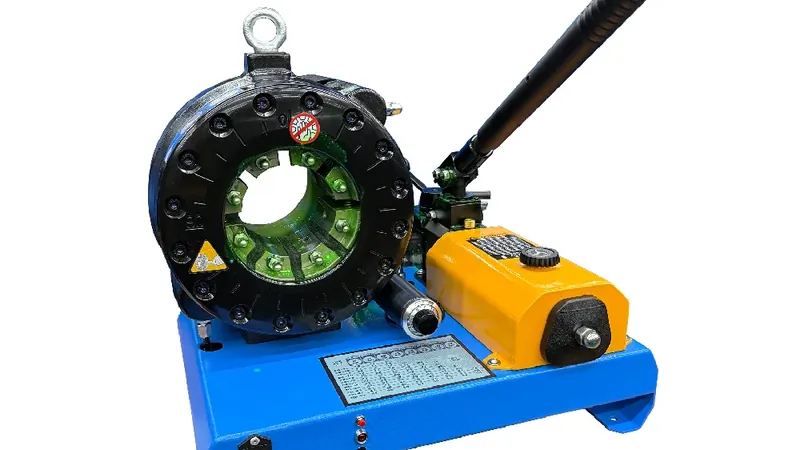
A dedicated radial hose crimper is engineered around the segmented die system. The machine head contains a ring of dies — usually six to ten segments — that close inward simultaneously when hydraulic pressure is applied behind a conical piston or master die.
| Attribute | Dedicated hose crimper |
|---|---|
| Force direction | Radial, all segments at once. |
| Tooling | Factory-calibrated die set, matched to a hose/fitting system. |
| Setting method | By die-to-die contact (manual), by pressure (powered hydraulic), or by target diameter (CNC). |
| Tonnage | Compact 6 ton; workshop 137 ton; industrial up to 830 ton. |
| Application | Permanent hydraulic hose assemblies; concentric crimp diameter; repeatable setup. |
The dies are the core of the machine. They are manufactured to a specific cone angle, die profile, and die length, and they come with (or are matched to) a published target crimp diameter for specific hose and fitting combinations. The master die or conical piston is the component that converts the cylinder’s linear force into radial closure. Without that conversion, the machine is a press, not a crimper.
The Dedicated Industrial Hose Press — TRC P165 and P175
For large-bore industrial pipe and mining hose, TRC builds a dedicated industrial hose press class. These are not converted shop presses; they are purpose-built hose crimpers with very high tonnage, engineered for workpieces that no workshop crimper can handle.
| Model | Tonnage | Hose range | Where it fits |
|---|---|---|---|
| TRC P140 | 320 ton | Up to ~3″ R13, plus industrial pipe | Large hydraulic and industrial pipe producers; strong in Europe, Turkey, Brazil, USA. |
| TRC P160 | 350 ton | Large-bore industrial hose | Same profile as P140, higher tonnage. |
| TRC P165 | 500 ton | Same max opening as P160, higher crimping force | Heavy industrial; separate power unit. |
| TRC P175 | 830 ton | Every hydraulic size plus 15-inch industrial pipe | Mining, metallurgy, marine, aerospace; flagship model; strong in Dubai, Canada. |
These machines use radial segmented dies, not uniaxial platens. The “press” in the name describes the high-force format, not a shop-press layout. A TRC P165 or P175 is a hose crimper scaled to industrial pipe tonnage; it produces a concentric radial crimp on every workpiece it is rated for.
Can a Shop Press Be Used for Hose Crimping?
In strict engineering terms: yes, with significant caveats. A shop press can be made to produce an acceptable crimp if all of the following conditions are met.
| Requirement | What it means |
|---|---|
| Engineered radial die set | Custom-machined segmented dies that close around the ferrule from multiple directions. |
| Precision alignment fixture | A fixture that holds the die set concentric to the press ram. |
| Calibrated tonnage control | A way to stop the press at a defined tonnage or position. |
| Validation data | A published or self-developed target crimp diameter for the specific hose + fitting, verified by first-piece measurement. |
| Guarding against stored energy and flying debris | OSHA 1910.212-compliant guards; interlocked operation. |
| First-piece inspection on every batch | Caliper measurement at three positions around the ferrule. |
If any one of those is missing, the shop-press setup is not defensible. The first two — engineered radial dies and a precision alignment fixture — are where most attempts fail.
When a Shop Press Setup Is Defensible (The Narrow Case)
There is one narrow case where a shop press setup is defensible: low-volume emergency repair on a single hose size, with engineered tooling, calibrated tonnage control, validation data for that specific hose + fitting, OSHA-compliant guarding, and first-piece inspection on every assembly. That is a long list. It describes a workshop that has effectively rebuilt a dedicated crimper inside a shop press frame, at a cost that usually exceeds buying a compact dedicated crimper.
If the shop already owns a press and already owns the engineering time, the narrow case can make sense for 1–2 assemblies per month on a single hose size at low pressure. Beyond that narrow envelope, a dedicated crimper is cheaper, safer, and faster.
| Workload | Realistic option |
|---|---|
| Occasional emergency only, 1–2 assemblies/month, low pressure, single hose size | Shop press with properly engineered tooling, validated for the specific hose. |
| 20–50 assemblies/month | Dedicated compact crimper: TRC P10HP or TRC P16HP. |
| 50–300/month | Dedicated workshop machine: TRC P20 or TRC P32A. |
| 300+/month | Dedicated workshop or CNC: TRC P20D or TRC P32D. |
| 2″–4″ R13 industrial | Dedicated industrial hose press: TRC P140 / P160 / P165 / P175. |
Why Most Shops Should Stop Trying
Three reasons the shop-press approach usually loses to a dedicated radial crimper.
1. The engineering cost exceeds the machine cost. Designing and machining a radial die set, building an alignment fixture, fabricating OSHA-compliant guards, and validating the setup costs more than buying a compact dedicated crimper like the TRC P10HP or TRC P16HP.
2. The setup is fragile. A dedicated crimper’s die system is factory-aligned. A shop press setup depends on the operator loading the fixture correctly every time. Once the fixture moves, concentricity is lost and the crimp goes oval.
3. The safety risk is real. Hose crimping stores energy in the ferrule. If a die cracks, a fixture shifts, or a ram releases unexpectedly, the stored energy can eject the die or fitting. OSHA 1910.212 explicitly covers flying chips and parts from power presses and applies to any hose crimping setup, including shop-press conversions.
Warning. A shop press set up with generic V-block tooling is not acceptable for hydraulic hose crimping at any pressure class. The crimps will be oval, the setup is not repeatable, and the safety risk is real.
When a Dedicated Crimper Pays for Itself
The total cost of ownership of a shop-press hose setup is not just the press and the dies. It is also the operator time per crimp, the rework rate, the validation cost, and the safety risk. For most shops, the crossover point where a dedicated crimper becomes cheaper is around 20–30 assemblies per month. Below that, the shop-press case may be defensible for one hose size. Above it, the dedicated machine wins on every axis — cost, speed, quality, safety.
If you are already running a shop press for hose, the next investment is a dedicated radial crimper, not a bigger press. TRC equipment is built in a 5,000 m² CE/SGS/UL+ISO certified factory serving more than 300 customers across 50+ countries, with a four-hour response window on technical inquiries.
Frequently Asked Questions
Can I crimp hydraulic hose on a shop press?
With significant engineering, yes — engineered radial dies, a precision alignment fixture, calibrated tonnage control, validation data, and OSHA-compliant guarding are all required. For most shops, the engineering cost exceeds the cost of a dedicated compact crimper, and the setup is fragile and slow.
Why is a dedicated hose crimper better than a shop press?
Because of force direction. A dedicated crimper uses radial segmented dies that close from every direction at once, producing a concentric crimp within about 0.1 mm ovality. A shop press pushes in one direction, which tends to produce an oval crimp unless the tooling is engineered to convert uniaxial force into radial closure.
How does a hydraulic press multiply force?
Through Pascal’s Law. A pressure change applied to a confined incompressible fluid is transmitted throughout the fluid, so a small force on a small input piston produces the same pressure in a larger output cylinder. The governing equation is F = P × A (force equals pressure times area). Joseph Bramah patented the first hydraulic press on this principle in 1795. The same principle powers every hydraulic hose crimper today.
What OSHA standard applies to a hose crimper?
OSHA 1910.212 — General requirements for all machines. The standard covers point-of-operation guarding, flying-chip hazards, two-hand controls, anchoring, and inspection of guards. It applies to dedicated hose crimpers and to shop-press conversions alike. A shop-press hose setup must meet the same guarding requirements as a dedicated crimper, which is a major part of the engineering cost.
What is a hydraulic hose press machine?
In the context of the TRC P165 (500 ton) and TRC P175 (830 ton), a hydraulic hose press machine is a dedicated high-force hose crimper engineered for large-bore industrial pipe and mining hose. It uses radial segmented dies like any hose crimper; the “press” in the name describes the high-force format, not a shop-press layout.
Buyer question: what tonnage do I need for 2-inch R13 hose?
A minimum of 200 ton; 245–320 ton is preferred for sustained production. The TRC P32 (200 ton, 3.7 kW three-phase motor) covers 2-inch R13 for workshops; the TRC P140 (320 ton) and TRC P160 (350 ton) cover it for industrial production. See our heavy-duty category for the full range.
References and technical boundaries
- Wikipedia — Hydraulic press. Reference for the Bramah press principle, the 1795 patent, the uniaxial force direction, and the manufacturing applications.
- Wikipedia — Pascal’s Law. Reference for the underlying hydraulic principle, the 1653 origin, and the F = P × A relationship.
- OSHA 1910.212 — General requirements for machine guarding. Covers power presses and flying-chip hazards; applies to shop-press hose conversions and to dedicated hose crimpers alike.
- ISO 12100:2010 — General risk assessment and risk reduction for machinery. Supports the general safety framework.