AC Hose Crimping Tool Selection: Hose, Fitting and Die Compatibility
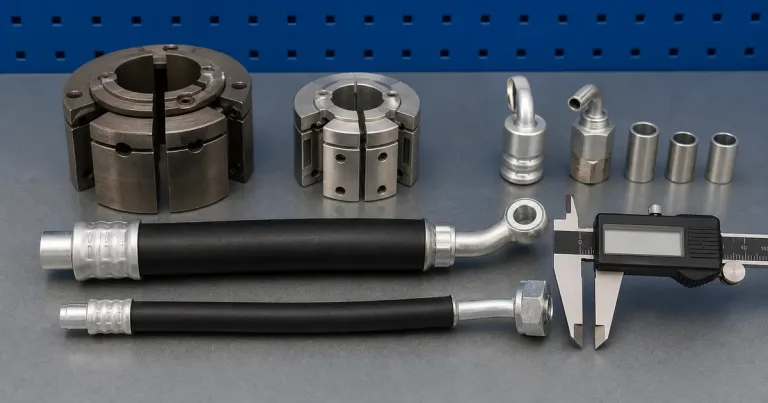
An AC hose crimping tool is selected by the assembly, not by the ferrule size. Automotive air-conditioning hose assemblies use specific hose constructions (barrier and reduced-barrier), specific fitting families (beadlock, spring-lock, barb), specific refrigerants (R-134a and R-1234yf), and specific crimp geometries that differ from hydraulic hose. Treating an AC hose like a small hydraulic hose is how most AC crimping mistakes happen.
This article explains what makes AC hose crimping different, how the hose type and fitting family decide the tool, and the TRC models engineered specifically for this work.
Why AC Hose Crimping Is Not Generic Hose Crimping
| Difference | What it means for the tool |
|---|---|
| Refrigerant compatibility | The assembly has to hold R-134a or R-1234yf over years of service. Refrigerants circulate between a low-pressure evaporator and a high-pressure condenser; the crimped assembly must withstand fluctuating pressure differentials without leaking. |
| Barrier hose construction | A thin inner nylon barrier limits refrigerant permeation. The barrier affects how the ferrule grips and how the crimp transfers force into the hose structure. |
| Fitting families | AC fittings (beadlock, spring-lock, barb) differ from hydraulic JIC, ORFS, and flange fittings. Die profiles are not interchangeable. |
| SAE J2064 standard | Coupled automotive refrigerant hose assemblies are specified by SAE J2064, which sets leak, burst, and impulse requirements for the finished assembly. |
| Permeation limits | Barrier hose is rated to a maximum permeation rate (e.g., ≤15 kg/m²/year). A poor crimp worsens permeation by leaving a micro-gap between the barrier and the stem. |
The Refrigerant Transition — Why It Affects Hose Assembly
The refrigerant inside the hose changes what the assembly has to do. According to Wikipedia's article on refrigerants, the industry is in the middle of a forced transition:
| Refrigerant | GWP (100-year) | Status | Hose assembly implication |
|---|---|---|---|
| R-134a | 1,530 | Phased out. Banned in new US light vehicles from 2025 and all new vehicles from 2028. By 2022, 98%+ of new US vehicles already used R-1234yf. | Older hose systems; still common in service work. |
| R-1234yf | ~0.5 | Current standard. ASHRAE A2L safety classification (mildly flammable). | Newer hose systems; barrier construction mandatory for permeation compliance. |
The regulatory driver is climate: the EU began phasing out mobile AC refrigerants with GWP above 150 starting in 2011, and the US followed. For hose assembly, the practical consequence is that newer vehicles use R-1234yf, the barrier hose construction is mandatory for permeation compliance, and the crimp has to seal against a refrigerant that is chemically different from R-134a.
Refrigerant must be chemically stable, non-corrosive to system components, and miscible with the compressor lubricant. The inner barrier of the hose has to resist both the base fluid and the specific oil mixed with it. A crimp that looks correct but leaves a micro-gap can increase permeation past the SAE J2064 limit, producing a slow leak that only shows up months later as a system that "doesn't cool as well as it used to."
Step 1 — Identify the Barrier Hose Type
AC hose comes in several constructions, and the type decides what die and ferrule combination the tool needs.
| Hose type | Construction | Crimping implication |
|---|---|---|
| Standard barrier hose | Inner nylon barrier + rubber reinforcement + outer cover. | Standard AC die and ferrule. |
| Reduced-barrier hose | Thinner wall; same inner diameter but smaller outer diameter. | Requires a smaller ferrule and a dedicated die. Standard-barrier dies do not fit. |
| Non-barrier hose | Older or low-pressure hose without a barrier layer. | Less common; may use a hydraulic-style fitting. |
| Specialty hose (R-1234yf rated) | Engineered for newer low-GWP refrigerants. | Follow the manufacturer's crimp data strictly. |
The most common compatibility mistake is using a standard-barrier die on a reduced-barrier hose. The die is too large; the crimp is under-compressed; the refrigerant leaks.
Step 2 — Identify the Fitting Family
| Fitting family | How it seals | Tooling implication |
|---|---|---|
| Beadlock (most common) | A bead on the fitting stem engages a corresponding groove in the hose; the ferrule crimps the hose to the stem. | Specific beadlock die profile; common thread sizes 5/8-18 UNF, 3/4-16 UNF, 7/8-14 UNF. |
| Spring-lock | A spring-loaded collar engages the fitting; the ferrule crimps the hose. | Different die profile from beadlock; dedicated tooling usually required. |
| Barb | The fitting has multiple barbs that grip the hose inner tube; the ferrule crimps over the barbs. | Another die profile; common on older or low-pressure AC systems. |
A tool set up for beadlock fittings cannot reliably crimp spring-lock or barb fittings without a die change and a different target crimp diameter. AC work usually involves at least two of the three families, so the tool has to cover both.
Step 3 — Sleeve and Ferrule Matching
AC fittings come in one-piece and two-piece constructions.
| Fitting type | Construction | Tooling implication |
|---|---|---|
| One-piece (integrated shell) | The ferrule is pre-positioned on the stem; the assembler inserts the hose and crimps. | The die has to match the integrated profile. |
| Two-piece (separate ferrule) | The ferrule slides over the hose before the stem goes in; the assembler positions it and crimps. | The die has to match both the stem profile and the ferrule profile. |
Why AC Crimping Is Sensitive to Die Profile
AC hose crimping is sensitive to die profile in ways that hydraulic crimping sometimes is not. The permeation limit is tight, and a die that "looks right" can still produce a slow leak.
Wikipedia notes that refrigerant must be "chemically stable during use" and "miscible with the lubricant," and that it operates by circulating between low and high pressure. A crimp that leaves a micro-gap between the inner barrier and the stem allows refrigerant to permeate through over time. The leak is slow — it may take weeks or months to become noticeable — but it takes the assembly out of SAE J2064 compliance.
| What the operator sees | What is actually happening |
|---|---|
| The crimp looks clean — no cracks, no exposed cord, ferrule seated square. | Visual inspection does not catch a micro-gap between barrier and stem. |
| The first leak test passes. | A short leak test does not catch slow permeation. |
| Weeks later, the system "doesn't cool as well." | Refrigerant has permeated through the micro-gap. |
| Re-check shows the assembly is under-charged. | The crimp was the root cause, not the refrigerant. |
The fix is not a different refrigerant. The fix is a die matched to the specific hose + fitting combination, with the target crimp diameter published by the component manufacturer.
Manual vs Powered AC Crimping
| Format | Where it fits |
|---|---|
| Manual hand-pump AC tool | Low-volume shops; field AC repair; up to about 20 assemblies per day. |
| Pneumatic AC crimper | Workshops with shop air; 50+ assemblies per day; consistent cycle. |
| Electric workshop AC crimper | Production shops; high volume; repeatable setup. |
AC hose crimping does not require the tonnage of hydraulic hose crimping. Most AC assemblies are crimped at 5–20 ton, well within the capacity of a compact tool. The critical variable is the die profile and the target diameter, not the force.

TRC AC-Specific Models
TRC builds crimpers engineered specifically for AC hose work.
| Model | Tonnage | Key selling points | Strong markets |
|---|---|---|---|
| TRC P70C | 20 ton | Specifically designed for AC hose; maximum pressure only 20 ton, not suitable for hydraulic oil pipe. | Auto parts inquiries; customers report the machine is large; prefer smaller. |
| TRC P120C | 200 ton | Equipped with special C-port; crimps irregular tubes and AC pipes; design-forward. | Russia, Middle East (customers report the machine is large; prefer smaller). |
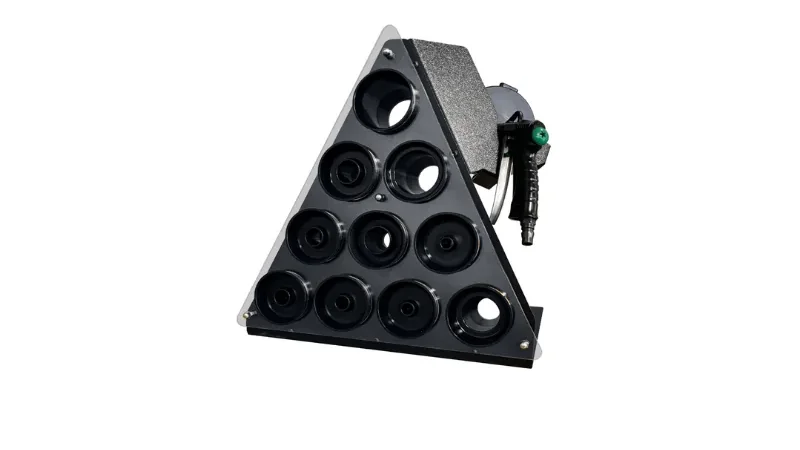
For repeat automotive refrigerant-hose work, the TRC P70C is more appropriate than adapting a general hydraulic-hose machine. See the air conditioning hose crimper category for details.
SAE J2064 and Why the Hose Is Only Half the Assembly
SAE J2064 specifies coupled automotive refrigerant hose assemblies. The hose alone meeting the spec does not make the assembly meet the standard; the hose + coupling + crimp has to meet the standard's leak, burst, and impulse requirements.
| What the hose spec covers | What the assembly spec covers |
|---|---|
| Hose construction, pressure class, permeation rate. | The finished assembly's leak rate, burst pressure, impulse life. |
| The hose as a component. | The hose + coupling + ferrule + crimp as a system. |
This is why AC hose crimping has to follow the manufacturer's published crimp data, not a generic die selection. The assembly's fitness is proven by testing the finished combination, and the test result depends on the crimp.
A Working Scenario — Not a Customer Case
An illustrative scenario. A workshop producing custom AC hose assemblies used a "universal" AC die set that covered several fitting sizes but was not matched to the specific hose and fitting manufacturer's combination. The crimps looked clean visually.
Under leak testing, several assemblies showed permeation rates above the SAE J2064 limit. The root cause was the die profile: the universal die produced an uneven crimp across the ferrule, leaving a micro-gap between the inner barrier and the stem. The refrigerant permeated through the gap over time.
The workshop switched to dies matched to the specific hose + fitting combinations they carried. The permeation rates fell back within specification, and the leak-test reject rate dropped from about 8% to under 1%.
The lesson: AC hose crimping is sensitive to die profile in ways that hydraulic crimping sometimes is not. The permeation limit is tight, and a die that "looks right" can still produce a slow leak.
Frequently Asked Questions
Can I use a hydraulic hose crimper for AC hose?
Sometimes, if the machine accepts the correct AC die and the component manufacturer publishes a validated AC crimp instruction. The default for AC work is a dedicated AC tool like the TRC P70C, because AC fittings, barrier hose constructions, and permeation requirements differ from hydraulic hose.
What is the difference between barrier and reduced-barrier AC hose?
Barrier hose has a thin inner nylon barrier that limits refrigerant permeation. Reduced-barrier hose has a thinner wall — same inner diameter, smaller outer diameter. Reduced-barrier hose requires a smaller ferrule and a dedicated die; standard-barrier dies do not fit.
What is a beadlock fitting?
The most common AC fitting family. A bead on the fitting stem engages a groove in the hose; the ferrule crimps the hose to the stem. Common thread sizes are 5/8-18 UNF, 3/4-16 UNF, and 7/8-14 UNF. Beadlock fittings require a die matched to the beadlock profile.
Buyer question: why do my AC hose assemblies leak after crimping?
The most common cause is a die profile that does not match the hose and fitting combination. The crimp looks clean visually but leaves a micro-gap between the barrier and the stem, and the refrigerant permeates through the gap over time. Use the die and target diameter published by the hose and fitting manufacturer, and verify with a leak test.
References and technical boundaries
- SAE J2064 — Coupled automotive refrigerant air-conditioning hose assemblies. Defines the coupled assembly requirements referenced in this article.
- Wikipedia — Refrigerant. Reference for R-134a and R-1234yf properties, GWP, and the regulatory transition.