
Gates Hydraulic Hose Crimper Compatibility: What Can and Cannot Be Mixed?
A Gates hydraulic hose crimper is one part of a controlled assembly system. The machine supplies force and movement, but the finished assembly also depends on the hose, the coupling, the ferrule, the die set, the machine setting, and the target crimp diameter. A crimper that can physically close around a fitting is not automatically approved for that hose-and-coupling combination.
This article explains the five layers of compatibility that decide whether a hose assembly is defensible, why mixing brands fails at an engineering level, and how TRC crimpers can be configured to match a known hose and fitting system.
Why a Crimper Is Only One Layer of the System
A hose coupling is a permanent mechanical connector installed on the end of a hose. Wikipedia defines coupling installation for higher-pressure applications as an internally swaged or crimped process that requires special hydraulic machinery and matched dies — the machine physically deforms the metal ferrule and coupling stem directly into the hose structure to secure it against pull-off force.
The key engineering point is that "physically deformed into the hose structure" is not a generic operation. The deformation has to reach a specific target crimp diameter, at a specific measurement position, within a specific tolerance window. That target is published by the hose and coupling manufacturer for one exact combination of hose + stem + ferrule + die + setting. Change any one of those components to a different brand, and the published target no longer applies.
| Layer | What it controls | What happens if you change it |
|---|---|---|
| Hose | Carries the fluid; reinforcement (braid or spiral) provides the pressure rating. | Different reinforcement changes the die profile and skive requirement. |
| Coupling stem | Seats inside the hose ID; serrations engage the inner tube or wire layer. | Different stem profile changes the engagement depth and target diameter. |
| Ferrule | Surrounds the hose OD and stem; deformed inward during crimping. | Different wall thickness or profile changes tonnage and die ID requirements. |
| Die set | Segmented tooling that closes around the ferrule. | Different profile produces a different crimp even at the same target OD. |
| Target crimp diameter | The finished OD published by the manufacturer. | Substituting components invalidates the published target. |
The Five Compatibility Layers in Practice
When a workshop asks "can I use a different-brand crimper on Gates hose?", the honest answer is: only with evidence at each of five layers.
Layer 1 — Hose Identification
The hose part number is the entry point. A "1/2-inch Gates hose" is not a single thing — it could be a Gates C12-32 (1/2" SAE 100R2), a Gates MegaTuff MXG 5K (1/2" high-impulse spiral), or several other constructions. Each has a different reinforcement, a different OD, and a different published crimp instruction.
Layer 2 — Coupling Series
Gates publishes coupling families engineered for specific hose families. A MegaCrimp coupling is engineered for a specific wire-braid hose range; a Global Spiral coupling is engineered for a specific spiral hose range. The stem profile, the ferrule profile, and the target crimp diameter are all tied to the coupling-hose pairing.
Layer 3 — Uncrimped Ferrule OD
Two ferrules with the same nominal hose size can have different uncrimped ODs across manufacturers. The die set has to accept the ferrule before crimping, and the target crimp diameter is calculated from the specific ferrule's starting OD.
Layer 4 — Die Set Matching
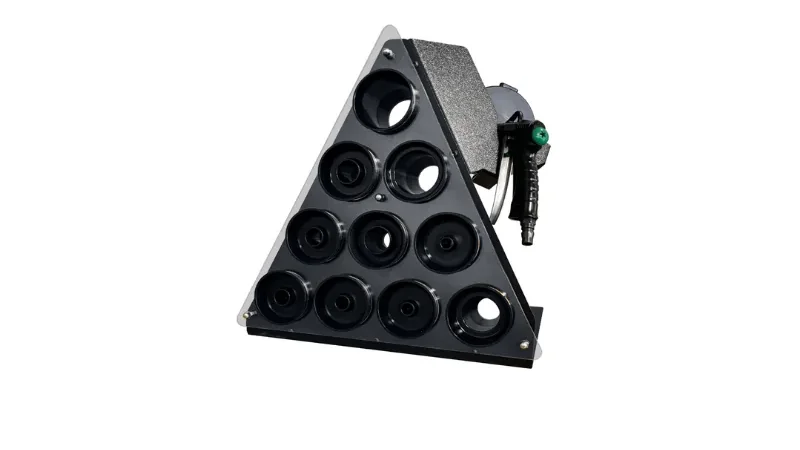
The die set has to match three things: the cone angle or drive interface to the machine, the die length to the ferrule's crimp band, and the die profile (bowl, flat, or stepped) to the ferrule's shape. A die that physically fits the machine but was not engineered for the specific hose + coupling combination produces an uneven or under-compressed crimp.
Layer 5 — Target Crimp Diameter
The target crimp diameter is the finished OD the ferrule must reach after crimping. It is published by the hose and coupling manufacturer for each validated combination. Without it, the operator cannot verify the crimp, and the assembly is not defensible.
Why Cross-Brand Mixing Fails at an Engineering Level
The recurring question in our user-question library is whether one brand's hose can be coupled with another brand's fitting on a third brand's crimper. The engineering answer is that each manufacturer's crimp data assumes the full set — hose + stem + ferrule + die + target diameter — comes from one controlled system.
Wikipedia notes that hose coupling systems "rely on highly specific mating geometries" and that "incompatibilities still exist" even between designs that appear dimensionally similar. The same nominal hose size, across manufacturers, can map to different ferrule ODs, different stem profiles, and different target crimp diameters. The crimp may look identical visually, but the mechanical lock, the seal, and the fatigue life are different.
| What buyers assume | The engineering reality |
|---|---|
| Same nominal size = interchangeable. | Same nominal size maps to different ferrule ODs, stem profiles, and targets across brands. |
| If the die fits the machine, the crimp is valid. | Die profile, length, and cone angle also have to match. |
| A visually clean crimp is a passing crimp. | Visual inspection misses under-crimp, over-crimp, and wrong-die errors. |
| One successful assembly proves compatibility. | One passing proof test is not statistical validation. |
What "Validation" Actually Requires
If a workshop needs to crimp a non-Gates coupling on Gates hose, or use a different-brand crimper on Gates components, validation means producing evidence — not assumption.
| Evidence required | Source |
|---|---|
| Published target crimp diameter for the exact combination | Hose and coupling manufacturer's crimp data. |
| Die identification matching the combination | Die stamping + manufacturer's die chart. |
| First-piece measurement at three positions around the ferrule | Calibrated caliper (0.02 mm). |
| Proof pressure test at 2× working pressure | Hydrostatic test bench. |
| Impulse test (when required) per SAE J343 | Impulse test bench. |
| Written compatibility statement from the component manufacturer | Manufacturer's technical support. |
Without that evidence, the assembly is a guess. With it, the assembly is defensible.
How TRC Crimpers Match a Known Hose and Fitting System
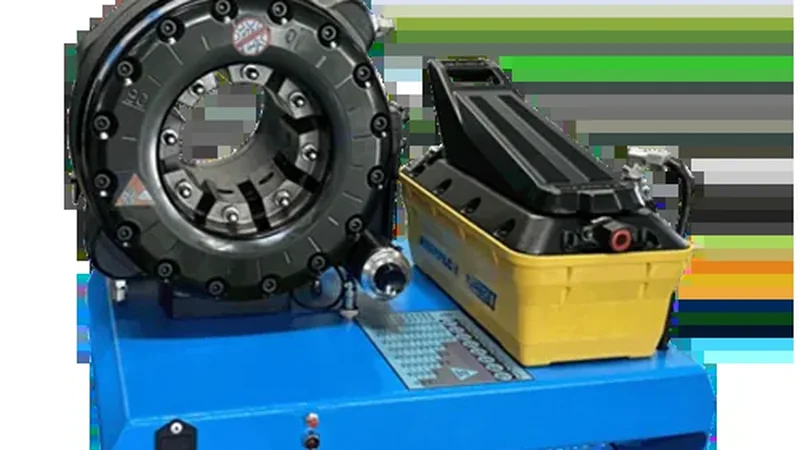
TRC builds crimpers across the full tonnage range, and each machine family uses a defined die series. The die set is configured per order based on the customer's hose and fitting system.
| TRC model | Tonnage | Die series | Typical hose coverage |
|---|---|---|---|
| TRC P20 | 137 ton | P20 series (14 standard dies, P20/14 to P20/47, covering 14–52 mm) | Up to 1-1/2" 4SH braided and spiral. |
| TRC P20D | 137 ton CNC | P20 series with stored programs | Same range with CNC repeatability and batch records. |
| TRC P32 | 200 ton | P32 series | Up to 2" R13. |
| TRC P32A | 200 ton | P32 series; drawer-type die cabinet | Value pick; strong in Malaysia, South America, South Africa. |
| TRC P140 | 320 ton | Industrial die series | Large-bore industrial. |
The right approach is to send TRC the hose part number, the coupling part number, the uncrimped ferrule OD, and the published target crimp diameter. We can then confirm whether a TRC die set is engineered for the specific combination, and configure the machine accordingly. See the hydraulic hose crimper category for the full range, or contact us through the contact page for die-matching support.
A Working Scenario — Not a Customer Case
An illustrative scenario, not a named customer case. A mobile repair business has access to a branded crimper, but the hose stock and couplings offered by a second supplier are cheaper. The machine can physically close around the alternate ferrules, so the operator assumes the assemblies are equivalent.
The first assemblies pass visual inspection. Under pull-off testing, the pull-off force is measurably lower than the validated combination — the alternate ferrule's wall profile is different, and the original die does not compress it correctly. The customer rejects the batch and moves to another supplier.
The lesson is that physical closure is not technical approval. The ferrule has to be the one the crimp data was published for; substituting it invalidates the system.
What to Send a Supplier Before Mixing Systems
If cross-brand use is being considered, collect the following before producing any assembly for a customer.
| Information | Source |
|---|---|
| Exact hose part number and construction | Hose label or reel tag. |
| Exact coupling part number and series | Coupling package or catalog. |
| Uncrimped ferrule OD, measured at the bench | Caliper at the ferrule's flat band. |
| Published target crimp diameter for the combination | Hose and coupling manufacturer's crimp data. |
| Proposed machine model and die identification | Machine nameplate; die stamping. |
| Machine supplier's written compatibility statement | Supplier's technical support. |
| First-piece inspection plan | Caliper, go/no-go gauge, record template. |
| Any validation required (burst, impulse, pull-off) | Test plan per SAE J343 or equivalent. |
This is the right place to be conservative. A visually neat ferrule can still be under-crimped, over-crimp, or assembled with incompatible components.
Frequently Asked Questions
Can I use a different-brand crimper on Gates hose and couplings?
Sometimes, with evidence at all five compatibility layers. The alternate crimper must accept a die engineered for the specific combination, reach the required tonnage, and have a repeatable setting method. The assembly must be verified against the published target crimp diameter.
Can I mix hose ends from another brand with Gates hose?
No. Each manufacturer publishes crimp data for its own system. Mixing hose and couplings across systems invalidates the published target diameter and can produce an assembly that leaks or fails under pressure. Wikipedia notes that coupling systems "rely on highly specific mating geometries" and that incompatibilities exist even between similar-looking designs.
Where do I find Gates crimp data?
Through the Gates published crimp data system, which ties specific hose + coupling + crimper + die combinations to a published target crimp diameter and setting. The values are not transferable to non-Gates components.
Buyer question: does TRC supply dies for Gates hose and couplings?
TRC supplies die sets matched to our machine families, and we can configure a die set for a known hose and fitting system. Send us the Gates part numbers and the uncrimped ferrule OD, and we will confirm the die series, die IDs, and target diameters — and whether your existing TRC die set covers the combination.
References and technical boundaries
- ISO/TS 17165-2:2018 — Hydraulic hose assemblies, practices. Supports the controlled-system principle that hose, fitting, ferrule, die, and setting form a validated combination.
- Wikipedia — Hose coupling. Reference for coupling types, permanent vs reusable installation, and mating-geometry compatibility.
- Wikipedia — Crimp (joining)). Reference for the general definition of crimping as deformation-based joining.