
Portable Hydraulic Hose Crimping Tool for Service Trucks
A portable hydraulic hose crimping tool is a vehicle problem before it is a machine problem. A unit that produces excellent crimps on a test bench may be useless in a service truck if it does not fit the available space, draws more power than the vehicle can supply, or weighs more than the operator can safely load and unload. The first specification decision is therefore not tonnage. It is truck fit.
This article walks through how to specify a portable tool that actually fits the truck and the work. The approach is to start from the truck and the repair list, then narrow down to a TRC model that matches both. We also cover the workpiece-access problem for elbow fittings, which is the single most common reason a portable unit gets sent back.
A Portable Tool Is a Truck Problem First
Most buyers start with tonnage. That is the wrong first question. A portable hydraulic hose crimping tool has to live in a vehicle, run from the vehicle's power system, be carried by one person, and be set up at the job site before any crimp is made. Each of these constraints eliminates formats before tonnage becomes relevant.
| Truck constraint | What it decides |
|---|---|
| Available bed or compartment space | Machine footprint and mounting format. |
| Power source (12V, 24V, battery) | Which power formats are possible. |
| Payload capacity | Total carried weight of machine + dies + hose + tools. |
| Mounting points | Fixed bracket, slide-out tray, or removable. |
| Operator strength and crew size | Whether a 45 kg unit is practical. |
| Climate and weather exposure | Whether a battery unit with onboard electronics is safe in the truck box. |
These constraints eliminate formats before any tonnage discussion. We tell every buyer to write down the truck constraints first and the hose list second.
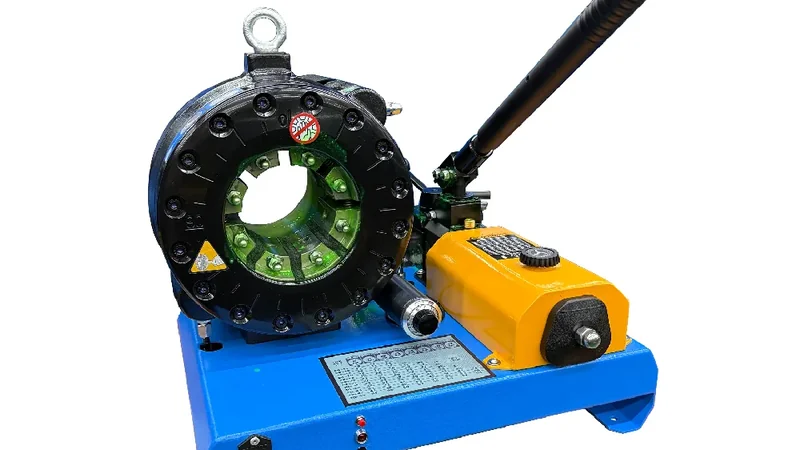
Step 1 — Build the Repair List First
The repair list decides tonnage, die system, and whether skiving is required. A common mistake is to size the machine for the largest hose the truck might see once a year. That logic pushes the buyer into a heavy cordless unit when a lighter 12V unit would do the daily work better.
| Repair list variable | What it tells you |
|---|---|
| Hose types (2SN, 2SC, 4SH, AC barrier) | Die system; skiving requirement. |
| Hose sizes by frequency | Minimum die set; dominant sizes get dedicated dies. |
| Working pressure classes | 60-ton vs 200-ton tonnage requirement. |
| Fitting families | One or multiple systems. |
| Special assemblies (90° elbows, AC) | Whether a standard portable is sufficient. |
| Largest hose on the truck's target equipment | The tonnage ceiling for the machine. |
A typical service-truck repair list shows 80% of assemblies within 1/4" to 1" 2SN/2SC, which is well within an 80-ton portable's capacity. The remaining 20% — a 1-1/4" 4SP or a 1-1/2" 4SH spiral line — drives the tonnage decision. If that 20% is rare and the customer can wait, an 80-ton unit is the right choice. If the truck services mining or heavy construction where 1-1/2" 4SH is weekly work, step up to a 137-ton or 200-ton cordless.
Step 2 — Choose the Power Route
The power route is where truck reality meets hydraulic force. Hydraulic crimping stores a large amount of energy in a small cylinder, and that energy has to come from somewhere. Each power route has a clear cost and a clear ceiling.
| Power route | Typical tonnage | Strengths | Limits | TRC examples |
|---|---|---|---|---|
| 12V vehicle-powered | 60–80 ton | Runs from the truck's starter battery with the engine running; no separate battery to manage. | Tonnage ceiling; about 40–60 crimps per session before voltage sag. | TRC P18CS, TRC P20CS |
| 24V vehicle-powered | Up to 200 ton | Higher sustained current; suitable for heavy trucks and equipment with 24V systems. | Only works where a 24V system is available; not common on pickups. | For heavy-truck fleets. |
| Battery-powered (cordless) | 80–200 ton | No vehicle dependency during the crimp; runs anywhere on site; higher peak current. | Battery management; spare battery required for sustained work; electronics sensitive to heat and dust. | TRC P20CSD (137 ton CNC cordless), TRC P32CS (200 ton cordless) |
| Dual-power (electric + battery) | 95 ton | Workshop mains for normal work; battery for field calls; one machine covers both. | Two power systems add weight and a second failure mode. | TRC P18XL |
| Hand-pump | 6–95 ton | No electricity of any kind; works in any environment; lowest failure mode. | Slow cycle; operator fatigue limits daily volume; usually a backup, not a primary. | TRC P10HP, TRC P16HP, TRC IN2 |
For most service-truck applications on pickup or medium-duty chassis, a 12V vehicle-powered portable (80 ton) or a cordless unit is the dominant choice. We recommend 12V for crews whose truck is always running during the crimp, and cordless for crews who work away from the truck at the equipment.
Total Carried Weight: The Number Most Buyers Miss
Manufacturers quote machine weight. Buyers compare machine weight. Both miss the point. The number that matters is total carried weight, which includes the machine, the die set in its rack, hydraulic oil, the hose inventory, fittings, cutting and cleaning tools, and the mounting hardware. That total is what the truck payload and the operator's back have to handle.
| Configuration | Machine weight | Total carried weight (with kit) |
|---|---|---|
| Manual plier-type tool | 1–3 kg | 2–5 kg |
| Compact 12V portable (TRC P20CS, 80 ton) | ~55 kg G.W. | 80–110 kg |
| Cordless portable (TRC P32CS, 200 ton) | ~350 kg G.W. | 400+ kg (typically slide-mounted) |
| Hand-pump portable (TRC P16HP, 95 ton) | ~34 kg G.W. | 55–75 kg |
A 12V portable with a minimal kit lands around 80–110 kg. The truck's payload and the mounting hardware have to handle the total, not just the machine. We have seen crews buy an 80-ton unit and then discover the truck bed cannot take the mounting tray plus the die rack plus the hose coils without exceeding payload. Calculate the total before specifying the machine.
Workpiece Access: The Elbow-Fitting Problem
A portable unit that cannot reach the workpiece is useless, no matter how good its crimp quality is on the bench. The most common access problem is the 90° elbow fitting. The fitting stem sticks out perpendicular to the hose axis, and the die head has to accept that stem without hitting it.
| Access problem | What it means | How to verify before buying |
|---|---|---|
| 90° short elbow | Die opening has to clear the elbow body during closure. | Check the master die opening depth and the segment side clearance. |
| 45° elbow | Less restrictive than 90° but still needs clearance. | Same check as above. |
| Long elbow or jump fitting | Hose enters the die at an angle; die length matters. | Confirm die length covers the crimp band with the fitting stem protruding. |
| Installed line on equipment | Machine has to load onto the line, not the line onto the machine. | Confirm the die head opens wide enough to load over an existing assembly. |
Our opinion is direct: if the truck's repair list includes more than occasional elbow fittings, the die-head geometry has to be confirmed before purchase, not after. The TRC P20CS series has a generous die opening that handles most 90° short elbows within its tonnage class; the TRC P32CS handles the larger elbow bodies on 1-1/2" to 2" spiral assemblies. For trucks that primarily do straight-stub work, any portable in the tonnage class will fit.
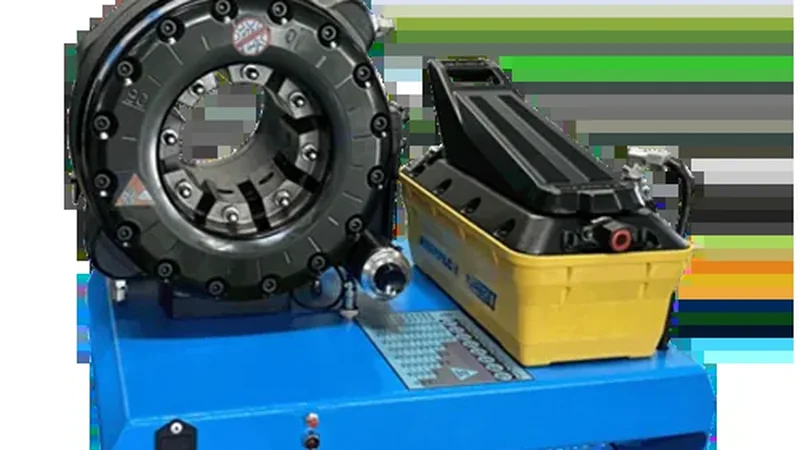
TRC Portable Lineup
TRC's portable category covers 12V vehicle-powered units, cordless battery units, dual-power units, and a non-electric backup. The lineup is built so that a buyer can move up in tonnage without changing the die system or the operator routine.
| Model | Tonnage | Power | Key selling points | Strong markets |
|---|---|---|---|---|
| TRC P18CS | 80 ton | 12V | Relatively light, vehicle battery powered, push-button operation. | Europe, North America, South America. |
| TRC P20CS | 80 ton | 12V | Simple construction, vehicle battery powered; popular with customers selling hydraulic solutions or service trucks. | Europe, North America, South America. |
| TRC P20CSD | 137 ton | 12V + CNC | CNC, multiple crimp modes, full crimp data logging; for professional mobile service with short-batch production needs. Cycle time 7.2 s. | Professional mobile service. |
| TRC P18XL | 95 ton | Dual (workshop electric + 12V/24V battery) | Workshop mains in normal use; battery for emergency field work. | Turkey, Eastern Europe, Russia. |
| TRC P32CS | 200 ton | Battery | Simple construction; reaches 2" 4SH hose on a cordless platform. | Professional service; heavy truck fleets. |
| TRC IN2 | Non-electric | Hand-pump | No power required; moderate weight; simple construction; low failure rate; for workshops and individuals with large-pipe needs. | Global inquiries. |
| TRC P10HP | 10 ton | Hand-pump | Compact hand pump for small-diameter hose and tubes; zinc-nickel alloy plating; 720-hour salt-spray tested. | Russia, Middle East, mobile A/C. |
See the portable hydraulic hose crimper category for the full list. Our recommendation for a first portable on a pickup service truck is the P18CS or P20CS — the 80-ton 12V class covers the majority of service-truck repair lists at the lowest weight and complexity. Step up to the P20CSD only if the crew needs crimp data logging for warranty work, and to the P32CS only if the target equipment routinely runs 1-1/2" to 2" spiral hose.
Field Inspection: Don't Skip It
Field crimping has the same measurement requirements as workshop crimping. The fact that the crimp was made on a truck does not lower the acceptance standard. If anything, field work raises the standard because the downstream cost of a callback is higher.
| Check | Tool | Frequency |
|---|---|---|
| Crimp diameter | Caliper (0.02 mm) at three positions, 120° apart | Every first piece; sample thereafter. |
| Visual | Operator inspection | Every assembly. |
| Cleanliness after cutting | Visual; projectile clean if required | Every assembly. |
| Insertion mark | Paint marker applied before crimp | Every assembly; verify mark has not moved after crimp. |
| Working-pressure leak test | On the equipment, at operating pressure | First assembly of every hose size on every job. |
Discipline on the first-piece check is what separates a field crew that produces defensible assemblies from one that produces callbacks. We tell every new mobile-service buyer to invest in a calibrated caliper and a paint marker before buying spare dies.
Frequently Asked Questions
Are battery-powered portable hose crimpers reliable in the field?
Yes, within their tonnage class and with a disciplined battery routine. A 12V vehicle-powered unit produces about 40–60 crimps per engine-running session before voltage sag becomes an issue; a high-capacity lithium cordless reaches about 200 crimps per charge. Carry a spare battery and a charge cable, and store the battery out of direct sun in summer.
What tonnage portable do I need for my service truck?
Most service-truck repair lists fall within the 60–80 ton range (1/4" to 1" 2SN). For larger hose or spiral above 1", a higher-tonnage portable like the TRC P20CSD (137 ton) or TRC P32CS (200 ton) is required. Size for the work you actually do, not the largest hose you might see once a year.
How much does a portable hose crimping tool setup weigh?
A minimal 12V portable kit is about 80–110 kg total, including the machine, die rack, hose coils, fittings, and tools. A larger cordless kit with a full hose inventory can push past 400 kg and usually requires a slide-mount tray. The truck's payload and the operator's safe handling capacity both have to accommodate the total.
Can a portable unit crimp 90° elbow fittings?
Some can, some cannot. The die opening geometry has to accept the fitting stem perpendicular to the hose axis. If your repair list includes elbows, confirm the die opening depth and segment side clearance before buying. The TRC P20CS series handles most 90° short elbows in its tonnage class; the TRC P32CS handles larger elbow bodies on spiral hose.
What is the best first portable for a pickup service truck?
For most pickup service trucks running 1/4" to 1" 2SN work, the TRC P18CS or TRC P20CS at 80 ton, 12V, is the right starting point. It covers the majority of repair lists at the lowest carried weight. Move up in tonnage only when the repair list demands it.
References and technical boundaries
- Wikipedia — Hydraulic machinery. Reference for hydraulic force generation and Pascal's principle as applied to portable hydraulic tools.