A hydraulic AC hose crimper uses fluid pressure to move the tooling. Manual-pump and powered machines can both apply the force needed to form a sleeve. The practical difference is how pressure and movement are supplied, controlled and repeated.
Finished assembly quality still depends on the correct hose, fitting, sleeve, die and target dimension.

The pump is only one part of the cycle
A technician can complete a few assemblies with a hand-powered hydraulic tool, but a growing queue makes operator effort and setup time visible. The decision to move to powered equipment should follow workload and workpiece access, not the assumption that hydraulic power alone guarantees compatibility.
When a manual pump makes sense
A manual hydraulic AC hose crimping tool can suit low-frequency repair, off-grid work or a shop that needs a compact secondary tool. It keeps the power system simple, but the operator supplies the pumping effort and controls the work sequence.
Check:
- total tool and pump weight;
- stable mounting during use;
- hose length between pump and head;
- die-change method;
- elbow and fitting clearance;
- how the final setting is reached and recorded.
When powered operation earns its space
A powered AC hose pipe crimping machine is easier to justify when the shop makes repeated assemblies, changes sizes often or needs consistent workflow between operators. Electric or other powered operation can reduce physical effort and simplify return movement.
Do not convert machine closing time directly into finished assemblies per hour. Cutting, cleaning, fitting insertion, die changes and inspection remain part of the cycle.
Power source does not decide compatibility
Hydraulic pressure follows the same physical principle in both routes. A powered pump does not make an incorrect die compatible, and a manual pump does not make a correctly specified assembly inferior.
For either type, confirm:
- Hose and fitting system.
- Uncrimped sleeve OD.
- Die profile and working range.
- Target finished dimension.
- Inspection and validation method.
Buyer question: which is more reliable?
Reddit and buyer-forum discussions repeatedly raise the manual-versus-electric question. Reliability cannot be decided from the pump type alone. Review seals, connections, valve control, tooling condition, service access and the operator’s ability to repeat the specified setting.
Manual equipment reduces dependence on electricity. Powered equipment reduces repetitive pumping. Both need maintenance and correct crimp data.
Select the operating route after the component route
TRC’s air conditioning hose crimper page covers the dedicated machine category. Send your component list and expected workload. The recommendation should explain not only what can be crimped, but also why the proposed power and control method fits the work.
Compare the two power paths at the workbench
| Work step | Manual hydraulic route | Powered hydraulic route |
|---|---|---|
| Pressure generation | Operator cycles a hand pump | Motor or powered pump drives the hydraulic circuit |
| Work pace | Suits short, intermittent runs | Reduces effort during repeated runs |
| Site needs | Stable support and room for pump hose | Stable bench, correct electrical or air supply |
| Control risk | Operator can stop frequently, but pumping varies | Repeat controls can help, but settings still need verification |
| Main selection question | Can the operator complete the full cycle safely? | Does the workload justify the machine and utilities? |
Neither route removes the need to identify the component system. The hydraulic circuit supplies movement to the tooling; it does not know whether the sleeve and fitting belong together.
Put measured workload ahead of convenience
Count accepted assemblies, not ram movements. Time a normal job from the moment the hose and fitting reach the bench until the finished assembly has been measured and released.
| Observed task | Manual route changes it? | Powered route changes it? |
|---|---|---|
| Component identification | No | No |
| Cutting and insertion marking | No | No |
| Die retrieval and change | Depends on tool design | Depends on tool design |
| Closing and return | Operator pumps and releases | Pump and controls move the head |
| Finished measurement | No | No |
| Job record | No | No |
Use accepted pieces per hour = 60 ÷ observed minutes per accepted piece. If a manual trial takes 8 minutes and the powered trial takes 6.5 minutes, the calculated rates are 7.5 and 9.2 pieces per hour. Those numbers are an example of the method, not measured TRC production data.
The result can be surprising. A shop that spends four minutes identifying mixed fittings gains less from powered closing than a shop running one documented batch all afternoon.
Shop-floor rule: Move to powered operation when pumping effort, return time or repeat setup is the measured constraint. Do not buy it to compensate for missing component data.
Check the hydraulic path before judging reliability
Pascal’s principle explains why pressure applied to a confined fluid can transmit force through the hydraulic circuit. It does not tell you whether a specific pump, hose, valve or head is in good condition.
For a manual system, examine the reservoir, pump lever, release valve, connecting hose, couplings and head return. For a powered system, add the motor, electrical controls, pump noise, oil leaks and destination power data.
| Symptom during a trial | Possible area to inspect | Do not assume |
|---|---|---|
| Head creeps before reaching the setting | Valve, seal or circuit condition | The die is too large |
| Slow or incomplete return | Return mechanism, oil condition or obstruction | More pressure will fix it |
| Different results between operators | Setting method, pumping endpoint or measurement | Manual power is inherently inaccurate |
| Motor runs but head movement is weak | Pump, valve, oil level or load | Electrical power guarantees full force |
Follow the machine manual for service. Never search for a hydraulic pinhole leak with a hand.
Keep P70C inside its documented application
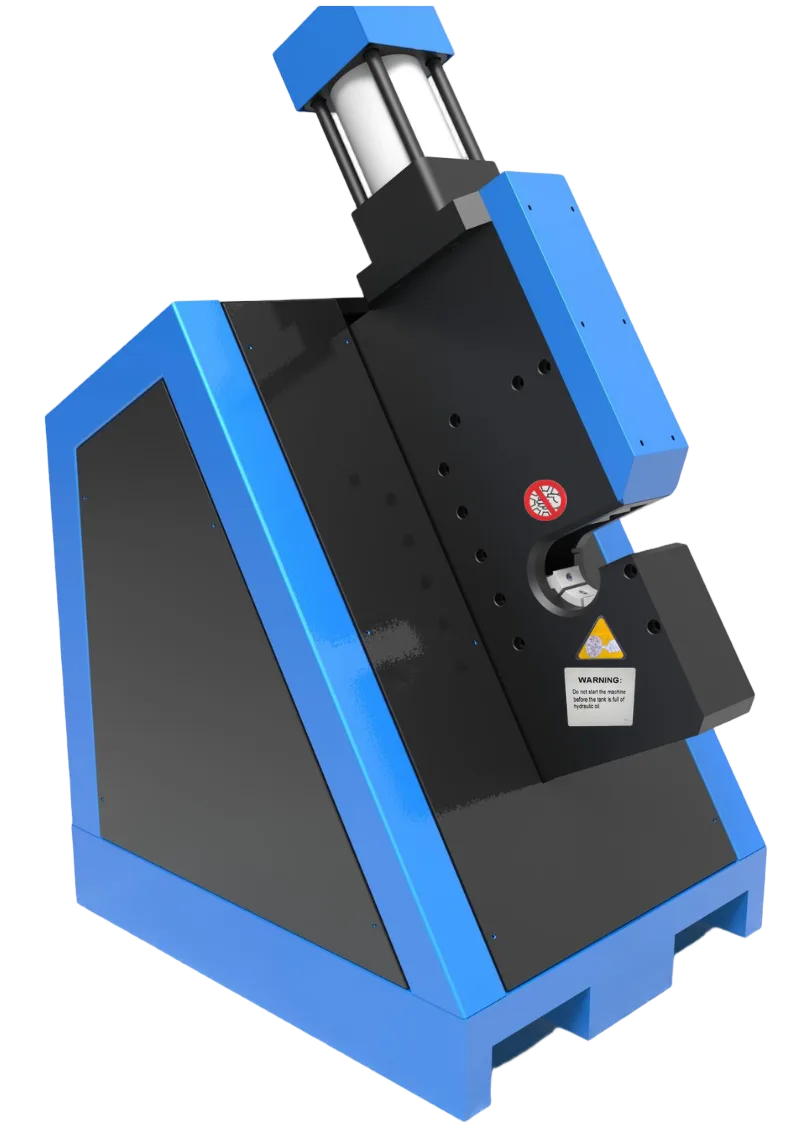
The TRC product record identifies the P70C A/C hose machine with a 0.16–2 inch crimp range and 20-ton maximum force. It also states that the model is not for hydraulic-oil hose.
That makes P70C a useful example of a dedicated route. It is not evidence that every sleeve between those nominal sizes has a supported die. Ask for a die schedule tied to the refrigerant-hose components you will use.
| Buyer question | Evidence needed |
|---|---|
| Does my sleeve fit the head? | Uncrimped sleeve OD, length and fitting geometry |
| Is there a suitable die? | Die identification, profile and working range |
| Can I repeat the setup? | Adjustment method and first-piece record |
| Can it crimp hydraulic hose too? | No: the P70C product record excludes hydraulic-oil hose |
Plan the bench around awkward fittings
A long rigid tube or elbow close to the sleeve can be harder to load than the largest straight fitting. Photograph the part against a ruler and record the distance from the sleeve to the first bend.
The machine needs space for entry, alignment, closure and removal. A compact head can still be inconvenient if the pump hose pulls it off line or the operator has nowhere to support the rigid tube.
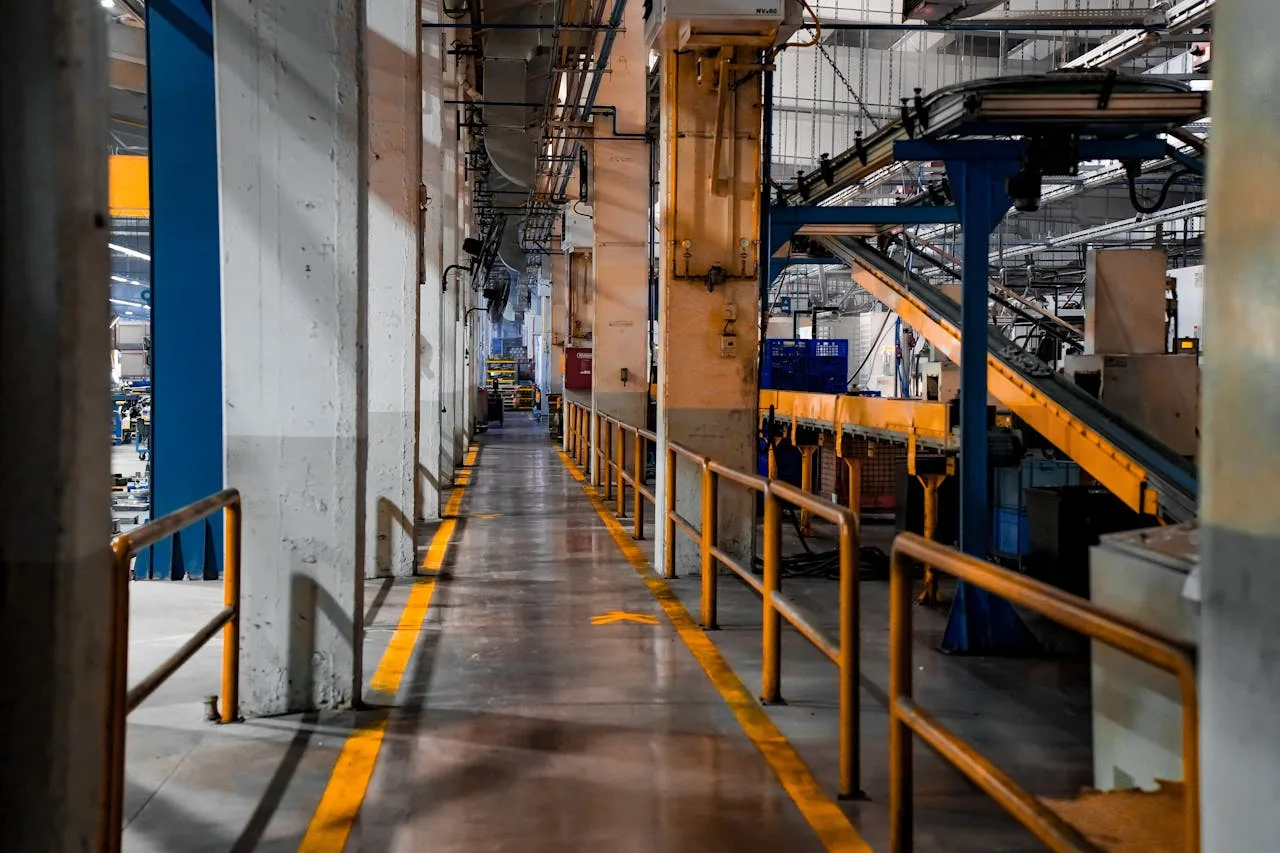
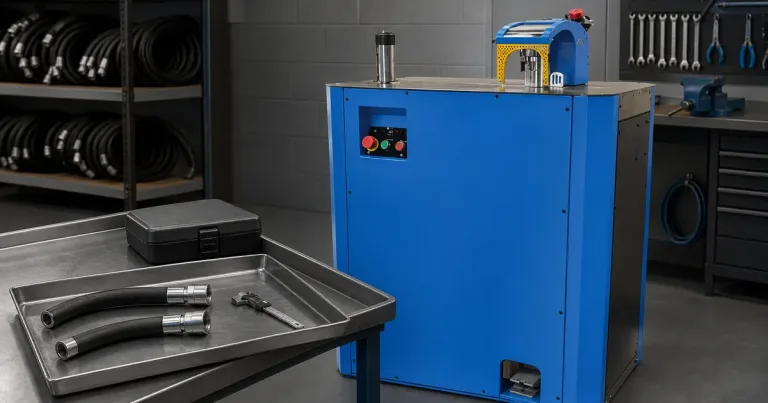
The bench photo shows a hydraulic-hose work area, so use it as a layout reference only. Refrigerant hose still needs its own components, tooling and service procedure.
Reliability is a maintenance question
For a manual unit, inspect the pump connection, hose, seals, release valve and return action. For a powered unit, add the motor, switchgear, controls and power specification. On both, keep the die seat clean and examine tooling for damage or uneven wear. A machine that closes reliably but produces an out-of-spec crimp has not completed the job.
When comparing workshop throughput, observe a full size change. Count die retrieval, tool setup, workpiece loading, crimping, measurement and return. A powered head saves little if the operator spends most of the shift searching for unidentified dies.
Compare ownership cost with your own inputs
Manual equipment has a lower utility burden, but operator time is not free. Powered equipment adds motor, controls and electrical requirements, but it can reduce repetitive pumping.
Build the comparison with:
annual operating hours = expected accepted assemblies × observed minutes per assembly ÷ 60
Then add machine, required dies, bench, measurement tools, maintenance allowance and operator time. Do not copy a payback percentage from another shop. A mobile technician making five repairs a month and a production bench making 50 assemblies a day will reach different answers with the same machine prices.
SAE J3062 provides hose-requirement context, while SAE J2064 addresses coupled automotive refrigerant hose assemblies. Neither source turns pump type into component compatibility.
Work through one manual-to-powered decision
Suppose a shop records 25 accepted assemblies in a normal week. Identification, cutting, insertion and measurement take five minutes per piece. Manual pumping and return add two minutes; a powered trial reduces that portion to 45 seconds.
The manual route requires 25 × 7 = 175 minutes. The powered route requires 25 × 5.75 = 143.75 minutes. The illustrative saving is 31.25 minutes per week, before setup, maintenance and changeovers.
That result does not automatically justify a new machine. The shop should multiply the measured time by its own labor cost, then add growth, operator fatigue and peak queue exposure. At 250 accepted assemblies per week, the same per-piece difference becomes much more important.
Now change the scenario. If the operator spends another four minutes searching for fittings and dies, both routes perform badly. Fix identification and workstation layout first.
Specify the power and control details
A powered quotation should state voltage, phase and frequency for the destination. It should also explain how the operator sets the result, how the head returns and what happens after power loss.
For a manual route, ask for pump type, connecting hose, couplings, mounting and the release method. Confirm the total carried system, not only the head weight.
| Technical file item | Manual system | Powered system |
|---|---|---|
| Operating instruction | Pump, release and return | Controls, setting and return |
| Hydraulic drawing | Useful for service | Useful for service |
| Electrical drawing | Usually not applicable | Required for destination setup |
| Wear parts | Seals, hose and couplings | Seals, pump and control parts |
| Fault record | Loss of pressure or return | Add motor and control faults |
Train operators on the same acceptance point
Manual and powered teams should release the same finished component row to the same measurement rule. Do not allow one operator to stop by feel while another relies on a control value.
During training, make one accepted first piece and one deliberately rejected visual sample without pressurizing or installing it. Mark the defect and explain which process record exposes it. The exercise gives operators a concrete stop condition without presenting a bad hose as usable.
Choose the secondary machine for a real reason
Some shops keep a manual hydraulic AC hose crimper as backup after installing a powered bench machine. That can be sensible when the manual system uses documented tooling and covers the high-frequency component rows.
The backup plan should state where it is mounted, which pump and dies belong to it and how the setting is transferred. A manual head stored without identified dies is equipment inventory, not a recovery plan.
Run the backup process periodically on a known non-production sample, following the machine and component instructions. Record any seal, hose or return problem before the main machine fails.
Ask the operator after the trial
Purchasing sees price and specifications. The technician sees whether the elbow can be loaded, whether the die is easy to identify and whether the measurement can be made without moving the work twice.
Use a short operator review with four fields: awkward fitting access, die change, setting clarity and safe body position. A powered machine that wins the time study but forces poor workpiece handling is not the better route.
Keep the final recommendation short
State the supported component rows, normal weekly workload, chosen power route, included dies, utilities and unresolved work. Attach the time study and sample record behind that page.
The decision should read plainly: “powered bench machine for the four documented high-frequency rows; manual system retained for field backup; two special elbows remain outsourced.” That is more useful than calling one format generally superior.
Review that statement after the first month. If the powered machine saves little because preparation still controls the cycle, improve the bench before buying another head. If pumping fatigue appears during peak work, the observed data supports the change.
Keep the timing sheet, component map and operator comments together. They explain the power choice to purchasing and prevent the next buyer from repeating the same trial.
Where hydraulic power helps, and where it does not
Hydraulic actuation matters when the operator needs controlled force in a compact head, but the pump does not decide whether the assembly is correct. Imagine a mobile technician who repairs agricultural and construction equipment and occasionally replaces cab A/C lines. The truck has no guaranteed mains supply, so a hand-pumped unit is attractive. The business case works only if the head, dies and component data cover the actual refrigerant fittings carried on the truck.
We would qualify that setup with three trials. First, load the straight fitting that represents the highest normal sleeve OD and record whether it seats squarely. Second, repeat the same assembly several times and compare the specified finished measurement, not just the handle effort. Third, load the most awkward elbow and confirm there is room for the tube and fitting without side-loading the die area.
For a bench shop doing repeated batches, the calculation changes. A powered pump removes dozens of manual strokes and makes the endpoint easier to approach consistently, but it also adds electrical supply, controls and maintenance. If component changes dominate the day, better identification and die storage may save more time than a faster closing cycle.
Engineering note: We do not use pump pressure or advertised force as a substitute for finished-part inspection. Pressure tells you what happened in the hydraulic circuit; the component data and measured sleeve tell you whether the assembly reached its required condition.
Before ordering, send the supplier a component table and ask for an identified tooling response. That exchange exposes compatibility gaps before they become field repairs.
Frequently asked questions
AC hose crimping tools: what works for automotive A/C lines?
Use a documented refrigerant-hose system and a tool with identified dies for its sleeves. Manual hydraulic equipment can suit occasional controlled repairs. Regular batches make stable powered operation easier to justify.
Is a hand-pumped crimper reliable enough for field repair?
It can be, provided the head is secure, the components and die are documented, the pump reaches a repeatable endpoint and the finished piece is measured. The manual pump removes dependence on electricity; it does not remove process controls.
Compare a complete operating cycle
Use the A/C hose crimper category to review the dedicated route, then send TRC the component schedule, volume and site utilities. Ask for the proposed operating sequence as well as the machine model.