Hose Crimping Kit and Workshop Equipment Checklist
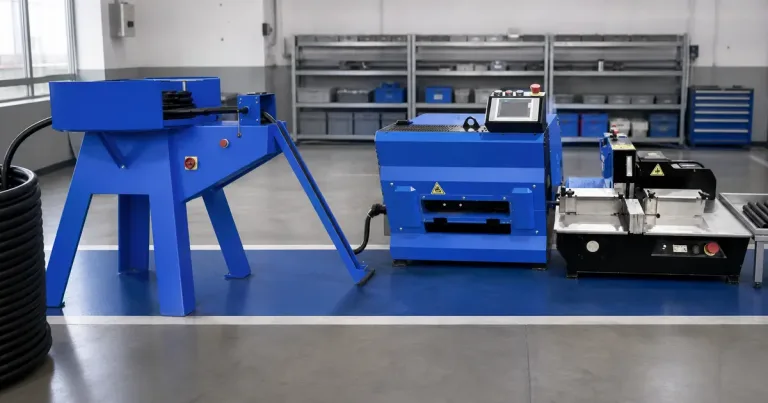
A hose crimping kit is not a machine in a case. It is a miniature assembly line: storage, cutting, cleaning, fitting insertion, crimping, measurement, and records. Buyers who order “a kit” and receive only a crimper and a few dies usually discover the missing pieces on the first day of production, when they have no way to cut the hose square, no way to clean it after cutting, and no way to verify the finished crimp.
This article explains what a working kit actually contains, the assembly-line and lean-manufacturing principles that drive the layout, and TRC kit configurations that match each workload.
A Kit Is an Assembly Line in Miniature
Wikipedia defines an assembly line as a manufacturing process where the unfinished product moves from workstation to workstation. The core principles — division of labor (each station does one task), workstation design (minimize operator motion), and line balancing (respect precedence and cycle time) — apply directly to a hose assembly kit.
| Principle | Application to a hose kit |
|---|---|
| Division of labor | Each station (storage, cutting, cleaning, insertion, crimping, measurement, records) does one task. Combining stations is possible, but the seven tasks still have to happen. |
| Workstation design | Each station is positioned so the operator’s motion is minimized. The hose travels the least possible distance between stations. |
| Line balancing | The kit is balanced when no single station is a bottleneck. The slowest station limits the output of the whole kit. |
| Bottleneck identification | If the crimper cycle is 8 seconds but the cleaning step takes 30 seconds per hose, cleaning is the bottleneck — not the crimper. |
Lean manufacturing adds the concept of waste elimination. Wikipedia identifies seven categories of waste (muda): inventory, waiting, excess motion, defects, overproduction, overprocessing, and transportation. For a hose kit, the most relevant wastes are:
| Waste | In a hose kit |
|---|---|
| Waiting | Operator idle while the die change is done. |
| Excess motion | Walking between a poorly-located cutter and crimper. |
| Defects | Rework from a bad crimp; contamination from a skipped cleaning step. |
A well-designed kit eliminates these wastes by putting the right equipment at each station and sequencing them so the material flows in one direction.
The Seven Stations of a Working Kit
| Station | Equipment | Why it matters |
|---|---|---|
| 1. Storage | Hose reels or coils; fitting bins; ferrule bins. | Hose stored dry, away from UV and heat, tagged with part number and date. Aged hose crimps fine but fails early. |
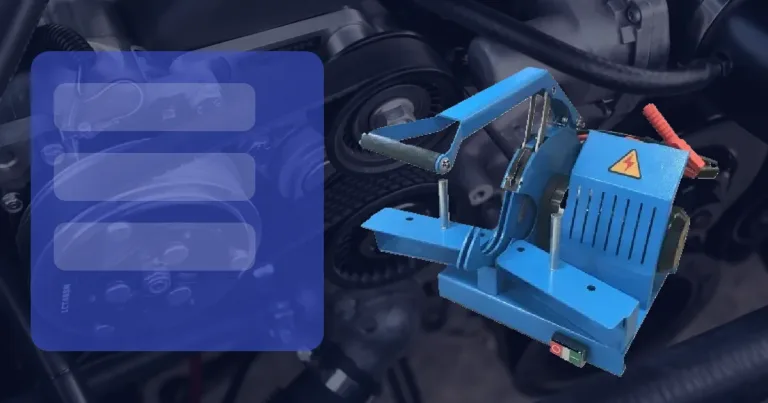
| 2. Cutting | A hose cutter — bench-mounted or portable. | A square, clean cut is required for the fitting to seat correctly and for the ferrule to align. |
| 3. Cleaning | Air nozzle with inline filter, or projectile cleaning kit; caps and plugs. | Cutting produces debris inside the hose. If the debris is not removed, it enters the customer’s hydraulic system. |
| 4. Fitting insertion | Bench vise or clamp; skiving tool if the fitting system requires it. | The stem has to bottom against the fitting shoulder. The insertion depth is marked on the hose cover and checked again after crimping. |
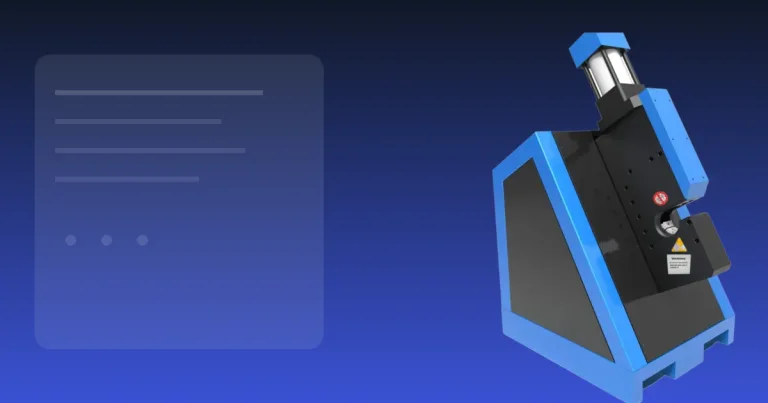
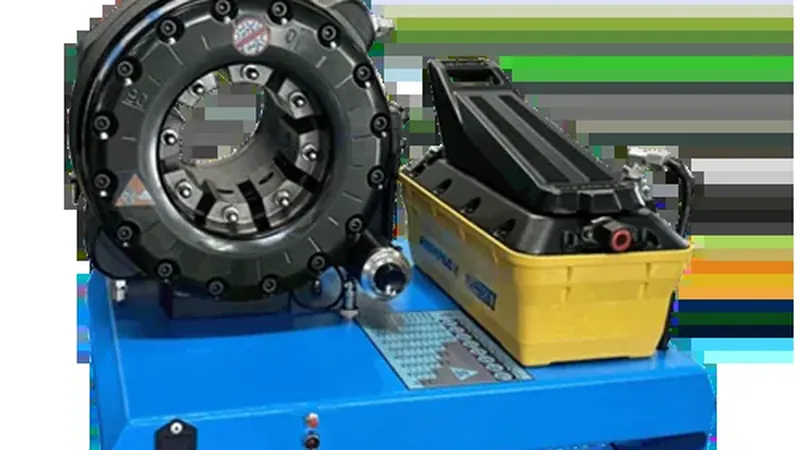
| 5. Crimping | The crimper + matched die set. | The crimper executes the validated crimp instruction. The die set has to match the hose + fitting system. |
| 6. Measurement | Caliper (0.02 mm); go/no-go gauge for standard sizes. | Crimp-diameter measurement is the primary acceptance check. Without it, the assembly is a guess. |
| 7. Records | Batch record template; assembly labels; crimp data sheets. | Traceability for each assembly. ISO/TS 17165-2:2018 expects hose assemblies to be selectable, traceable, and replaceable. |
A kit that has all seven stations is a working setup. A kit that has only the crimper is a machine with missing support equipment.
Station 3 — The Cleaning Step Most Kits Miss
The cleaning station is the one most commonly omitted from a kit, and it is one of the most expensive to skip.
ISO/TS 18409:2018 defines the sampling method for verifying hose assembly cleanliness. It does not set a universal pass/fail level, but it gives a defensible way to measure the result. Published manufacturer data shows projectile cleaning reaching ISO 4406 cleanliness codes around 13/10 on properly prepared assemblies.
| What happens when cleaning is skipped | The downstream cost |
|---|---|
| Rubber dust and wire fragments from cutting remain inside the hose. | Debris enters the customer’s hydraulic system at first pressurization. |
| If an abrasive cutter was used, abrasive particles are also present. | Abrasive particles accelerate pump and valve wear. |
| The fitting is crimped over the debris. | The debris is sealed inside the assembly, committed to the customer’s system. |
| The system runs for a while, then the pump fails early. | The root cause is contamination from the skipped cleaning step, not the crimp. |
Once the fitting is crimped on, the inside of the hose is sealed. Any debris inside is committed to the customer’s hydraulic system. The cleaning step cannot be recovered later.
The Cold-Weld Principle — Why the Crimper Station Matters
Wikipedia’s article on crimping explains that crimping joins ductile materials by deforming them past their yield point to create cold-weld tension and static friction. The joint is mechanically stronger than soldered or brazed joints because no alloy is used. The die geometry determines the final crimp profile, and the compression force must be neither too light (leaving voids) nor too strong (causing deformation damage).
This is why the crimper station cannot operate alone. It depends on the upstream stations having produced a clean, square-cut, correctly-inserted hose, and it depends on the downstream measurement station verifying the result. The kit is a system, not a collection of independent tools.
TRC Kit Configurations by Workload
TRC’s catalog covers the stations a working hose assembly kit needs. Configurations below are illustrative; each kit is configured per order based on the customer’s hose mix.
| Workload | Crimper | Cutter | Cleaning | Skiving |
|---|---|---|---|---|
| Field / low volume | TRC P10HP or TRC P16HP | TRC C250AC portable | Air nozzle with filter | TRC SH50 manual |
| Workshop, mixed 1/4″–1″ | TRC P20 or TRC P20S | TRC C300 | Projectile kit | TRC S50 |
| Production, mixed 1/4″–2″ | TRC P32A or TRC P32D | TRC C400F | TRC CK50 water wash | TRC S50 |
| Heavy industrial, 2″–4″ R13 | TRC P140 | TRC C520A | Flushing bench | TRC S50 |
Pair with a TRC test machine (mechanical or computer version), TRC G7 hose rack, and TRC ZK100/200 pin pricker for a complete industrial line.
See the hydraulic hose crimper category and the starter kit resource for more.
A Working Scenario — Not a Customer Case
An illustrative scenario. A new hose workshop budgeted for a crimper and dies but overlooked cutting, cleaning, insertion control, measurement, and validation. The missing stations appeared later as rework, contamination complaints, and assemblies that could not be accepted by the customer.
The workshop then added a TRC C300 cutter, a projectile cleaning kit, and a calibrated caliper to the original crimper. First-pass yield improved, and the contamination complaints stopped. The cost of the missing stations, added later, was higher than if they had been specified with the original kit.
The lesson is the assembly-line principle: the bottleneck is often not the crimper. It is the missing station upstream or downstream. Lean manufacturing calls this “defects” waste — rework caused by missing a step in the process.
Frequently Asked Questions
What should be in a hose crimping kit?
Seven stations of equipment: storage (hose and fitting inventory), cutting (hose cutter), cleaning (air nozzle with filter or projectile kit), fitting insertion (vise and skiving tool if required), crimping (crimper + die set), measurement (caliper and optionally go/no-go gauges), and records (batch template and crimp data). A kit with only the crimper is incomplete.
How much does a hose crimping kit cost?
It depends on configuration. Specify the items against your hose mix and quote each component. Contact us through the contact page for a TRC kit quote.
Do I need a cleaning station if I use a blade cutter?
It depends on the cleanliness class required. A blade cutter produces less debris than an abrasive cutter, but it still produces some. For servo, marine, or mining applications, projectile cleaning, water wash, or flushing is usually required.
Buyer question: can I start with a minimal kit and expand later?
Yes, as long as the minimal kit includes the seven core stations in some form. Starting with only the crimper and dies is a false economy; the missing items will be needed on the first day of production. Lean manufacturing calls this “waiting” and “defects” waste — the cost appears later as rework and contamination.
References and technical boundaries
- Wikipedia — Assembly line. Reference for the assembly-line principles applied to a hose kit layout.
- Wikipedia — Lean manufacturing. Reference for the seven wastes and waste elimination applied to kit design.
- Wikipedia — Crimp (joining)). Reference for the cold-welding principle that makes the crimper station dependent on upstream and downstream stations.
- ISO/TS 18409:2018 — Hydraulic hose assembly cleanliness sampling. Defines the sampling method used to verify the cleaning station output.
- ISO/TS 17165-2:2018 — Hydraulic hose assemblies, practices. Supports the traceability expectation for hose assemblies.