
Industrial Hose Crimper for High-Volume Production
An industrial hose crimper is specified by the mix of assemblies it has to produce, the volume it has to sustain, and the changeover profile of the line. A machine that is right for a workshop producing 100 assemblies per day in three hose sizes is wrong for a line producing 2,000 assemblies per day across ten hose sizes — even if the maximum hose size is the same.
The honest framing is this. The machine is one station in a production line. The bottleneck is rarely the crimp cycle. It is almost always changeover, material handling, or first-piece verification. Buying a bigger machine does not solve a changeover bottleneck; it makes the bottleneck more expensive to feed. This article covers how to specify an industrial crimper by production mix, how to apply lean manufacturing principles to the hose workshop, and the TRC models that fit each workload.
An Industrial Hose Crimper Is Specified by Its Mix, Not Its Max
The first question to ask is not "what is the biggest hose I will crimp?" but "what does the mix of hoses I will crimp look like over a typical shift?" The mix drives machine count, die storage, and CNC vs mechanical control.
| Mix profile | Typical TRC model |
|---|---|
| 90% braided hose up to 1", 10% spiral up to 1" 4SH | TRC P20 or TRC P20D |
| Mixed braid up to 1-1/2", some spiral | TRC P32 or TRC P32A |
| Dominant 1-1/2" to 2" spiral | TRC TRC120L or TRC P140 |
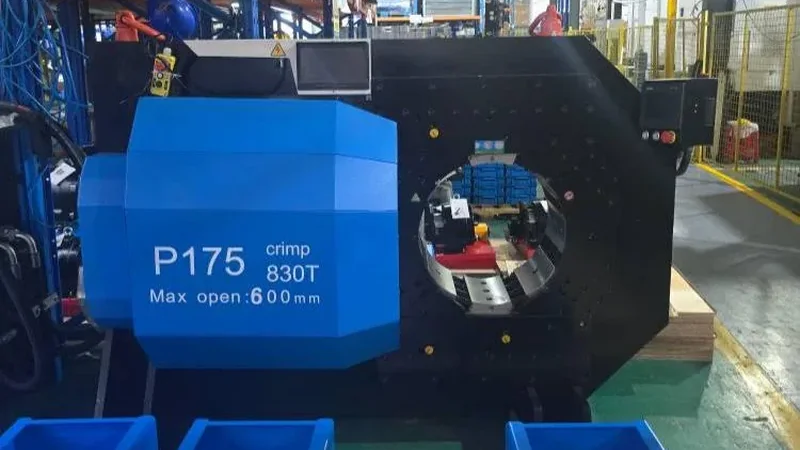
| Mining-grade 2" to 4" R13 | TRC P160, TRC P165, TRC P175 |
A workshop that runs 90% braided hose does not need an industrial-grade machine. It needs a workshop-grade P20 or P32, sized to the mix, with a die cabinet that covers the range. A workshop that runs 90% spiral hose needs an industrial-grade machine, because the tonnage class and the die geometry are different.
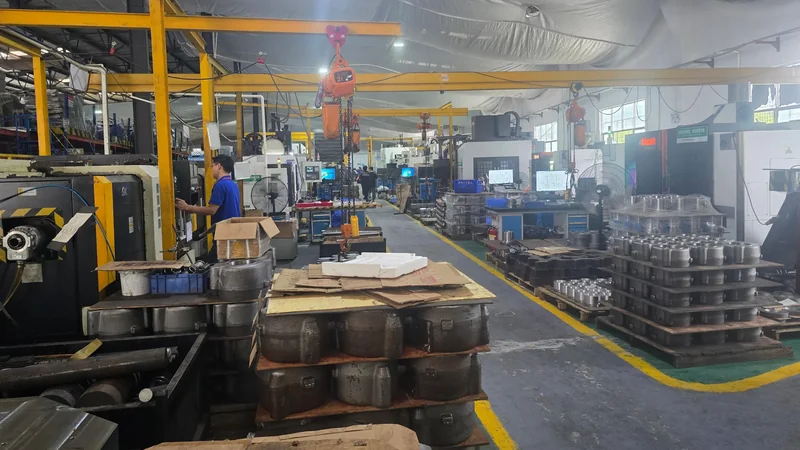
Lean Manufacturing and the Seven Wastes in a Hose Workshop
Lean manufacturing identifies seven wastes (muda) that reduce line efficiency. Every one of them appears in a hose workshop, and most of them show up at the crimper station.
| Waste | How it appears at the crimper | What reduces it |
|---|---|---|
| Overproduction | Crimping more assemblies than the next station can consume | Pull scheduling by downstream demand |
| Waiting | Operator waits for die change, first-piece check, or material | Quick-change dies, parallel stations |
| Transport | Moving cut hose across the shop to the crimper | Line layout: cut, clean, skive, crimp in sequence |
| Over-processing | Re-crimping assemblies because the first piece was not measured | First-piece discipline; caliper at the bench |
| Inventory | Stacked WIP between stations | One-piece flow or small batch |
| Motion | Operator walks to the die cabinet multiple times per changeover | Die storage at the machine; die rack |
| Defects | Under-crimped or over-crimped assemblies | Verified target diameter; CNC for traceability |
We recommend mapping the seven wastes on the actual shop floor before buying a machine. The map shows where the next investment belongs. In most workshops we have reviewed, the crimper is not the bottleneck — die changeover and first-piece verification are.
Bottleneck Theory: Changeover vs Cycle Time
The Theory of Constraints says every production line has exactly one bottleneck at any time, and throughput is governed by that bottleneck. Increasing capacity anywhere except the bottleneck is wasted money.
| Bottleneck type | Symptom | Fix |
|---|---|---|
| Cycle time | Assemblies queue at the crimper; operator never waits | Higher tonnage or faster cycle machine |
| Changeover | Machine idle while dies swap and settings adjust | Quick-change dies; CNC with stored programs |
| First-piece verification | Operator stops to measure and re-set | Dedicated QC station; caliper at the bench |
| Material handling | Cut hose piles up; finished assemblies pile up | Line balancing; cell layout |
Most workshops that complain about crimper throughput are actually bottlenecked on changeover. The fix is not a bigger machine. The fix is faster die swap, stored CNC programs, and a first-piece check that does not require the operator to leave the station.
Line Balancing: A Capacity Worksheet
Line balancing means distributing work so that every station in the cell takes roughly the same time. For a hose assembly cell, the stations are: cut, clean (if required), skive (if required), crimp, first-piece check, and label. The table below is a worked example for a typical small-batch workshop.
| Station | Time per assembly | Comment |
|---|---|---|
| Cut | 15 s | Powered saw; manual load |
| Clean | 10 s | Blow-out or solvent wipe |
| Skive | 20 s | Only on interlock fittings |
| Crimp | 8–12 s | Workshop machine at full cycle |
| First-piece check | 30 s on first piece, 5 s thereafter | Caliper at three positions |
| Label and rack | 10 s | Traceability tag |
In this example the crimp station runs at 8–12 seconds per assembly, but the line balance is governed by skiving (20 s) and first-piece check (30 s on the first piece). Adding a faster crimper does not help. Adding a second skive station, or a quick-change die system, does.
The honest answer on capacity numbers: any "assemblies per hour" claim is meaningless without conditions. Honest output numbers come with the hose mix, the die change profile, and the first-piece verification discipline attached.
TRC Industrial Lineup by Tonnage Class
| Model | Tonnage | Hose range | Key selling points | Strong markets |
|---|---|---|---|---|
| TRC TRC120L/H | 245 ton | Up to 2" R13 / 3" 2SP | Integrated design; CNC version (120L) and mechanical version (120H). Visually similar to some well-known industrial brands; popular with European and large Chinese customers. Often the first choice for individual shops opening for the first time. | Europe, large Chinese customers |
| TRC P120 | 280 ton | Up to ~3" R13 | Separate power unit; higher tonnage than 120L. | Turkey, Eastern Europe |
| TRC P120C | 200 ton | Special C-port for irregular and AC pipe | Design-forward; crimps irregular tubes and AC pipes. | Russia, Middle East |
| TRC P140 | 320 ton | Up to 3" R13 + industrial pipe | Separate power unit; crimps both hydraulic and industrial pipe. Strong fit for large hydraulic and industrial pipe producers. Pair with test machine, cutter, skiver for full line. | Europe, Turkey, Brazil, USA |
| TRC P160 | 350 ton | Large-bore industrial | Higher tonnage than P140. | Same as P140 |
| TRC P165 | 500 ton | Same max opening as P160, higher force | Heavy industrial; separate power unit. | Heavy industrial |
| TRC P175 | 830 ton | Every hydraulic size + 15" industrial pipe | Flagship; crimps everything. Mining, metallurgy, marine, aerospace. | Dubai, Canada |
The TRC production line is built in a roughly 5,000 m² facility behind TRC's overseas projects, with CE, SGS, and UL+ISO certification. TRC has served 300+ customers across 50+ countries, including large-scale hydraulic and industrial pipe producers.
Our honest pick for a first industrial machine is the TRC120L. It covers up to 2" R13 in a single integrated frame, the CNC version stores programs per hose and fitting combination, and the market feedback from European and large Chinese customers is consistent. Shops that need to go past 2" R13, or that need to crimp industrial pipe alongside hydraulic hose, should move straight to the P140 or P160.
Tooling and Changeover
Changeover is where mixed-production lines win or lose. The numbers below are typical for a workshop running six to ten hose sizes per shift.
| Changeover factor | What it costs |
|---|---|
| Die swap time | Manual 5–8 min; quick-change 1–2 min. |
| First-piece verification | About 30 seconds per hose size. |
| Setting adjustment | Manual machines may need adjustment; CNC stores programs. |
For mixed production with frequent changeover, CNC models like the TRC P20D, P32D, or TRC120L pay for themselves in reduced setup time. The CNC stores the target diameter, the offset, the speed profile, and the pressure-maintain time per program; the operator recalls the program and runs. On a mechanical machine, the operator re-sets the stop, runs a first piece, measures, and corrects.
Worked Example: Why One Machine Became the Bottleneck
An illustrative scenario. A workshop producing about 120 finished assemblies per day on a single 137-ton TRC P20, with a mix of 1/2", 3/4", 1" 2SN, and occasional 1" 4SH. Die changes averaged 6 per day; cumulative lost time was about 35% of the available crimping window.
The workshop added a second 137-ton TRC P20 dedicated to the dominant 1/2" and 3/4" sizes. Output went to roughly 280 assemblies per day. First-pass yield improved from about 88% to about 95%.
The bottleneck was changeover, not tonnage. The fix was a second machine configured for a narrow die range, not a single bigger machine. This is the line-balancing principle in practice: dedicate capacity to the dominant mix, and free the original machine for the long tail.
Frequently Asked Questions
How many hose assemblies per hour can an industrial hose crimper produce?
It depends on hose mix, die change profile, first-piece discipline, and operator skill. A single-hose-type line can sustain 300+ per hour; mixed lines typically produce 100–200 per hour. Any number without conditions attached is a marketing claim, not a capacity figure.
Do I need a CNC industrial hose crimper?
For mixed production with frequent changeover and traceability requirements, yes. CNC stores the program per hose and fitting combination, which removes the operator judgment from the setting. For single-hose-type production by an experienced operator, a powered hydraulic machine produces equivalent quality at lower cost.
How do I know when to add a second machine?
When changeover time on a single machine exceeds about 25–30% of the available crimping window. The fix is usually a second machine dedicated to the dominant mix, not a single bigger machine. Map the seven wastes first — the bottleneck may not be the crimper.
Buyer question: what size industrial hose crimper do I need for 2-inch R13?
A 200-ton machine is the minimum; 245–320 ton is preferred for sustained production. See our heavy-duty category. Send TRC the hose mix, the dominant sizes, and the target daily volume for a line-balanced recommendation.
References and technical boundaries
- ISO/TS 17165-2:2018 — Hydraulic hose assemblies, practices. Supports the controlled-system principle.
- Wikipedia — Lean manufacturing. Reference for the seven wastes (muda) and line balancing.
- Wikipedia — Theory of Constraints. Reference for bottleneck identification.