Hydraulic Hose Crimping Machine Manual vs Powered Operation
The question of manual hand-pump vs powered is not a question about quality. Both formats produce the same crimp if the die is correct and the first piece is measured. The real question is about workload, operator fatigue, and site constraints — and those are variables that change as a business grows.
This article compares the two formats side by side, on the five axes that actually decide which one fits. The short answer: below about 20 assemblies per day, a manual unit is defensible. Above that, a powered machine wins on every axis except initial purchase price.
Manual vs Powered — The Real Question
When a buyer asks "manual or powered?", they are usually trying to optimize one of three things.
| The buyer's real concern | What they are actually asking |
|---|---|
| "I want to keep the cost down." | Is the manual unit good enough for my volume? |
| "I don't have three-phase power." | Can a manual or pneumatic unit do the job without a power upgrade? |
| "I've heard hand-pump machines aren't reliable." | Is the manual format inherently lower quality? |
None of those concerns maps to a quality difference. A TRC manual unit and a TRC powered electric machine produce crimps within the same tolerance window, provided the die and the first-piece check are correct. The catch is the word "provided." A manual unit depends on the operator for every cycle. A powered machine removes that dependency, which is where the real difference shows up across a shift.
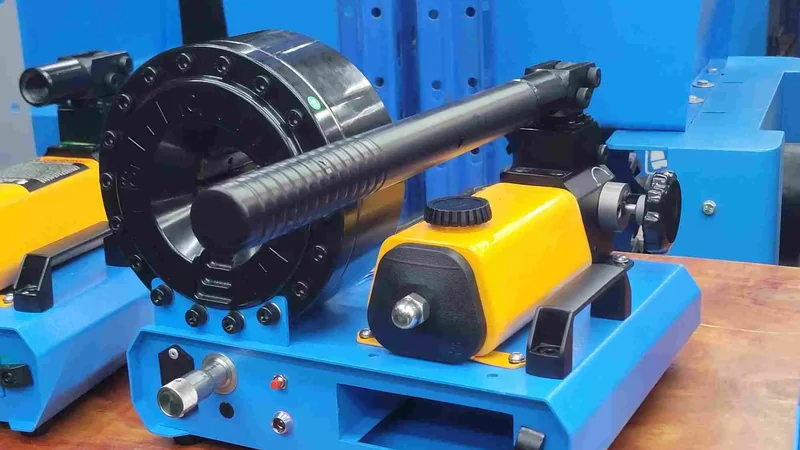
What Manual Requires of the Operator
A manual hose crimping machine uses a hand-operated hydraulic pump. The operator pumps a lever, which drives a small hydraulic cylinder. The cylinder uses an area ratio of about 10:1 to amplify the operator's input force at the dies.
| Operator demand | What it feels like in practice |
|---|---|
| Lever force per stroke | Up to about 20 kg on a bench hand-pump unit. |
| Strokes per crimp | About 15–25 strokes for a 1-inch 2SN crimp. |
| Cycle time | 30–60 seconds, including pump strokes. |
| Physical risk | Repetitive strain injury (RSI) — carpal tunnel, tendonitis — documented in industry literature. |
The trade-off is that the operator has to pump many times to cycle the cylinder through its full stroke. That is where the 30–60 second cycle time comes from — not from the machine being slow, but from the operator having to supply the energy. Hydraulic amplification does the multiplication; the operator supplies the raw input.
What Powered Requires of the Site
A powered hose crimping machine removes the operator's physical effort from the cycle. But it introduces a different dependency: the site has to supply power or air.
| Power format | Site requirement | TRC examples |
|---|---|---|
| Electric, single-phase 110V/220V | Common workshop outlet. | TRC P18X (80 ton compact). |
| Electric, three-phase 380V/440V | Requires three-phase supply. | TRC P20 (137 ton), TRC P32 (200 ton). |
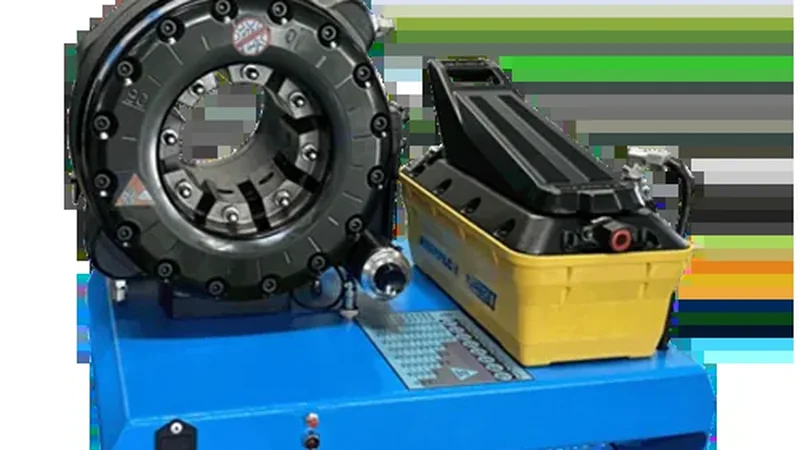
| Pneumatic (air-over-hydraulic) | Shop air at 90–150 PSI, 2.5–3.5 CFM. | TRC P16AP (95 ton), TRC P20AP (137 ton). |
| Battery / vehicle-powered (12V/24V) | Vehicle outlet or dedicated charger. | TRC P20CS (80 ton 12V), TRC P32CS (200 ton cordless). |
The site constraint is binary. If you do not have three-phase power, you cannot run a 137-ton three-phase workshop machine without a power upgrade. Pneumatic and battery formats exist to bridge that gap, but each has its own dependency — compressor capacity for pneumatic, charge state and cycle count for battery.
Five-Axis Comparison
The table below compares manual and powered on the five axes that decide which format fits. Read down the "Quality consistency" row first; that is the axis where the manual format hits its ceiling.
| Axis | Manual hand-pump | Powered (electric or pneumatic) |
|---|---|---|
| Sustainable assemblies per shift | ~15–20 | ~150–300+ |
| Cycle time per crimp | 30–60 seconds | 7–12 seconds |
| Quality consistency across a shift | Drifts past about 20 assemblies | Stable across the full shift |
| Operator fatigue | High; RSI risk documented | Low; mainly setup and loading |
| Site requirement | None | Power or shop air |
The most important row is "Quality consistency across a shift." A manual unit produces equivalent quality to a powered unit for the first 15–20 assemblies. Past that, the operator's judgment of die-to-die contact drifts, and the same setting produces a different crimp. A powered machine holds the same setting across the full shift because the hydraulic pressure comes from a pump, not from the operator's arm.
Tonnage Ceiling: When Manual Stops Making Sense
Above about 95–110 ton, the operator effort becomes unsustainable for any meaningful daily count. The table below shows where each hose size class crosses the manual ceiling.
| Hose size | Approximate tonnage required | Manual feasibility |
|---|---|---|
| Up to 1/2" 2SN | 30–60 ton | Easy on any TRC hand-pump unit. |
| 1/2" to 3/4" 2SN | 60–80 ton | Sustainable for low volume. |
| 3/4" to 1" 2SN | 80–110 ton | Borderline; fatigue past 10 assemblies/day. |
| 1" to 1-1/4" 2SN | 110–137 ton | Possible on TRC P20HP, but only for low volume. |
| 1" 4SH and above | 100+ ton on heavy-wall ferrule | Not recommended for sustained hand-pump use. |
We recommend treating 110 ton as the practical ceiling for a hand-pump unit in daily use. Above that, the cycle is sustainable for a handful of assemblies per day, not for a shift. A workshop that needs to crimp 1" 4SH regularly should move to a powered 137-ton machine.
Crimp Quality: Does Power Make It Better?
No, not inherently. The crimp quality depends on the die, the setting, and the first-piece check — not on whether the hydraulic pressure comes from a hand pump or an electric motor.
| Situation | Effect on quality |
|---|---|
| Correct die, correct setting, first piece measured | Manual and powered produce equivalent crimps. |
| Fatigued operator on a manual unit | Quality drifts after about 20 assemblies per shift. |
| CNC machine with automatic setting | Most repeatable across operators; quality independent of operator skill. |
The honest answer on quality. Both formats produce a cold-weld bond between ferrule, wire reinforcement, and fitting stem — the bond that holds under impulse. The difference is repeatability across a shift, not the physics of the crimp. A manual unit run by a fresh, disciplined operator produces the same crimp as a CNC machine run on the same die and the same target diameter. The manual unit stops producing that crimp when the operator tires.
Decision Matrix
| Question | If "yes" | Lean toward |
|---|---|---|
| Daily count below ~20? | Yes | Manual is defensible. |
| Daily count above ~20? | Yes | Powered. |
| Need to crimp above 1-1/4" braided or 1" spiral? | Yes | Powered (or CNC). |
| Three-phase power or shop air available? | Yes | Powered becomes practical. |
| On remote sites without reliable power? | Yes | Manual or battery-powered portable. |
| Need batch records or traceability? | Yes | Powered or CNC. |
The decision is almost never about quality. It is about workload, site, and operator capacity. If the daily count is below 20 and the hose size is below 1-1/4" braided, a manual unit is the right call. If either condition flips, a powered machine pays for itself in 12–18 months on rework cost alone.
Hybrid Option: Portable Powered
A third format is worth mentioning: portable powered units running from a 12V/24V vehicle outlet or a battery pack. They combine the portability of a manual unit with the cycle consistency of a powered machine. The TRC P20CS runs 80 ton from a vehicle battery; the TRC P32CS reaches 200 ton cordless. See our portable category for the full family.
The catch on battery units: cycle count per charge is finite, and a cold battery delivers less tonnage than a warm one. For field service that runs 10–20 crimps between charges, a battery unit is the right answer. For field service that runs 50+ crimps per shift, a powered unit from the vehicle's alternator is more reliable.
Frequently Asked Questions
Is a manual hand-pump hose crimping machine reliable?
Yes, within its workload range. Up to about 15–20 assemblies per day, a hand-pump unit produces equivalent crimp quality to a powered machine, provided the first piece is measured. Above that count, operator fatigue becomes the dominant quality variable. Reliability is a workload question, not a format question.
Why is a powered machine better for production?
Because it removes operator effort from the cycle. A powered machine runs the same crimp cycle in 7–12 seconds instead of 30–60 seconds, does not produce operator fatigue, and sustains consistent quality across a full shift. The crimp physics are the same; the energy source is different.
Can I run a powered hose crimping machine without three-phase power?
It depends on the tonnage class. Compact machines up to about 95 ton often run on 110V or 220V single-phase. Workshop machines in the 137-ton class typically require 380V or 440V three-phase. Pneumatic machines require shop air at 90–150 PSI. Battery machines run from 12V or 24V vehicle power.
Buyer question: what is the crossover point where a powered machine pays for itself?
For most shops, around 20–30 assemblies per day. Below that, a manual unit produces equivalent quality at lower cost. Above that, the rework cost, operator fatigue cost, and lost capacity cost of staying with a manual unit exceed the additional capital cost of a powered machine — typically within 12–18 months.
References and technical boundaries
- ISO 4413:2010 — General rules and safety requirements for hydraulic systems. Supports the general safety framework.
- Wikipedia — Pascal's Law. Reference for the force-multiplication principle behind hand-pump and powered hydraulic crimpers.
- Wikipedia — Hydraulic machinery. Reference for hydraulic force multiplication and power density.