Tabla de Contenidos
- ¿Qué es una herramienta manual de prensado de tubería?
- 3 Off-Grid Crimping Solutions When There’s No Power
- Solución 1: Prensadora hidráulica de bomba manual
- Solución 2: Prensadora portátil a batería
- Solución 3: Prensadora manual de palanca para mangueras de pequeño diámetro
- Tabla comparativa de prensado fuera de red
- Aplicaciones reales
- Preguntas frecuentes
¿Qué es una herramienta manual de prensado de tubería?
A manual pipe crimping tool is a hand-operated device that deforms a metal ferrule or sleeve around a hose fitting to create a permanent seal — without needing electricity. Mechanics, miners, and field technicians use these tools on job sites where power outlets don’t exist.
These tools work on Pascal’s Law: a small force applied to a hand pump piston generates high hydraulic pressure inside the cylinder. A 34 kg TRC P16HP can produce 95 tons of crimping force from a few pumps of the lever. The principle is the same as a hydraulic press — force multiplication through confined fluid.
The key difference between a manual crimping tool and an electric hydraulic crimper is the power source: hand pump versus motor. Both achieve the same crimp quality.
The trade-off is speed versus independence from power.
3 Off-Grid Crimping Solutions When There’s No Power
Los sitios de construcción, campamentos mineros, operaciones forestales y campos agrícolas comparten un problema: no hay energía fiable. Cuando una manguera hidráulica revienta en una excavadora a 40 km del taller más cercano, necesita una herramienta que funcione sin enchufarse.
Aquí hay 3 soluciones reales, clasificadas por capacidad de prensado y portabilidad.
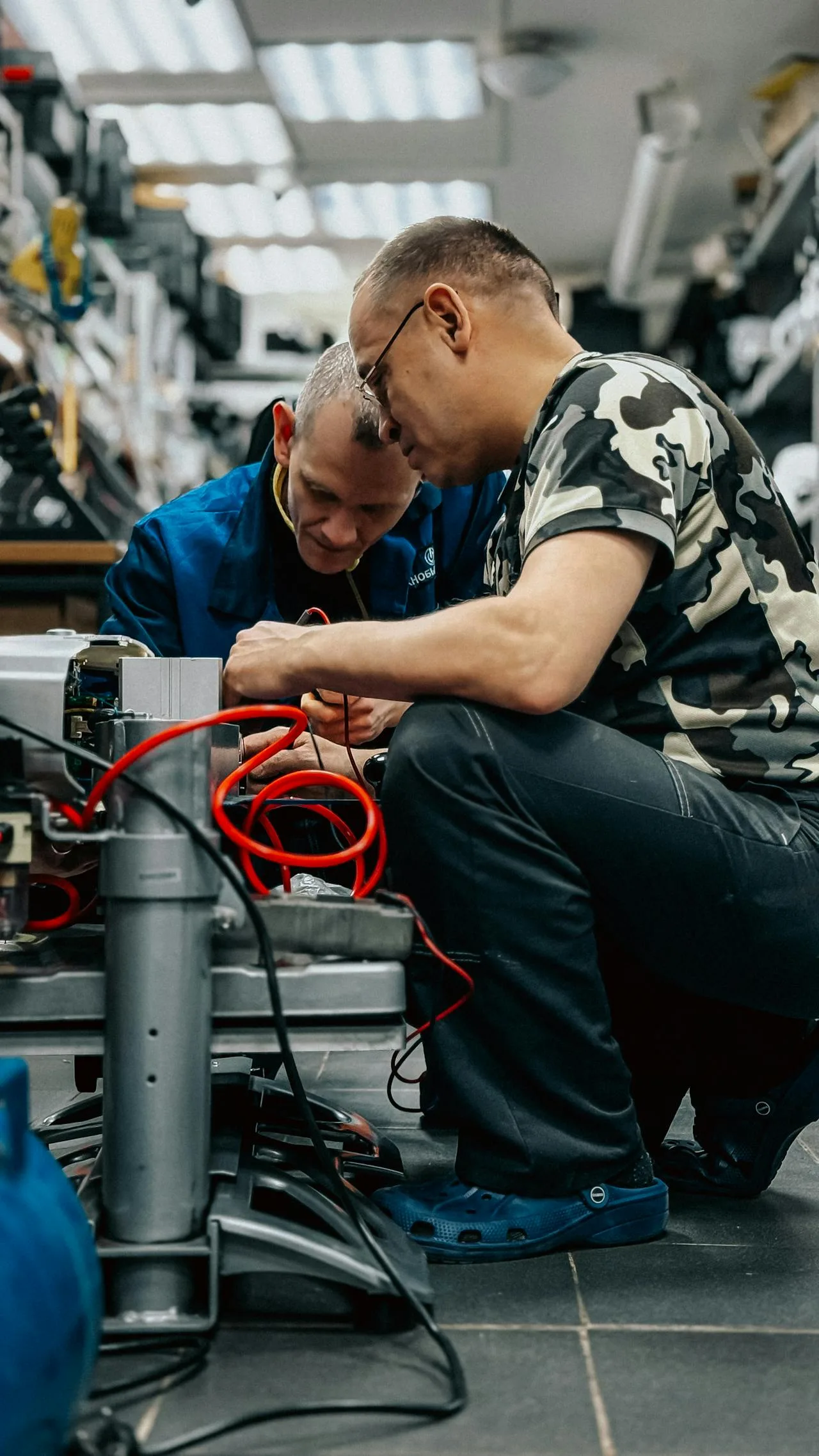
Solución 1: Prensadora hidráulica de bomba manual
La opción fuera de red más común. Una bomba manual impulsa el fluido hidráulico hacia el cilindro, empujando el juego de matrices hacia adentro para comprimir la férula. El tiempo de ciclo es de 8-12 segundos por prensado.
| Modelo | Crimp Force | Rango de manguera | Peso | Serie de Matrices |
|---|---|---|---|---|
| P16HP | 95 ton | ¼″–1″ 2SP | 34 kg | P16 (10 tamaños) |
| P18HP | 110 ton | ¼″–1″ 4SP | 38 kg | P18 (12 sizes) |
| P20HP | 137 ton | ¼″–1½″ 4SP | 52 kg | P20 (14 tamaños) |
Pros: No battery, no charger, no compressor. Works in rain, mud, and freezing temperatures down to -20°C. The P16HP fits in a service truck toolbox.
Cons: Operator fatigue sets in after 20–30 crimps. The P20HP weighs 52 kg — needs two people to load.
The P16HP comes with an SAE J517-compatible die set covering 10 hose sizes. It uses Cr12MoV die steel at HRC 58–62 hardness per especificaciones de prensado de la industria. Crimp tolerance is ±0.04 mm — identical to factory floor results.
The crimp creates a gas-tight connection: the ferrule deforms past its yield point, compressing the wire reinforcement into a cold-weld bond with the fitting. No solder, no heat. The joint is mechanically stronger than a soldered connection and highly resistant to vibration and thermal shock.
Solución 2: Prensadora portátil a batería
Battery-powered crimpers run on 12V car batteries or lithium packs. They’re faster than hand pumps — about 8 seconds per cycle — but you need a charged battery.
| Modelo | Crimp Force | Rango de manguera | Power Source | Peso |
|---|---|---|---|---|
| P18CS | 80 ton | ¼″–¾″ 4SP | Batería de coche de 12V | 35 kg |
| P20CS | 137 ton | ¼″–1½″ 4SP | Batería de coche de 12V | 48 kg |
Pros: Faster than hand pump. Less operator fatigue. P20CS covers the same range as the electric P20 shop machine.
Cons: Battery dies in 3–4 hours of continuous use. Cold weather below -10°C reduces battery capacity by 30–40%. You need a running vehicle to charge.
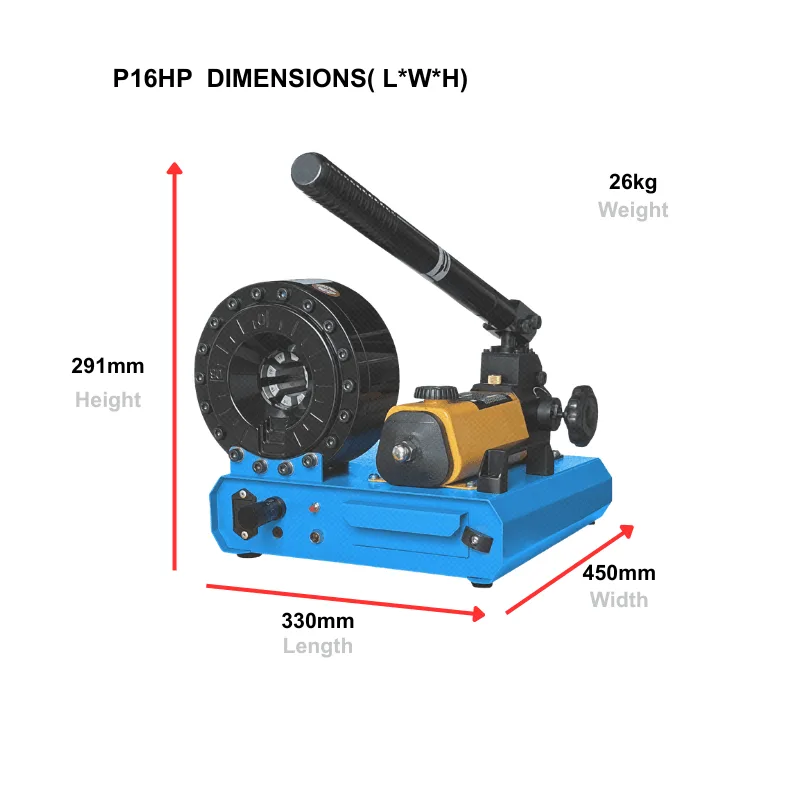
Solución 3: Prensadora manual de palanca para mangueras de pequeño diámetro
For hoses under ½″ (like low-pressure hydraulic, fuel lines, and coolant circuits), a lightweight manual lever crimper works. No hydraulics at all — just a compound lever that multiplies hand force. These tools produce a simple compression crimp — adequate for low-pressure circuits but not a true radial crimp with controlled deformation.
The P10HP weighs under 10 kg and crimps up to ¼″ hose. It uses a compound lever that multiplies hand force 30×. Not suitable for high-pressure hydraulic systems, but handles automotive AC lines and fuel hoses without any power source.
Pros: Lightest option. No fluid, no battery, no maintenance. Fits in a backpack.
Cons: Limited to small diameters. Cannot crimp 4SP or 6SP multi-spiral hose.
Tabla comparativa de prensado fuera de red
| Característica | Bomba de mano (P16HP) | Batería (P20CS) | Lever (P10HP) |
|---|---|---|---|
| Crimp Force | 95 ton | 137 ton | ~5 ton |
| Max Hose Size | 1″ 2SP | 1½″ 4SP | ¼″ |
| Peso | 34 kg | 48 kg | 10 kg |
| Energía necesaria | Ninguno | 12V battery | Ninguno |
| Tiempo de ciclo | 10 seg | 8 s | 5 sec |
| Crimp Tolerance | ±0.04 mm | ±0.04 mm | ±0.15 mm |
| Temp Range | -20°C to 50°C | -10°C to 45°C | -30°C to 60°C |
| Ideal para | General reparación de campo | de alto volumen remote sites | Light-duty small hoses |
Aplicaciones reales
Sitios mineros
Underground mines and open-pit mining operations rarely have power at the work face. When a hydraulic hose fails on a loader 200 meters underground, a hand pump crimper is the only option. The P18HP’s 110-ton capacity handles most mining hose sizes up to 1″ 4SP.
Construcción
Construction sites often have temporary power, but it’s unreliable. A battery-powered P20CS running off the excavator’s own battery lets you crimp replacement hoses on the spot. No towing, no downtime.
Agricultura y silvicultura
Tractors and harvesters break hydraulic hoses in the middle of fields. A hand pump crimper in the tractor toolbox means a 10-minute fix instead of a 2-hour trip to town. The P16HP’s 34 kg weight is manageable for one person.
¿Necesita una prensadora manual que funcione en cualquier lugar?
TRC manual crimpers cover ¼″ to 1½″ hose, no power required. Tell us your hose sizes and we’ll recommend the right model.
Preguntas frecuentes
¿Puede una herramienta manual de prensado lograr la misma calidad que una eléctrica?
Yes. Both use the same cilindro hidráulico and juego de matrices. The tolerancia de prensado is ±0.04 mm — identical.
The only difference is the power source (hand vs. motor).
¿Cuántos prensados puedo hacer antes de cansarme?
Most operators report fatigue after 20–30 crimps with a hand pump unit like the P16HP. For higher volume, switch to a battery-powered prensa portátil.
¿Puedo prensar manguera de 4 espirales con una herramienta manual?
Yes. The P18HP (110 ton) handles 1″ 4SP. The P20HP (137 ton) goes up to 1½″ 4SP.
You need enough crimping force to compress the multi-spiral wire braid per ISO 8434 standards.
¿Qué tamaños de matriz necesito para reparaciones de campo?
Carry the 5 most common sizes: 14, 16, 19, 23, and 27. These cover 80% of field repair scenarios. Full die sets are available for specific hose ranges.
¿Afecta el clima frío a las prensadoras manuales?
Las unidades de bomba manual funcionan hasta -20°C con aceite hidráulico anti-desgaste #68. Por debajo de eso, la viscosidad del aceite aumenta y el bombeo se vuelve más difícil. Las unidades a batería pierden 30-40% de capacidad por debajo de -10°C.
¿Puedo usar una prensadora manual en tubería de acero?
No. Hydraulic hose crimpers are designed for rubber hoses with metal reinforcement. Steel pipe requires a different tool — a pipe swaging machine or mechanical coupler.
¿Cómo mantengo una prensadora hidráulica manual?
Revise el nivel de aceite hidráulico mensualmente. Reemplace los sellos cada 12 meses o cuando note pérdida de presión.
Store with dies removed to prevent die face damage. Full maintenance instructions come with every TRC crimper.
What’s the warranty on TRC manual crimpers?
Garantía de 12 meses que cubre defectos de fabricación. Reparación o reemplazo gratuito dentro del primer año. El soporte técnico responde en 4 horas por correo electrónico o videollamada.


 English
  Español
  Русский