Hydraulic Hose Crimper Die Set Compatibility
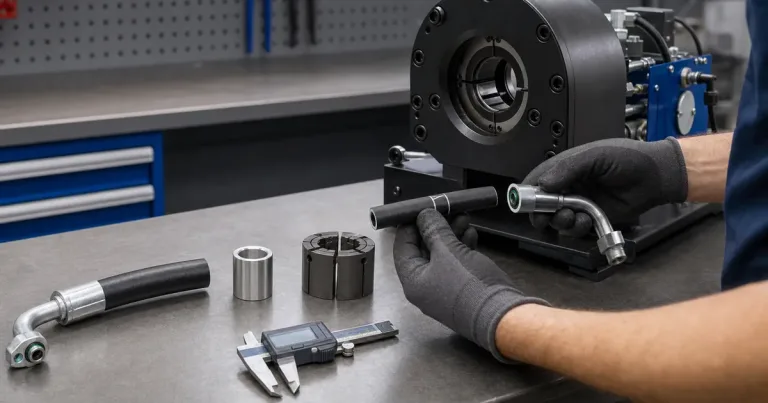
A hydraulic hose crimper die set is not one product. It is three compatibility questions stacked on top of each other. The die set has to fit the machine (interface), it has to match the component system (component data), and it has to be backed by a published instruction that tells the operator what target diameter to reach (crimp instruction). Any one of those layers failing produces a bad crimp, even if the other two are perfect.
This matters because crimping is a cold-forming operation. The die deforms the ferrule past its yield point so the ferrule grips the hose reinforcement and the fitting stem in a single, gas-tight joint. A wrong die produces a joint that either pulls out under pressure or cracks the inner tube and lets oil weep along the wire reinforcement. Both failures look fine on the bench and fail in service.
This article walks through the three layers, the engineering behind die geometry, the wear mechanics of tool steel dies, and the TRC die sets that cover common hose and fitting systems.
Three Compatibility Questions at Once
| Layer | What it asks | What it depends on |
|---|---|---|
| Machine interface | Does the die fit the machine? | Cone angle, drive key, locator ring, front-load vs side-load, die opening depth. |
| Component compatibility | Does the die match the hose + fitting + ferrule system? | Hose construction, fitting series, ferrule OD, profile, length. |
| Crimp instruction (data) | Is there a published target crimp diameter for this combination? | Hose and fitting manufacturer's crimp data sheet. |
All three layers have to pass. A die that fits the machine but does not match the component system produces a bad crimp. A die that matches the component system but has no published target diameter cannot be verified.
We recommend treating each die order as a system purchase. Send the machine model, the hose part number, the fitting part number, and the ferrule OD. That gives the supplier the three layers in one block of information.
Layer 1 — Machine Interface
The machine interface is the mechanical geometry that lets the die seat and move radially under load. Each manufacturer designs it differently, and the design is rarely published.
| Interface variable | What it must match |
|---|---|
| Cone angle | The machine's master die or piston taper. |
| Drive key or locator ring | The machine's die drive system. |
| Front-load vs side-load | The machine's die loading direction. |
| Die opening depth | The machine's head opening. |
| Die segment count | The machine's die ring geometry. |
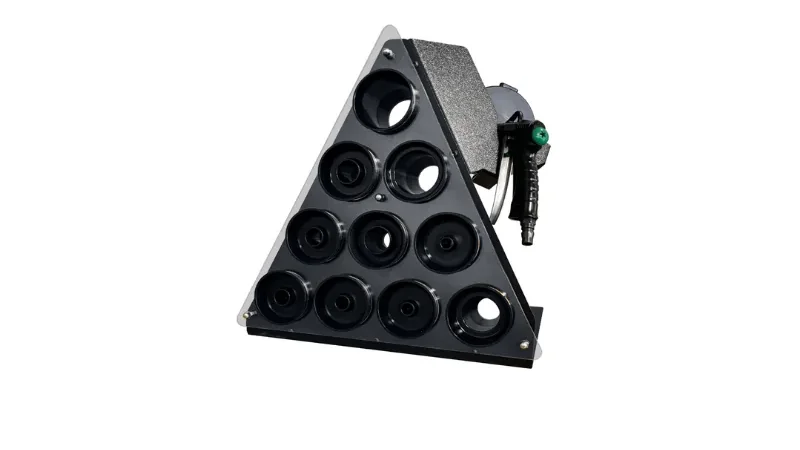
A die set is usually tied to a machine family. Dies that fit one TRC model family will not fit another, even if the tonnage and hose range are nominally identical. The TRC P16 die ring uses a 39 mm master die diameter and a 64 mm length; the TRC P20 uses 84 mm by 80 mm; the TRC P32 uses 99 mm by 80 mm. The cone angle, segment count, and drive features differ with each.
The honest answer on cross-family fit: even within the same manufacturer, a P16 die does not fit a P20 ring, and a P20 die does not fit a P32 ring. The interface is proprietary to the family, not universal to the brand.
Layer 2 — Component Data
Component data is what makes a die produce a specific crimp diameter for a specific hose and fitting. Two dies with the same ID stamp can still produce different crimps if the ferrule profile differs.
| Component variable | What it decides |
|---|---|
| Hose construction | Tonnage class; skive requirement. |
| Fitting series | Ferrule profile and engagement mechanics. |
| Uncrimped ferrule OD | Minimum die ID. |
| Ferrule profile | Required die profile. |
| Ferrule length | Required die length. |
Crimping is a radial contraction process, not a swaging process. Swaging uses tapered dies that hammer or press the ferrule from the outside. Crimping uses radial segmented dies that close on the ferrule from all sides at once. The difference matters: a crimp die has to match the ferrule profile exactly, because any gap between segments leaves a witness mark that becomes a stress riser under impulse loading.
This is why a "no-skive" ferrule and a "skive" ferrule of the same OD use different dies. The skive ferrule exposes the wire braid, and the die has to compress the wire directly to form the cold-weld bond between wire, ferrule, and stem.
Layer 3 — The Crimp Instruction
The crimp instruction is the published target crimp diameter for a specific hose, fitting, and die combination. Without it, the operator cannot verify the crimp.
| Source | What it gives you |
|---|---|
| Hose/fitting manufacturer's crimp data sheet | Target diameter, tolerance, measurement position, die ID. |
| Online crimp database (component manufacturer) | Ties hose + fitting + crimper + die to a published instruction. |
| Printed crimp chart | Bench reference. |
The target diameter is the finished crimp OD, measured at a specific position along the ferrule. The tolerance is typically plus or minus 0.1 mm. The operator measures the crimped ferrule at three positions, 120 degrees apart, and checks that the average is on target.
The catch is that the crimp instruction is owned by the component manufacturer, not the machine maker. The machine maker builds the machine and the die; the component manufacturer tests the assembly and publishes the target diameter. A die without a matching crimp instruction is a piece of metal, not a tool.
TRC Die Sets and Compatibility
TRC die sets are engineered to match our machine families and the major hose and fitting systems. Die sets are configured per order based on the customer's hose and fitting systems.
| TRC machine family | Die series | Coverage | Notes |
|---|---|---|---|
| P10HP manual compact | P10 | 1/4" small-bore; 4 dies (P10/06 to P10/13) | Field and low-volume AC and fuel line work. |
| P16HP / P18HP manual | P16 / P18 | 1" to 1-1/4" 4SP braided and some spiral | Smaller die IDs; field and low-volume. |
| TRC P20 / P20S / P20D / P22 (137 ton) | P20 series | 14 standard dies (P20/14 to P20/47); 4 optional (P20/06 to P20/12, P20/52) | Workshop standard; covers 14–60 mm crimp diameters. |
| TRC P32 / P32A / P32D / P32E / P32ES / P32S / P33 (200 ton) | P32 series | 19 dies; up to 2" 4SH | Workshop and production. |
| TRC TRC120L / P120 / P140 / P160 / P165 / P175 | Industrial | Large-bore industrial and R13 | Mining and heavy industry. |
We recommend specifying the hose and fitting system when ordering. The standard die list covers common combinations; non-standard combinations need a confirmed crimp data sheet before the die is machined.
Can You Borrow Dies Across Machines?
| Situation | Answer |
|---|---|
| Same manufacturer, same model, same die series | Yes; verify with a first-piece check. |
| Same manufacturer, different model with same die series | Usually yes; verify interface and run first piece. |
| Same manufacturer, different die series | No. |
| Different manufacturer | Usually no; the interface is proprietary. |
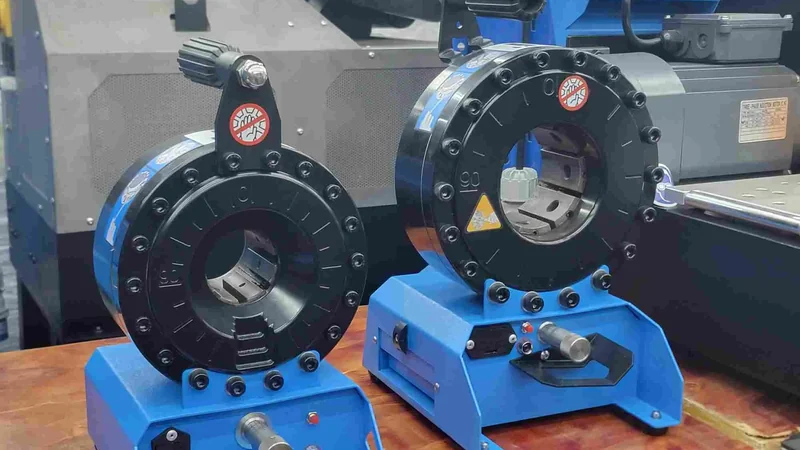
A common failure pattern is borrowing a die from one machine to another within the same workshop, without checking whether the machines are in the same family. The first-piece check catches this. We have seen shops borrow a die from a 137-ton machine to run on a 200-ton machine of the same brand; the die seats partially, the crimp goes oval, and the operator blames the machine.
The honest answer: die borrowing across machine families does not work because the cone angle, drive key, and segment count differ. The die may seat enough to cycle the machine, but it will not seat enough to produce a round, repeatable crimp.
Die Wear: When Good Dies Go Bad
Dies wear gradually. Wear shows up as drift in the crimp diameter long before it shows up as visible damage on the die face. Catching it requires measuring a calibration sample at fixed intervals.
Typical Cr12MoV tool steel dies, hardened to HRC 58–62, last about 10,000–30,000 crimps under normal use. Heavy-duty applications, where the die is closing on thick-walled spiral ferrules, reduce that to about 10,000–15,000 crimps. The Cr12MoV grade is a Chinese analog of D3 tool steel, chosen for its high carbon and chromium content and its resistance to abrasive wear from the ferrule edge.
| Wear indicator | What it means |
|---|---|
| Crimp diameter drifts over target by more than about 0.05 mm | Die wearing; calibration or reconditioning needed. |
| Visible steps or grooves on the die's inner surface | Significantly worn; replacement due. |
| Drift by more than about 0.15 mm | Out of service; do not use. |
| Surface cracks or impact damage | Unsafe; remove immediately. |
Visual inspection every 6–12 months, and calibration checks on a known sample, catch wear before it produces a bad batch. A die that drifts past 0.05 mm over target has worn enough that the same machine setting produces a looser crimp than the crimp data sheet specifies. Continuing to run that die produces a batch of under-crimped assemblies that may pass a visual check and fail in service.
Frequently Asked Questions
Can I use dies from one machine on another machine?
Only within the same machine family and component system, and only with a first-piece verification. Dies from a different manufacturer usually do not fit, because the machine interface is proprietary. Even within the same manufacturer, dies do not cross between families — a P16 die does not fit a P20 ring.
How long do hydraulic hose crimper dies last?
Typical Cr12MoV tool steel dies, hardened to HRC 58–62, last about 10,000–30,000 crimps under normal use. Heavy-duty applications on thick-walled spiral hose reduce that to about 10,000–15,000 crimps. Wear shows up as drift in the crimp diameter before it shows up as visible damage.
When should I replace a die?
When the crimp diameter of a calibration sample drifts more than about 0.05 mm over target, the die needs reconditioning or replacement. Past about 0.15 mm drift, the die is out of service. Any visible crack, chip, or impact mark means the die is unsafe and must be removed immediately.
Buyer question: what should a new die set include?
The dies themselves, with correct ID stamping; a crimp data sheet with target diameters for the hose and fitting systems you run; setting instructions for the machine; and (when possible) a first-piece sample for comparison. If the supplier cannot supply the crimp data sheet, ask whether the die is matched to a published component system, or whether it is a generic die without a verified instruction.
References and technical boundaries
- ISO/TS 17165-2:2018 — Hydraulic hose assemblies, practices. Supports the controlled-system principle.
- Wikipedia — Crimp (joining)). Reference for cold-weld mechanics and gas-tight crimp criteria.
- Wikipedia — Swaging. Reference for the distinction between swaging (tapered dies) and crimping (radial segmented dies).