Hydraulic Hose Crimper Universal: Machine Range vs System Compatibility
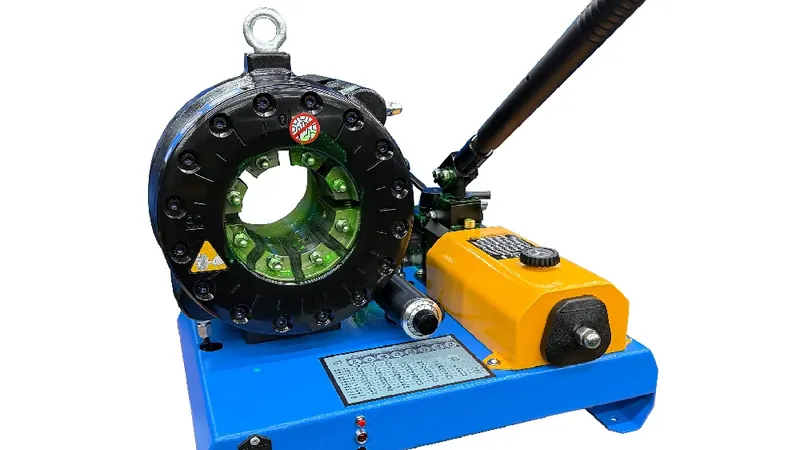
The word “universal” in a hydraulic hose crimper listing is a marketing word, not a technical specification. It can mean a wide crimp range (real and useful), or it can imply universal component compatibility (technically impossible). Buying on the second meaning is an expensive mistake.
This article explains the engineering difference between the two meanings, why universal component compatibility does not exist, and the TRC wide-range models that genuinely cover a workshop’s mix.
Two Meanings — Only One Is Real
| Meaning | What it describes | Real? |
|---|---|---|
| Wide crimp range | Machine covers 3/16″ to 2″ or larger with a multi-die set. | Yes — genuinely useful. |
| Universal component compatibility | Any hose + any fitting + any ferrule on any die. | No — technically impossible. |
| Multi-die system | Machine accepts multiple die sets, each matched to a hose and fitting family. | Yes — this is what “universal” usefully describes. |
| “Universal” voltage or power | Machine configurable for multiple voltages. | Yes — independent of crimp compatibility. |
A machine can have a wide crimp range and accept multiple die sets. It cannot crimp every brand of hose with every brand of fitting and produce a defensible assembly, because the hose + fitting + ferrule + die + target diameter form a controlled system.
Why Universal Component Compatibility Does Not Exist
A hydraulic hose assembly is a controlled system. The hose, fitting, ferrule, die, and target crimp diameter are tied together by the component manufacturer’s published data. Substituting components across systems invalidates the data.
Wikipedia notes that hose coupling systems “rely on highly specific mating geometries” and that “incompatibilities still exist” even between designs that appear dimensionally similar. The engineering reasons are specific:
| Why “universal compatibility” fails | The technical reason |
|---|---|
| Different hose constructions for same nominal size | Different die profile and tonnage. A 1″ braided hose and a 1″ 4SH spiral hose are different crimping problems. |
| Different fitting families | Different die profiles. One-piece, two-piece, and interlock fittings use different profiles. |
| Different ferrule ODs for same nominal size | Different minimum die ID. Two 1/2-inch ferrules from different manufacturers can differ by several millimeters in OD. |
| Different target crimp diameters | Each hose + fitting + die combination has its own published target. Copying a target from one system to another is not defensible. |
| Different stem serration profiles | Different engagement mechanics. The stem’s grip on the inner tube or wire layer changes with profile. |
What “Wide Crimp Range” Actually Means
A wide-range machine is genuinely useful in a workshop. It means one machine can cover everything from small braided hose up to large spiral hose, reducing the need for multiple machines.
| Machine class | Typical crimp range | Coverage |
|---|---|---|
| Compact 60–80 ton | 3/16″ to 1″ braided; some 3/4″ spiral. | Small braided; field and low-volume. |
| Workshop 137 ton | 3/16″ to 1-1/2″ 4SH. | Workshop sweet spot. |
| Workshop 200 ton | 3/16″ to 2″ R13. | Full workshop range. |
| Industrial 245–320 ton | Up to 2-1/2″ to 3″ R13. | Large industrial. |
| Heavy industrial 350–830 ton | Up to 4″ R13 and larger. | Mining and heavy industry. |
A 200-ton workshop machine with a wide crimp range can handle most of a typical workshop’s mix on one machine. That is a real benefit. But the machine’s range covers hose sizes; it does not cover every hose + fitting combination in that range. Each combination still needs its own validated die and target crimp diameter.
TRC Wide-Range Models
TRC builds several wide-range crimpers that genuinely cover a typical workshop mix. These are not “universal” in the any-component sense; they are machines with wide tonnage and die-system coverage, configurable per order.
| Model | Tonnage | Die series | Hose range | Key selling points |
|---|---|---|---|---|
| TRC P20 | 137 ton | P20 series (14 standard dies, P20/14 to P20/47, covering 14–52 mm) | 3/16″ to 1-1/2″ 4SH | Workshop classic; simple construction; rare failure. |
| TRC P20D | 137 ton CNC | P20 series with stored programs | Same as P20 | CNC repeatability; batch records; multiple crimp modes. |
| TRC P32 | 200 ton | P32 series | 3/16″ to 2″ R13 | Wider range; production workshop. |
| TRC P32A | 200 ton | P32 series; drawer-type die cabinet; caliper rack | Same as P32 | Value pick; strong in Malaysia, South America, South Africa. |
| TRC TRC120L | 245 ton CNC | Integrated die system | Up to 2-1/2″ | Integrated design; CNC; popular with European and large Chinese customers; visually similar to some well-known industrial brands. |
| TRC P140 | 320 ton | Industrial die series | Up to 3″ R13 + industrial pipe | Separate power unit; crimps both hydraulic and industrial pipe; strong in Europe, Turkey, Brazil, USA. |
See the hydraulic hose crimper category for the full range.
What “Universal” Should Mean in Your Buying Brief
If you want a genuinely useful “universal” machine, define what you mean.
| Useful definition | What to specify |
|---|---|
| Wide crimp range | The size range you actually need (e.g., 3/16″ to 1-1/2″ braided, up to 1″ 4SH). |
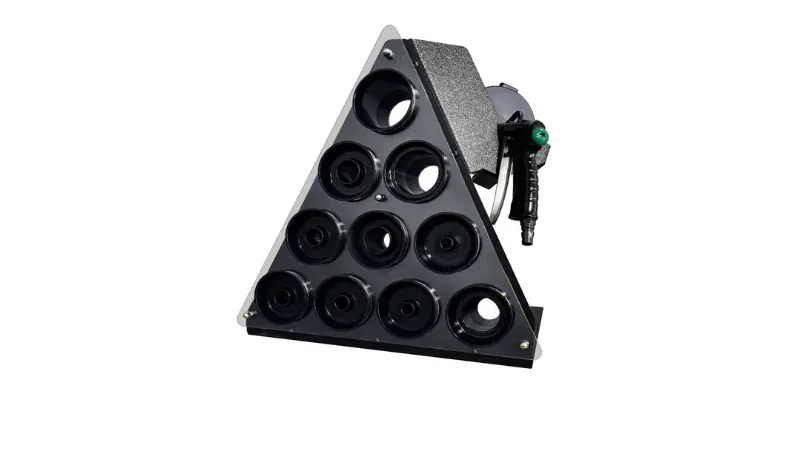
| Multi-die system | The die sets you need, each matched to a hose and fitting family in your mix. |
| Validated combinations | Published target crimp diameters for each combination. |
| Upgrade path | Machine can accept additional die sets if your mix expands. |
A buying brief that specifies those items produces a genuinely useful machine. A buying brief that says only “I need a universal crimper” leaves the definition to the supplier, and the result is usually a mismatch.
Used “Universal” Machines — A Second Warning
Used machines advertised as “universal” carry an additional risk: the die set that made the machine “universal” when new may be incomplete or missing.
| Risk with used “universal” machines | What to check |
|---|---|
| Die set incomplete | Count the dies against the original specification; missing dies reduce the effective range. |
| Die wear | Inspect each die for wear, cracks, or impact damage. |
| No crimp data | The original crimp data sheet may be missing; without it, target diameters are unknown. |
| Machine wear | Check the master die, cone angle, hydraulic seals, and calibration. |
| Missing accessories | Foot pedal, die racks, calipers, gauges may have been separated. |
A used “universal” machine with a partial die set and no crimp data is effectively a narrow-range machine with no way to verify the crimp. The price may look attractive; the value usually is not.
A Working Scenario — Not a Customer Case
An illustrative scenario. A workshop bought a 200-ton machine advertised as “universal,” expecting to crimp any hose and fitting combination they encountered. The machine’s crimp range covered 3/16″ to 2″, and the die set included 12 dies across that range.
The workshop took on a job involving 1-1/4-inch 4SH hose with an interlock fitting from a specific manufacturer. The die set included a die with the right nominal ID, but the profile was engineered for a different fitting family. The crimp diameter came out within tolerance on the first piece, but the ferrule did not grip the wire reinforcement correctly because the profile was wrong.
Under impulse testing, the assemblies developed micro-leaks before reaching the required cycle count. The workshop had to source a specific die, which took several weeks and cost more than they had budgeted.
The lesson: “universal” in the wide-range sense is real and useful; “universal” in the any-component sense is not. The machine’s range covered the hose size; it did not cover the specific fitting family.
Frequently Asked Questions
Is there a universal hydraulic hose crimper that works with any hose and fitting?
No. The hose, fitting, ferrule, die, and target diameter form a controlled system. A machine can have a wide crimp range and accept multiple die sets, but it cannot make every hose + fitting combination valid. Each combination still needs its own validated die and target crimp diameter.
What does “universal” mean in a hydraulic hose crimper listing?
Usually it means the machine has a wide crimp range — for example, 3/16″ to 2″. Sometimes it means the machine accepts multiple die sets. It does not mean the machine is compatible with any brand of hose and any brand of fitting, regardless of how the listing is worded.
Can I use a “universal” machine with dies from another manufacturer?
Only if the die’s machine interface matches (cone angle, drive key, locator ring) and the die has been validated for the specific hose + fitting combination you intend to crimp. A die that physically fits the machine but was not engineered for your component system can produce a bad crimp.
Buyer question: should I buy a used “universal” machine?
Only after inspecting the die set for completeness and wear, confirming the crimp data is available, and verifying the machine’s calibration. A used “universal” machine with a partial die set and no crimp data is effectively a narrow-range machine with no way to verify the crimp.
References and technical boundaries
- ISO/TS 17165-2:2018 — Hydraulic hose assemblies, practices. Supports the controlled-system principle.
- Wikipedia — Hose coupling. Reference for coupling mating geometries and incompatibilities.