High-Pressure Hydraulic Hose Crimping Tool Selection
The phrase "high pressure" gets used loosely. In hydraulic hose it has a specific meaning, and that meaning changes what the crimping tool has to do. A high-pressure hydraulic hose crimping tool is not just a higher-tonnage version of a standard workshop machine. It is a machine engineered to crimp specific hose constructions — multi-wire spiral hose like EN 856 4SH, 4SP, SAE 100R12, R13, and R15 — and to produce assemblies that survive burst and impulse testing at the pressures those hoses are rated for.
The honest starting point is this. Pressure belongs to the assembly, not the tool. A correctly crimped assembly matches the hose's published working pressure; a badly crimped assembly can fail well below it. The tool's job is to produce the cold-weld bond between ferrule, wire reinforcement, and fitting stem that lets the assembly reach its rated pressure. Tonnage is necessary for that bond, but tonnage alone is not sufficient — die profile, skiving discipline, and a verified target crimp diameter all matter as much. Choosing a high pressure hydraulic hose crimping tool is therefore a question of matching the machine to the hose construction, not just buying the biggest tonnage on the floor.
High Pressure Belongs to the Assembly, Not the Tool
The pressure rating belongs to the hose, not the machine. A correctly crimped assembly matches the hose's published working pressure; a badly crimped assembly can fail well below it. SAE J517 defines the pressure classes, and the table below shows where the practical cutoff sits.
| Hose type (SAE J517 / EN) | Reinforcement | Typical working pressure at 1" ID |
|---|---|---|
| SAE 100R2 / EN 853 2SN | Two wire braids | ~3,000–4,000 psi |
| SAE 100R12 / EN 856 4SP | Four spiral wires | ~4,000–4,500 psi |
| EN 856 4SH | Four spiral wires, heavy | ~4,000–5,000 psi |
| SAE 100R13 | Four to six spiral wires | up to 5,000–6,000 psi |
| SAE 100R15 | Six spiral wires (special) | up to 6,000 psi |
The practical cutoff for "high pressure" in hose crimping is usually around 4,000 psi working pressure — the point where braided hose gives way to spiral hose. Below that cutoff, two-wire braid hose runs on a 60–95 ton machine. Above it, the construction changes from braid to spiral, the ferrule wall gets heavier, and the tonnage requirement jumps.
Why 4SH and 4SP Are Harder to Crimp
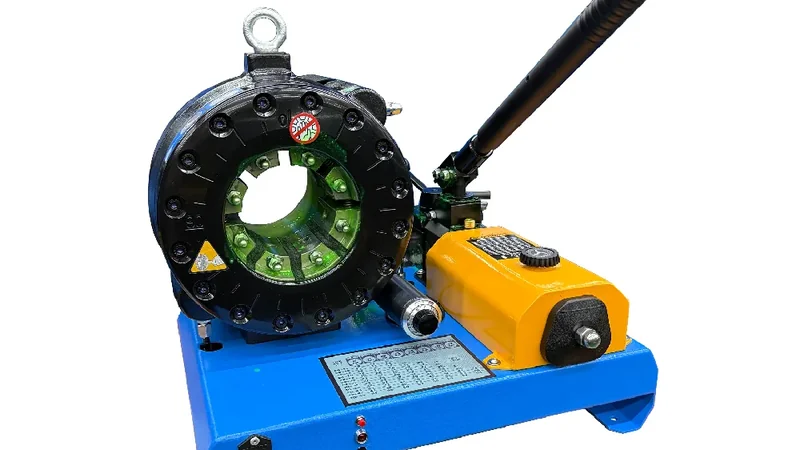
Spiral hose is harder to crimp than braided hose for four reasons, and each one shows up in the machine specification.
| Reason | What it means for the tool |
|---|---|
| Thicker reinforcement | More wire to compress; higher tonnage required. |
| Heavier ferrule wall | More tonnage to deform the ferrule past its yield point. |
| Skive requirement | Most high-pressure spiral fittings require skiving. |
| Larger stem profile | Die profile is more complex; die ID has to clear the stem. |
The first two reasons drive tonnage. A two-wire braid hose at 1" ID crimps at roughly 80–100 ton. A four-wire spiral hose at the same ID crimps at 100–137 ton because the operator is deforming four layers of high-tensile wire plus a heavier ferrule wall in a single stroke. That is why a 95-ton machine tops out at 1" spiral and a 137-ton machine is the workshop standard for 1" to 1-1/2" spiral.
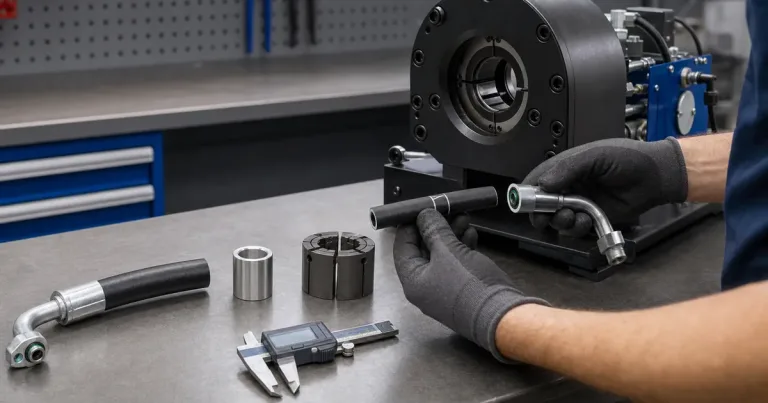
The third reason drives tooling. Skiving removes the outer rubber cover so the ferrule grips the wire directly. A die set matched to a skive system has to compress bare wire, not rubber-covered wire, and the crimp instruction is different for the two systems.
Machine Inputs for High-Pressure Hose
The tonnage table below maps the high-pressure hose range to TRC models. The numbers are typical requirements for properly skived, properly matched assemblies.
| Hose size (4SH / R13 class) | Approximate tonnage | TRC model |
|---|---|---|
| Up to 1/2" 4SP | ~60 ton | TRC P18X (80 ton compact) |
| 1/2" to 3/4" 4SH | ~80–100 ton | TRC P16HP or TRC P20 |
| 3/4" to 1" 4SH | ~100–137 ton | TRC P20 or TRC P20D |
| 1" to 1-1/2" 4SH | ~137–200 ton | TRC P32 or TRC P32A |
| 1-1/2" to 2" R13 | ~200–280 ton | TRC TRC120L (245 ton) or TRC P140 |
| 2" to 4" R13 / R15 | ~280–830+ ton | TRC P160, TRC P165, TRC P175 |
We recommend sizing the machine one class above the minimum for sustained production. A 1" 4SH assembly is on the edge of a 100-ton machine's capability; in production, that edge produces cycle-time drift and die wear. A 137-ton machine runs the same assembly in the middle of its range, with margin for the heavy-wall ferrule and for die wear over time.
The Skiving Question
Skiving is decided by the fitting system, not the pressure class. A one-piece no-skive fitting does not require skiving even at high pressure. A two-piece interlock fitting almost always requires skiving because the ferrule has to grip the wire directly to form the cold-weld bond.
| Hose / fitting type | Skive requirement |
|---|---|
| 4SP with one-piece no-skive fitting | No skive. |
| 4SH with interlock fitting | External skive required. |
| R12 / R13 / R15 with interlock | External skive; internal skive may also be required. |
| High-pressure interlock (two-piece) | External + internal skive. |
The catch is that skiving adds a process step and a failure mode. An under-skived hose leaves rubber between ferrule and wire, and the cold-weld bond fails under impulse. An over-skived hose damages the wire, and the assembly fails burst. Skive depth and length are specified by the fitting manufacturer, and they have to be measured, not guessed.
TRC's skiving line: TRC SH50 (manual, low cost) and TRC S50 (electric, workshop).
Validation: Why Burst and Impulse Tests Matter
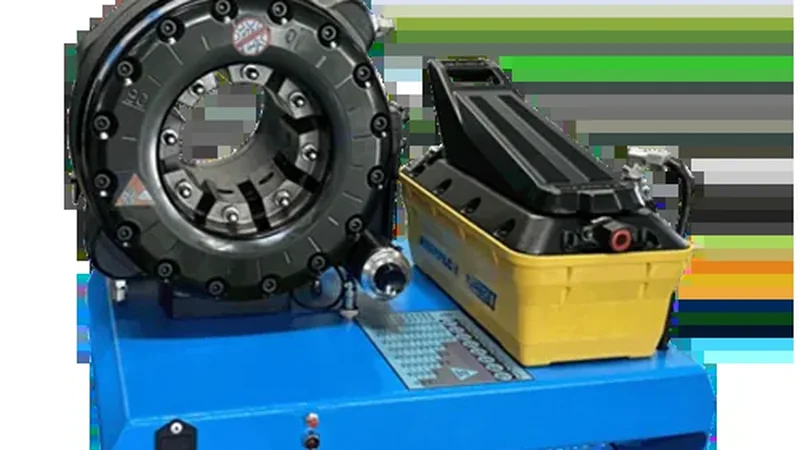
A high-pressure assembly that looks right on the bench can still be wrong. Validation is what separates a crimp that holds from a crimp that fails on the first impulse cycle.
| Test | Standard | What it tells you |
|---|---|---|
| Proof pressure | ISO 1402; typical 2× WP for 30–60 s | Assembly does not leak at twice rated pressure. |
| Burst pressure | ISO 1402; typical 4× WP minimum | Assembly survives to at least four times rated pressure. |
| Impulse cycling | SAE J343; 100,000–200,000+ cycles at ~133% WP | Assembly survives fatigue cycling. |
For high-pressure service, these tests are not optional. SAE J343 defines the impulse test procedure: the assembly is cycled between zero and roughly 133% of working pressure, at a controlled oil temperature, for a specified number of cycles. A correctly crimped 4SH assembly survives 200,000 cycles; a badly crimped one fails in the first few thousand. The failure mode is almost always pull-out or weep-at-the-ferrule, not hose burst.
The honest answer on validation. A workshop that crimps high-pressure hose for paying customers needs a proof test bench at minimum, and an impulse test capability if the customer spec requires it. Visual and dimensional checks catch gross errors. They do not catch the cold-weld failures that impulse testing catches.
See the heavy-duty category for the full TRC range.
Frequently Asked Questions
What tonnage machine do I need for high-pressure hose?
It depends on size and construction. A 1-inch 4SH assembly typically requires 100–137 ton. A 1-1/2-inch 4SH may require 200 ton. A 2-inch R13 requires 200–245 ton. Mining-grade 4-inch R13 can require 500 ton or more. When in doubt, size one class above the minimum for sustained production.
What is the difference between 4SH and 4SP hose?
Both are four-wire spiral hose to EN 856. 4SP is rated to higher pressure at smaller sizes; 4SH is a heavier construction rated to similar pressures at larger sizes. In practice, 4SH has a heavier wall and a heavier ferrule, which is why the tonnage requirement is higher for the same diameter.
Does high-pressure hose require skiving?
It depends on the fitting system, not the pressure class. One-piece no-skive fittings do not require skiving. Two-piece interlock fittings on spiral hose almost always require external skiving, and may require internal skiving as well. The fitting manufacturer's crimp data sheet specifies the skive depth and length.
Buyer question: how do I validate a high-pressure hose assembly?
With proof, burst, and impulse tests per ISO 1402 and SAE J343. Visual and dimensional checks are necessary but not sufficient. A proof test at twice working pressure catches leaks. An impulse test at 133% working pressure for the specified cycle count catches cold-weld failures that visual checks miss.
References and technical boundaries
- SAE J517 — Hydraulic Hose. Reference for SAE 100R hose specifications and pressure classes.
- SAE J343 — Test procedures for SAE 100R series hose assemblies. Defines proof, burst, and impulse tests.
- ISO/TS 17165-2:2018 — Hydraulic hose assemblies, practices. Supports the controlled-system principle.
- Wikipedia — Crimp (joining)). Reference for cold-weld mechanics and gas-tight crimp criteria.