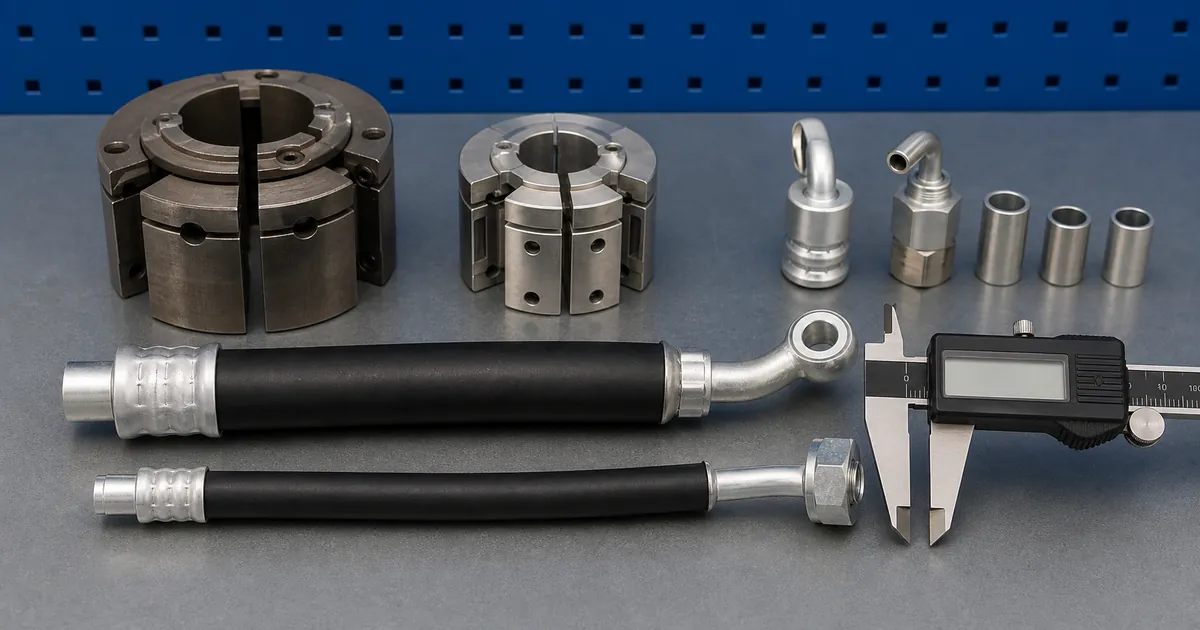
A reduced barrier AC hose crimper is not defined by pump type or force alone. Reduced-barrier hose uses a smaller outside envelope than many standard-barrier hoses, so the matching fitting, sleeve and die system can differ even when the nominal hose size looks familiar.
Mixing components by size label is a common route to leakage.
The size label hides the important difference
A workshop introduces reduced-barrier hose to save routing space but continues using the fitting and die assumptions from a standard-barrier line. Similar nominal hose sizes can have different outside diameters and ferrule requirements, making system identification the first control.
What changes with reduced-barrier hose?
The hose construction is designed to provide refrigerant containment with a smaller outside diameter. That affects the fitting stem, sleeve dimensions and tooling required to form the joint.
The exact values are system-specific. SAE J2064 provides standards context for coupled automotive refrigerant hose assemblies, but it does not publish one crimp diameter for every supplier.
| Feature | Standard-barrier route | Reduced-barrier route | Purchase consequence |
|---|---|---|---|
| Nominal hose ID | Can match the reduced-barrier label | Can match the standard label | ID alone cannot select the die |
| Outside envelope | Usually larger for a comparable ID | Smaller by design | Sleeve and die may be smaller |
| Fitting and sleeve | System-specific | System-specific | Do not cross-use by appearance |
| Crimp data | Belongs to the exact component row | Belongs to the exact component row | No universal diameter |
| Routing | More outside space required | Can suit tighter routing | Smaller OD does not simplify approval |
Workshop rule: If the hose marking, fitting series or sleeve identity changes, treat it as a new setup even when the size label stays the same.
Compatibility checklist
Before using an auto AC hose crimper, confirm:
- The hose marking and barrier type.
- The fitting and sleeve series approved for that hose.
- The uncrimped sleeve OD and length.
- The machine and die reference.
- The target finished dimension and measurement location.
- The required leak or pressure check.
If one item is missing, stop and obtain the component instruction.
Create one row per assembly rather than one row per hose size.
| Assembly row | Hose reference | Fitting and sleeve | Die | Finished target | Released? |
|---|---|---|---|---|---|
| Straight fitting | Exact part | Exact parts | Identified die | Current data | Only after first-off check |
| 45-degree elbow | Exact part | Exact parts | Identified die | Current data | Check loading clearance |
| 90-degree elbow | Exact part | Exact parts | Identified die | Current data | Check loading and removal |
| Long rigid tube end | Exact part | Exact parts | Identified die | Current data | Support during crimp |
This catches a problem that a size-only chart misses: the sleeve can be correct while the fitting geometry cannot enter the head.
Can a manual tool do the job?
A manual AC hose crimper can be suitable when it accepts the correct dies, has enough working space and provides a repeatable stop or setting. Manual operation is not the compatibility risk. The risk is using an undocumented component combination.
A powered machine can reduce effort and support repeated work, but it still needs the same component data.
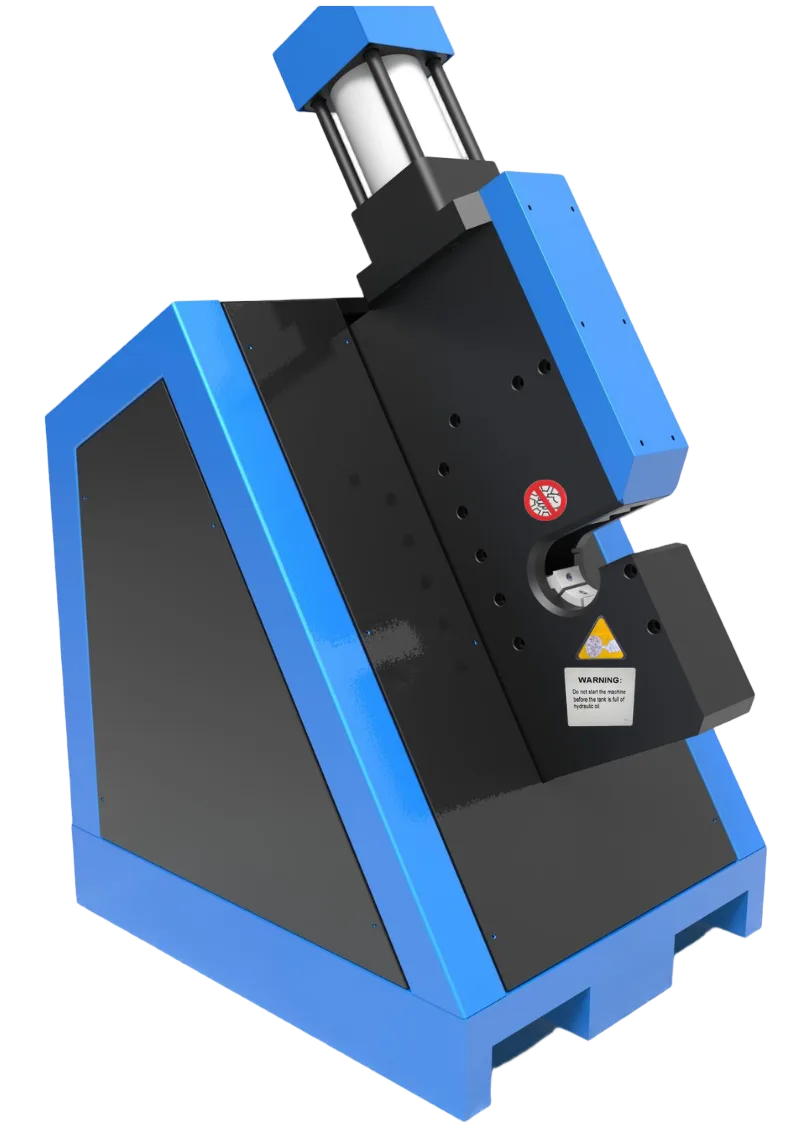
TRC records P70C for A/C hose, with a 0.16–2 inch crimp range and 20-ton maximum force. The product record excludes hydraulic-oil hose. It does not state that every standard- or reduced-barrier sleeve inside that range is covered.
Ask TRC to map the actual sleeve OD and fitting geometry to available tooling. Do not convert the broad machine range into a component approval.
Signs that the setup needs review
Do not accept a crimp automatically if:
- the sleeve shows uneven collapse;
- the hose moves relative to the insertion mark;
- the die closes at the end of its travel without reaching the specified result;
- the hose cover is pinched or cut;
- the measured sleeve is outside the supplier’s range.
Re-check the part identities before changing the setting.
| Symptom | First check | Unsafe response |
|---|---|---|
| Sleeve closes but target is not reached | Hose, sleeve and die identities | Repeatedly reduce the setting |
| Hose cover pinches near sleeve | Component match and insertion | Accept because the OD is correct |
| Fitting tilts during closure | Loading support and die seating | Hold the part near moving dies |
| Slow leak after installation | Full assembly and service record | Add a second crimp over the first |
Run a controlled standard-to-reduced changeover
Mixed shops should color-code storage only as a secondary aid. Labels and part numbers remain the authority.
- Clear the previous hose, sleeves and fittings from the bench.
- Return the previous dies to their identified location.
- Read the next hose marking and component instruction.
- Install the documented die and inspect its seating.
- Mark insertion depth and make one first-off assembly.
- Measure and release that piece before starting the batch.
Record who performed the changeover. If production later drifts, the shop can see whether the issue began with a component lot, die change or adjustment.
Buying advice
Ask the machine supplier to review photos, markings and dimensions from the actual reduced-barrier components. TRC’s air conditioning hose crimper category is the commercial next step, but a final recommendation should name the compatible component route.
Reduced barrier is a hose-system description, not a promise that any smaller die will work.
Price the extra tooling honestly
A manual AC hose crimper can look inexpensive until the buyer adds reduced-barrier dies, missing sleeves, a suitable cutter and measurement tools. Compare the complete operating scope.
ready-to-work cost = machine + standard-barrier tooling + reduced-barrier tooling + preparation tools + measurement + component stock
Leave any unresolved tooling row blank or mark it pending. Entering zero makes an incomplete quotation look artificially cheaper.
The same logic applies to training time. A shop moving between two systems needs a changeover rule and first-off record. That cost is smaller than repeated leak diagnosis, but it belongs in the plan.
Use a changeover check when both systems share a bench
Shops that handle standard and reduced-barrier hose should separate fittings, sleeves and dies by system. Similar labels invite substitution. A changeover sheet can require the operator to clear the previous components, confirm the next hose marking, retrieve the documented die and make a first piece.
Keep the first-piece record beside the job traveller. If the measured result changes after a die change, inspect die seating and component identity before adjusting the machine. The goal is to find the source of variation, not to “dial in” an undocumented combination.
A smaller hose is not automatically easier to crimp
Reduced outside diameter can improve routing, but the smaller envelope leaves less room for casual assumptions. Short fittings and elbows may also make positioning harder. Ask for a trial using the most constrained part, not only a straight sample that is easy to center.
SAE J3062 distinguishes hose requirements from the coupled-assembly requirements in J2064. This supports the practical rule: verify the complete component and process route.
Use a first-piece trial on the hardest fitting
Do not approve the machine using only a straight sample. Select the reduced-barrier fitting with the least loading space, such as an elbow close to the sleeve or a long rigid tube.
Record component identity, uncrimped sleeve OD, die, setting, insertion mark and finished measurement. Repeat the trial only after the first piece passes. This is acceptance evidence for that component row, not a blanket claim for every reduced-barrier hose.
Pro tip: Keep one physical sample only if your quality system allows it and the identity remains traceable. The written record is still needed because a loose sample can lose its context.
A simple inventory rule prevents most mix-ups
Store standard- and reduced-barrier hose, fittings and sleeves in clearly separated labeled locations. Do not depend on color alone because suppliers may use similar finishes.
The job traveler should carry the exact component references. The operator retrieves one complete row, makes the first piece and returns unused material before starting another system.
If an unlabeled sleeve appears on the bench, quarantine it. Measuring its OD may help identify candidates, but it is not enough to approve the part.
What a supplier must show in a reduced-barrier trial
Ask for a close photograph of the hose marking, fitting and sleeve before crimping. The trial record should also name the die, setting, finished measurement and measurement location.
Reject a video that shows only the head closing. It proves movement, not compatibility.
The supplier should repeat the trial after removing and reinstalling the dies. That simple changeover check shows whether the setup can be restored without relying on the first operator’s memory.
Keep the accepted row narrow: exact hose, fitting, sleeve, die and result. Do not turn one sample into a claim that the machine covers every reduced-barrier product.
Review the first ten shop jobs
Check whether technicians selected the right component row, whether any sleeve appeared in the wrong bin and whether finished measurements stayed within the documented route.
Ten jobs are not a reliability study. They are enough to expose poor labels, unclear storage and repeated changeover mistakes.
Correct the process before adding another reduced-barrier family.
Keep one clear rule at the counter: a reduced outside diameter does not mean the operator should choose the next smaller standard die. The hose, fitting and sleeve references must lead to the approved tooling row.
If the part identity cannot be established, do not crimp it.
That refusal can feel slow at the counter, but it is faster than diagnosing a leak from a sleeve and hose that were never approved together.
Label the held parts and keep them away from approved inventory.
Record why.
Why the wrong sleeve can still look convincing
Reduced-barrier hose can make a purchasing mistake harder to see because the assembly may carry the same nominal size label as a standard-barrier line. The hose outside diameter, sleeve wall, insert geometry and die profile can still differ. A die may close neatly and leave an even-looking surface while the component combination remains undocumented.
In an illustrative parts-counter scenario, a technician brings in a damaged line marked with nominal hose size but no readable component number. The counter has both standard and reduced-barrier stock. Choosing the smaller-looking hose from appearance alone would create four unknowns at once: hose construction, fitting insert, sleeve and die.
We would pause the job and identify the system from the vehicle/application record or responsible component catalog. Measure dimensions only as supporting evidence, not as permission to mix parts. Once the combination is known, confirm the die, finished measurement and any required leak-validation step.
Loading space deserves the same attention. Reduced outside diameter does not guarantee an easy crimp when a short sleeve sits beside a large 90-degree tube. Ask the supplier to show the actual fitting entering and leaving the head, or send a sample for trial.
Counter rule: If you cannot write the hose, fitting, sleeve and die on one line, you do not yet have a repeatable assembly route. Put the unidentified parts aside until the component system is resolved.
That rule may delay one repair. It also prevents an unknown combination from becoming the shop’s informal “standard” after it happens to hold pressure once.
Frequently asked questions
AC hose crimping tools: what works for reduced-barrier automotive A/C lines?
Use a crimper that accepts the die specified for the exact reduced-barrier hose, fitting and sleeve. Confirm the finished measurement and the awkward fitting geometry before buying.
Confirm the component route before the machine
Send hose markings, fitting and sleeve references, uncrimped OD, elbow geometry and workload through the TRC contact page. Compare the proposed tooling within the A/C crimper category.