A Vevor hydraulic hose crimper is an online-marketplace buying option, not a complete hose-assembly system by itself. The mistake we see buyers make is comparing force, price and the number of dies before they identify the hose, coupling, ferrule and finished crimp they must produce.
This article gives you a purchase audit, not a changing marketplace specification sheet. We do not assign force, durability or compatibility claims to a Vevor model unless the current seller documents them. We compare the evidence you receive with a supported TRC workshop route, then show where a compact marketplace tool can still be a sensible choice.
The short answer: audit the system, not the marketplace badge
| Question | Evidence that passes | Answer that does not pass |
|---|---|---|
| What can it crimp? | Exact hose, coupling, ferrule and crimp-data references | “Common hydraulic hose sizes” |
| Which dies are included? | Die IDs, ranges, profile and machine fit | A die count or color chart |
| How do you verify the result? | Measurement point, target diameter and first-piece record | “The ferrule looks tight” |
| What happens when a part wears? | Named replacement-die, seal and support route | “Standard parts are available” |
| Will it fit the shop? | Power, mounting, opening and elbow-loading check | A product photo with no dimensions |
Engineering Note: A crimper can have enough force and still be the wrong purchase. Force closes the tooling; the approved component system tells you what tooling and finished diameter to use.
A Reddit startup question shows why workload comes first
A Reddit buyer described two drilling rigs, more than 40 hoses expected over two years and a budget below $3,000. That is roughly 1.7 hoses per month before emergency peaks: 40 hoses ÷ 24 months = 1.67 hoses/month.
The calculation does not select a machine, but it changes the buying logic. At that frequency, a compact system may be easier to justify than a full production station, provided the buyer can obtain compatible components, dies and crimp data. If those 40 hoses span many brands and fitting systems, tooling and inventory become the harder problem than monthly volume.
| Worked-example input | Value from the Reddit scenario | What it changes |
|---|---|---|
| Planned hoses | 40+ | Enough work to compare ownership with outsourced repair |
| Planning period | 24 months | Low average volume, but emergencies remain uneven |
| Average calculated demand | 1.67+ hoses/month | Manual or compact power can remain practical |
| Equipment budget | Under $3,000 | Missing dies and support can consume the apparent saving |
| Machines served | 2 drilling rigs | Downtime and hose-system variety need separate review |
This is a worked interpretation of a public buyer question, not a TRC customer result.
Build the component schedule before you compare machines
Prepare a component schedule with:
- hose brand, family, size and reinforcement;
- coupling and ferrule references;
- ferrule OD before crimping;
- target finished diameter;
- required die profile and usable length;
- expected work per day or month.
The machine must have enough opening and suitable tooling, but that is only the mechanical layer. The assembly data must come from the hose-and-coupling system or a qualified technical review.
“Dies included” is packaging information, not compatibility proof
A Vevor hydraulic hose crimping tool may be offered with several dies. Count alone tells you little. Ask for each die’s identification, range, geometry and compatibility with the machine’s die seat.
The search phrase “hydraulic hose crimper harbor freight” often appears in the same budget comparison. Treat it as a shopping route, not a machine specification: inspect the current listing, included tooling and support evidence on their own terms.
A die that closes around a ferrule can still be wrong in profile or length. Choosing by hose ID alone is a common mistake because different fitting systems can use different ferrule dimensions for the same nominal hose size.
Gates’ hose assembly and die guidance tells operators to use current crimp data, load the specified die and measure the finished crimp. Those instructions apply to the Gates system, but the purchasing lesson is wider: the die list and the crimp-data responsibility must be visible before you buy.
Warning: Never treat “the die closes” as an acceptance test. An over-crimp can damage the hose or coupling; an under-crimp can leave an assembly that leaks or separates in service.
Manual, powered and workshop routes solve different workloads
For occasional repair work, compact size and simple power may matter more than speed. For regular workshop output, consider mounting, operator effort, die-change time, repeat settings, measurement records and access to replacement parts.
The same check applies to a hydraulic hose crimper from Harbor Freight, a marketplace seller or an industrial supplier. Compare complete operating systems, not brand labels.
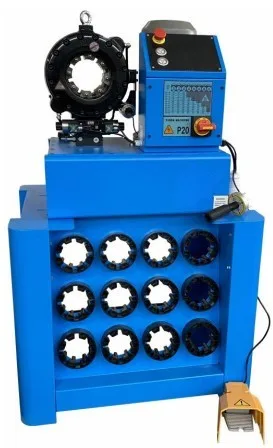
TRC’s product file gives two useful workshop reference points. The P20 is recorded at 137 ton with a stated range up to 1 1/2-inch 4-spiral hose. The P32 is recorded at 200 ton with a stated range up to 2-inch 4-spiral hose. These are TRC model facts, not claims about Vevor or Harbor Freight equipment.
| TRC reference route | Recorded force | Recorded hose statement | Better fit |
|---|---|---|---|
| P20 workshop family | 137 ton / 1370 kN | Up to 1 1/2-inch 4SP | Workshops whose documented component range stays inside the P20 envelope |
| P32 workshop family | 200 ton / 2000 kN | Up to 2-inch 4SP | Larger ferrules and 2-inch 4-spiral workshop requirements |
We do not recommend P32 merely because 200 ton is larger. Choose it only when the ferrule OD, opening, tooling and component schedule require the larger route. An oversized machine takes more capital and floor space without fixing undocumented components.
Seven documents separate a machine offer from a sales listing
Ask the seller for:
- A clear model identity and current manual.
- A complete packing list.
- Die data and replacement availability.
- Adjustment and calibration instructions.
- A proposed setup for your sample components.
- Photos or video showing the exact machine and tooling.
- Warranty and parts responsibilities in writing.
If you plan repeated production, request a sample crimp and measure it using the component manufacturer’s method. A single successful cycle is useful, but it does not replace the validation required for the end application.
Measure a first piece in more than one direction
Position and measurement come after component identity. Mark insertion depth, load the specified die and keep the ferrule aligned. Measure the finished crimp at the location required by the hose-system instructions; if the method requires readings in perpendicular directions, record both rather than choosing the smallest number.
Parker’s Karrykrimp 2 technical manual separates insertion marking, die selection, lubrication and workpiece position. The exact procedure belongs to Parker equipment, but it shows why “one button crimping” never replaces preparation and measurement.
Choose by ferrule OD, opening and elbow space
The hydraulic hose crimper selection resource starts with ferrule OD, production volume, power, opening and elbow-loading space. That framework is more reliable than selecting a machine because a listing uses the words “universal” or “professional.”
Use the listing to identify what is offered. Use component data and inspection to decide whether it is suitable.
A ready-to-work comparison exposes hidden cost
Put the marketplace offer and the supported alternative into the same worksheet. One row should cover the machine, another the pump or power unit, then the die sets, adapters, documentation, measuring tools, service parts and technical support. Write “not stated” rather than assuming an item is included.
The most revealing test is a sample built from the buyer’s own hose, coupling and ferrule. The seller should identify the die, setting and measurement point before the trial. After crimping, record the finished diameter in the positions required by the component instructions. If the offer cannot reach this stage, its low purchase price cannot yet be compared with a ready-to-work package.
| Cost line | Marketplace offer | Supported package | Buyer action |
|---|---|---|---|
| Base machine | Record current quoted scope | Record current quoted scope | Use the same Incoterm and voltage |
| Included dies | List every identified die | List standard and optional dies | Price missing sizes separately |
| Components and crimp data | Often outside the machine offer | Still controlled by the component system | Confirm supplier responsibility |
| Measurement | Check whether a gauge/caliper is included | State required tool and method | Add missing inspection equipment |
| Spares and support | Record named parts and response route | Record named parts and response route | Do not price vague promises as support |
| Freight and import | Add packing, freight and destination costs | Add the same cost categories | Compare landed scope, not website price |
Pro Tip: Write “not stated” in the comparison sheet. A blank cell is a purchasing risk; an assumption hides it.
Our view: a cheaper crimper is sensible only when the job is narrow
A compact unit may be reasonable for controlled, occasional work when the component range is narrow and the owner already has valid crimp data. It is a weaker fit when the shop expects many fitting families, daily die changes or rapid replacement support. Those demands are not a judgment on one brand; they are operating requirements.
TRC can compare a documented machine route against the same component schedule. That comparison should state the proposed opening, tooling route, power method and unresolved compatibility questions. It should not claim that a TRC die makes a third-party hose system valid.
The more varied the work becomes, the more you pay for information rather than raw force: current die data, fast changeovers, parts identity and technical review. This is why a more expensive supported machine can cost less per accepted hose in a mixed workshop, even when its purchase price is higher.
Use your own inputs:
Cost per accepted hose = (machine + dies + freight + setup + maintenance + rework + downtime) ÷ accepted hoses
Do not insert an assumed yield. Track accepted hoses and rework after the process starts. That turns the formula into evidence instead of a marketing forecast.
Record the decision even when you reject the machine. A short inspection note prevents the same unidentified press from returning through another seller under a new description.
Frequently asked questions
Is there such a thing as a universal crimper that uses dies for different hose brands?
The machine may accept several die sets and a wide mechanical range, but that does not make every cross-brand hose and coupling combination approved. You still need compatible hose, coupling and ferrule data, the specified tooling and a finished-crimp validation method.
Are Chinese crimpers worth considering against Parker, Gates or Eaton?
Yes, but only when you compare the complete configuration and support chain. Judge machine identity, die coverage, component data, sample evidence, replacement parts and landed cost; do not compare a bare Chinese machine price with a complete branded system.
How do I figure out which dies work with my fittings if the crimper has no chart?
Do not guess from hose ID. Record the hose, fitting and ferrule references, then obtain current crimp data from the component supplier or a qualified technical review. If the machine and dies cannot be identified, treat that as an unresolved safety and quality risk.
Ask for a comparison you can verify
Send the component schedule to TRC and request a line-by-line equipment proposal. The useful outcome is not “better than Vevor”; it is a configuration whose tooling, limits and inspection method are written down.
Continue with the hydraulic hose crimper category for machine formats, or use the starter-kit resource to check the cutter, cleaning, measuring and validation equipment around the crimper.