Hydraulic Hose Crimper
Compare TRC hydraulic hose crimper types by component system, ferrule OD, opening, power, output and loading space. Send sample data for a technical review.
Compare TRC hydraulic hose crimper types by component system, ferrule OD, opening, power, output and loading space. Send sample data for a technical review.
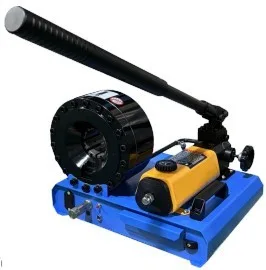
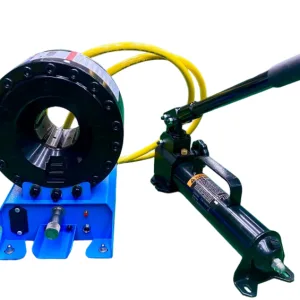
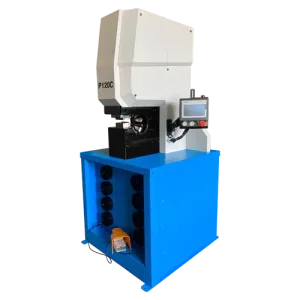
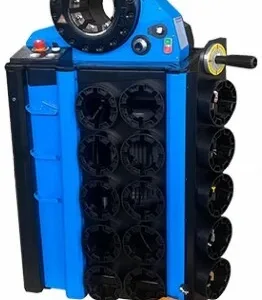
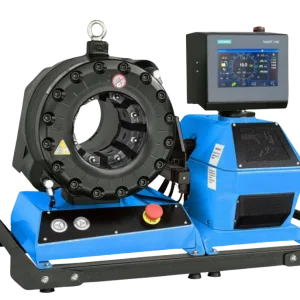
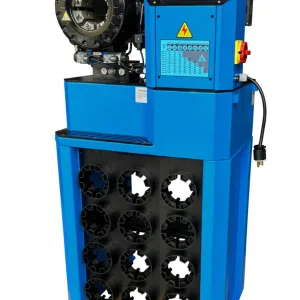
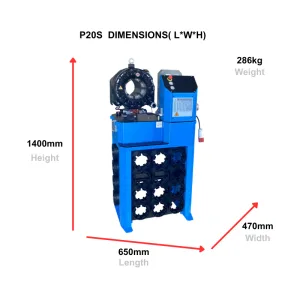
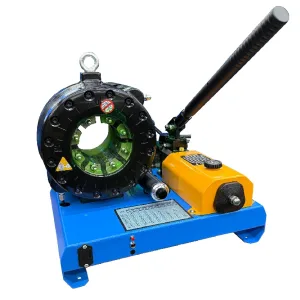
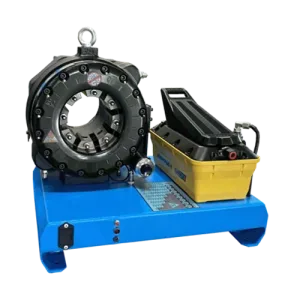
43 current machines | Manual, pneumatic, electric, mobile, heavy-duty and vertical routes
A hydraulic hose crimper should be selected around the assemblies you need to make—not around tonnage alone. TRC covers hand-pump, air-driven hydraulic, electric workshop, vehicle-powered, heavy-duty and vertical machines. We compare the hose and fitting system, ferrule outside diameter, target crimp data, maximum opening, loading clearance, available power and normal workload before recommending a series.
Send the smallest and largest representative assemblies whenever possible. A model remains a candidate until its tooling, loading envelope and finished-crimp requirements have been checked.
Start with the workpiece
“Up to 2 inch” is not a complete machine specification. Two hoses with the same nominal inside diameter can use different reinforcement, cover thickness, fittings, ferrules and finished crimp dimensions. Use the following inputs as the first selection gate.
Choose a working route
| Route | Suitable condition | Key limitation to check | Why it stays on the shortlist | Link |
|---|---|---|---|---|
| Manual | Low-frequency repair, simple utilities or no mains power | Operator effort, machine weight and assembly range | Removes dependence on workshop electricity when the workload remains realistic | /product-category/manual-hydraulic-hose-crimper/ |
| Pneumatic hydraulic | A workshop already has a suitable compressed-air system | Air-pump requirement, air supply and duty | Reduces repeated hand pumping while keeping a simple hydraulic crimping head | /product-category/pneumatic-hydraulic-hose-crimper/ |
| Portable / battery | Service truck, trailer or recurring field repair | Vehicle power, weight, footprint, tooling and inventory | Moves a controlled crimping process closer to the machine being repaired | /product-category/portable-hydraulic-hose-crimper/ |
| Electric workshop | Regular fixed-location work | Voltage, phase, opening, controls and changeover | Supports repeatable workshop flow and a broader choice of controls | /product-category/electric-hydraulic-hose-crimper/ |
| Heavy duty | Large ferrules, demanding hose construction or industrial workpieces | Actual ferrule OD, opening, dies and material handling | Covers work that exceeds standard workshop-machine geometry or force | /product-category/heavy-duty-hydraulic-hose-crimper/ |
| Vertical | Long elbows, short 90-degree fittings or access-sensitive loading | Actual workpiece path and US18/US20 tooling | Changes the loading orientation where a conventional front opening is awkward | /product-category/vertical-hydraulic-hose-crimper/ |
These routes describe operating conditions, not quality grades. A manual machine can be correct for controlled low-frequency work, while an electric or CNC machine can still be wrong if the assembly does not fit its opening or tooling.
Component-system control
The hose, fitting, ferrule, die and machine setting must lead to the finished result specified by the responsible component system. A crimper from another brand may be physically capable of producing that result, but the setting and tooling need valid data or a documented validation process. Do not assume compatibility because the parts fit inside the head or because one sample survives a short pressure check.
ISO/TS 17165-2 treats hydraulic hose assemblies as a complete selection, fabrication, installation and maintenance task. Gates’ eCrimp database is a manufacturer-specific example of selecting the crimper, hose, coupling and die together. TRC does not copy Gates settings; the example shows why component-specific crimp data matters.
Do not send only the hose ID. Send hose marking, fitting and ferrule references, pre-crimp ferrule OD, target diameter and representative samples.
Acceptance is measured
Review the scope of SAE J343 when the relevant SAE 100R hose-assembly test program applies.
Evidence before claims
TRC is a hydraulic hose equipment manufacturer serving overseas projects from application confirmation and configuration review through factory production, inspection coordination and export delivery. For a useful review, the evidence set should show the actual machine, nameplate or electrical configuration, supplied dies and accessories, representative crimped samples, the measurement position and the operating sequence.
Continue with the next decision
Questions buyers and hose technicians actually ask
List the hose and fitting systems found on the equipment, the largest ferrule OD, repair frequency and whether hoses are made in a workshop or at the machine. A fixed electric crimper may suit a central repair shop; a portable system may reduce travel for recurring field failures. The same machine still needs valid dies and crimp data for each assembly program.
The machine brand alone does not approve or reject the assembly. Use a hose, fitting and ferrule combination with valid crimp specifications, then confirm that the TRC machine and die can produce the specified result. Do not create a cross-brand combination by trial and error when no responsible party provides data or validation.
Confirm the component combination, preparation and insertion; measure the finished diameter at the specified positions with a suitable calibrated tool; inspect the assembly and apply the required test or sampling plan. A smooth appearance or a completed machine cycle is not enough by itself.
Do not accept or reject it from appearance alone. Stop and check that the assembly was loaded squarely, the correct die and setting were used, and the measured result meets the component specification at every required location. Repeated taper can also indicate a loading, tooling, wear or machine-condition issue that needs investigation.
Do not select dies from nominal hose ID alone. Hose construction, outside diameter, fitting, ferrule and target crimp diameter may differ. Use the valid crimp data for each exact assembly.
A machine may cover a broad physical diameter and force range, but it cannot make every component combination valid. “Universal” should be limited to the documented machine opening, force, tooling and control range; assembly compatibility remains component-specific.
Application review
Provide hose and fitting references, ferrule OD, target crimp data, smallest and largest samples, normal workload, available power and loading constraints. TRC will return a candidate route, the unresolved checks and the configuration information needed for quotation.