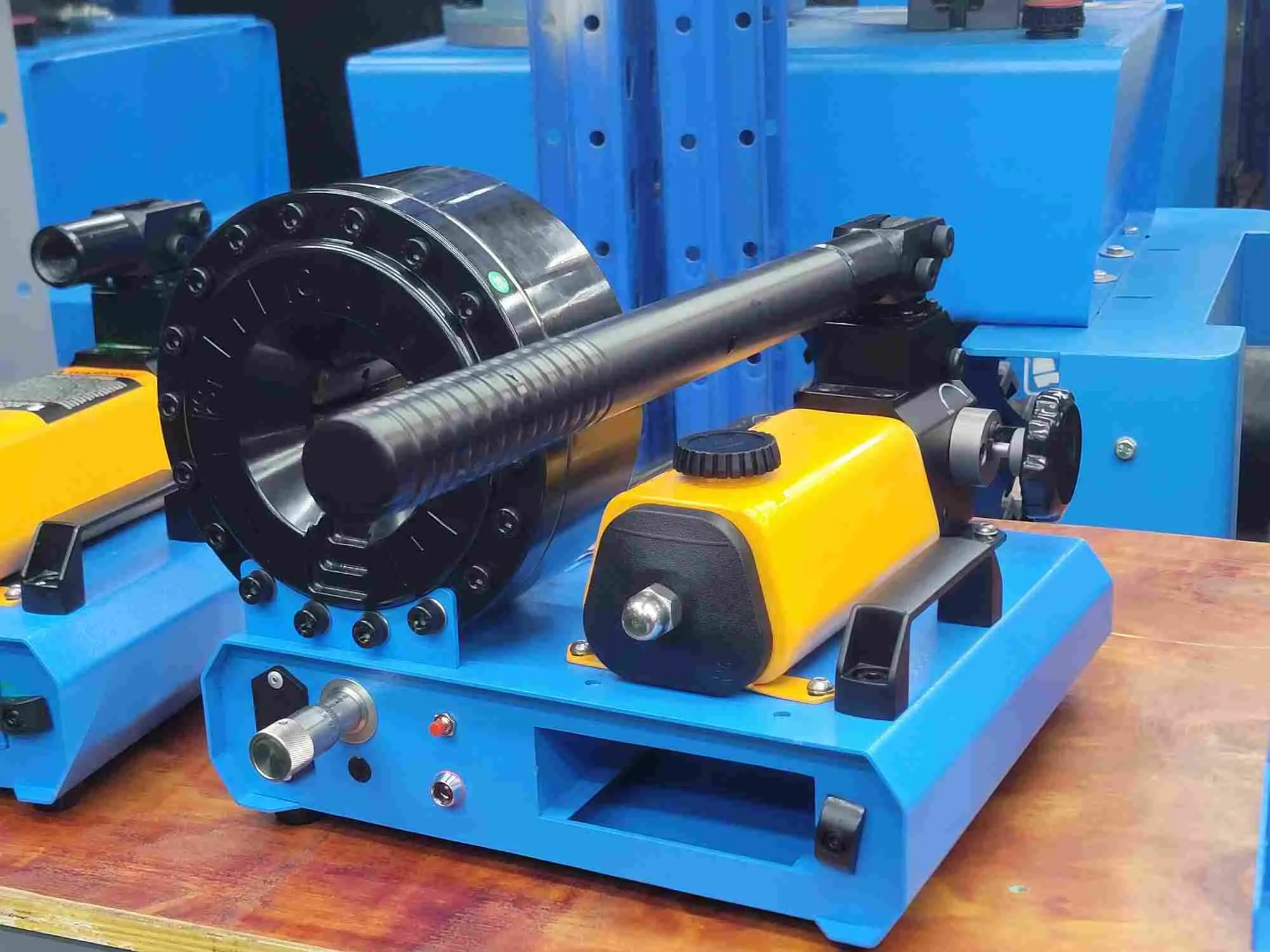
Hydro Crimping Tool: Why Hydraulic Force Beats Mechanical and Pneumatic
A hydro crimping tool uses hydraulic force — not muscle — to compress ferrules onto hose. That sounds simple enough, but the power source you choose changes everything: speed, cost, and crimp consistency.
Here’s how the three main options — hand pump, electric, and battery — compare in real workshop conditions for hydraulic crimping professionals.
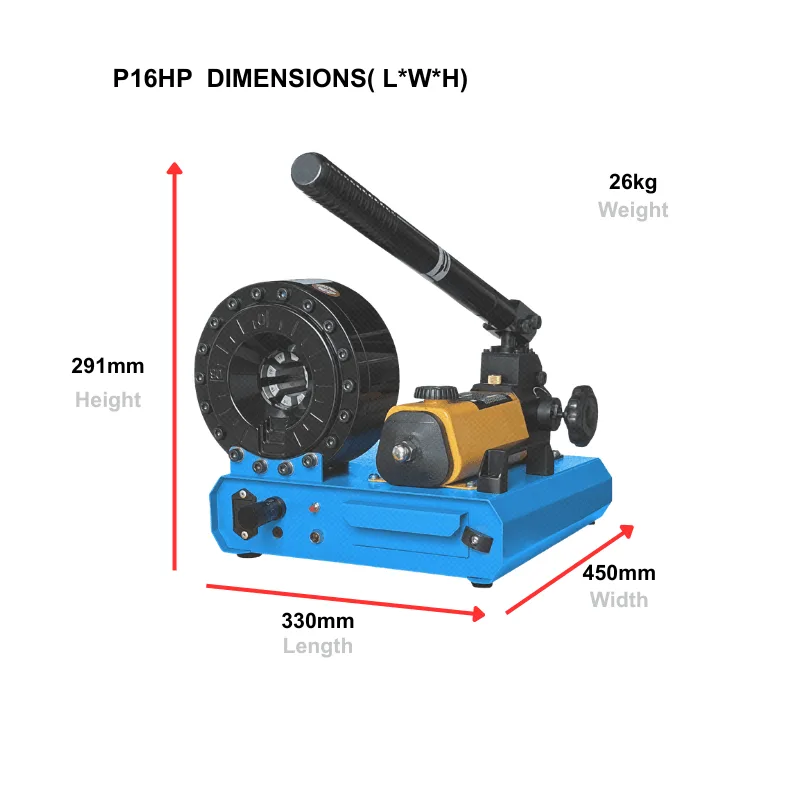
Tabla de Contenidos
- ¿Qué es una herramienta de prensado hidráulico?
- Comparación de tres fuentes de energía
- Comparación Lado a Lado
- Cuándo gana cada fuente de energía
- Los números de fuerza hidráulica
- Die Set Selection
- Open Head vs Closed Head
- Prueba de presión después del prensado
- Real-World costo por prensado
- Preguntas frecuentes
¿Qué es una herramienta de prensado hidráulico?
A hydraulic crimping tool — also called a hydraulic crimper tool or hydraulic compression tool — uses Pascal’s Law to multiply a small input force into enough pressure to deform metal ferrules.
A 10 kg push on a hand-pump lever becomes 100+ tons of radial force at the die face. That force multiplication is why hydraulic hose crimpers replaced mechanical and pneumatic methods in professional hose shops.
Un ciclo de prensado toma 8-15 segundos y produce una conexión permanente sin fugas con clasificación de 6.000 PSI de presión de trabajo.
Comparación de tres fuentes de energía
Every hydro crimping tool on the market uses one of three power sources. Each has specific advantages and limitations.
1. Bomba Manual (Hidráulica Manual)
El operador acciona una palanca para generar presión hidráulica. Sin electricidad, sin batería, sin compresor de aire.
| Especificación | Typical Range |
|---|---|
| Tonelaje | 60–137 T |
| Cycles por carga/tank | Unlimited (human powered) |
| Peso | 8–35 kg |
| Coste | $300–1,200 |
| Best for | reparación de campo, remote sites |
Real limitation: Operator fatigue. After 30-40 crimps in a day, your arms notice it. For daily production above 50 assemblies, hand pump is the wrong choice. But for a service truck doing 5-10 field repairs per week, manual hydraulic hose crimpers are ideal.
2. eléctrica Motor (taller Hydraulic)
Un motor eléctrico acciona la bomba hidráulica. El operador presiona un botón o pedal para iniciar el ciclo de prensado.
| Especificación | Typical Range |
|---|---|
| Tonelaje | 60–1,750 T |
| Cycle time | 8–20 seconds |
| Energía | 220V / 380V |
| Coste | $1,500–8,000 |
| Best for | Daily production, taller |
Real limitation: You need electricity and a bench. An electric hydraulic hose crimping machine isn’t portable. But it crimps faster, more consistently, and handles larger hose diameters than any hand-pump unit.
3. Battery (inalámbrica Hydraulic)
Una batería de ion-litio acciona un pequeño motor que genera presión hidráulica. Misma fuerza de prensado que una unidad de bomba manual, pero sin bombear.
| Especificación | Typical Range |
|---|---|
| Tonelaje | 60–200 T |
| Crimps por carga | 80–150 |
| Charge time | 30–60 minutes |
| Coste | $2,000–5,000 |
| Best for | servicio móvil trucks |
A battery-powered unit costs 3-5× more than an equivalent hand-pump unit. In cold weather (-10°C and below), battery life drops 30-40%. Always carry a spare battery if you’re running one of these on a service truck.
Comparación Lado a Lado
| Factor | Hand Pump | Eléctrica | Batería |
|---|---|---|---|
| Initial cost | $300–1,200 | $1,500–8,000 | $2,000–5,000 |
| costo por prensado (500 crimps) | $0.60–2.40 | $3.00–16.00 | $4.00–10.00 |
| Daily volume capacidad | 30–60 | 100–300+ | 60–120 |
| Max diámetro de manguera | 2″ | 6″ | 2″ |
| Needs eléctricaity | No | Yes (220V/380V) | No (battery) |
| Crimp consistencia | Depende del operador | máquina-controlled | máquina-controlled |
| operador fatiga | High after 30+ prensados | Ninguno | Ninguno |
Cuándo gana cada fuente de energía
Choose Bomba Manual When:
- Hace menos de 50 conjuntos por semana
- Trabaja fuera de la red: minas, granjas, sitios de construcción sin energía
- El presupuesto es inferior a $1.500
- Necesita respaldo para cuando la máquina eléctrica está parada
Choose eléctrica When:
- Hace más de 20 conjuntos por día
- Trabaja en un taller fijo con energía
- Necesita control CNC para trazabilidad ISO
- Prensa mangueras de más de 2″ de diámetro
Choose batería When:
- You’re running a mobile hose service truck
- Da servicio a múltiples sitios en un día
- Necesita velocidad sin sacrificar portabilidad
- Budget allows $2,000+ and you carry spare batteries
For a deeper comparison of machine types, see our hose crimping machine types guide. For setup instructions, check our machine setup walkthrough.
Los números de fuerza hidráulica
Understanding why hydraulic crimpers generate so much force comes down to basic fluid mechanics. Pascal’s Law states that pressure applied to a confined fluid transmits equally in all directions.
Here’s what that means in practice:
- A hand-pump lever applies roughly 30 kg of force to a 2 cm² piston
- That creates 150 bar (2,175 PSI) of presión hidráulica
- A 200 cm² crimp cylinder converts that to 30,000 kg (30 tons) of crimp force
- A large CNC machine with a 1,000 cm² cylinder at 350 bar produces 350,000 kg (350 tons)
That’s why hydraulic force beats mechanical advantage every time. A mechanical toggle press of similar force would weigh 5× more and cost 3× more.
Selección de juego de matrices: la parte que la mayoría hace mal
El juego de matrices contacta la férula directamente. Si se equivoca aquí, ninguna calidad de máquina lo salvará.
Die Compatibility Rules
- Match die series to machine model. A P16 die won’t fit a P32 crimper. The die holder geometry is different.
- Match die number to hose size + fitting type. A ¾″ one-piece fitting uses a different die than a ¾″ interlock fitting.
- Check die wear every 5,000 crimps. Profesional crimper dies are Cr12MoV or SKD11 tool steel, hardened to HRC 58-62. They last 5,000-10,000 crimps.
norma vs Non-norma Dies
| Die Type | Availability | Tiempo de Entrega | Use Case |
|---|---|---|---|
| Estándar | Stock | 1-3 days | Common tamaños: ¼″–2″ R1/R2 |
| Non-norma (*) | Custom order | 7-14 days | Oversize, specialty conexiones |
According to SAE J517 and ISO 17165, die-to-hose compatibility is the single biggest factor in crimp quality. The crimping process requires precise die geometry, and using mismatched dies voids the tolerance specification.
Cabeza abierta vs cabeza cerrada: cuándo importa
El diseño de la cabeza de prensado determina qué conexiones puede prensar. Esta es una diferencia de capacidad, no una mejora de rendimiento.
Closed Head (norma)
El portamatrices forma un anillo completo. Las matrices se cierran concéntricamente desde todos los lados. Los prensados más consistentes con la tolerancia más estrecha (±0,03 mm con CNC).
Trade-off: you can only crimp straight fittings. A 90° elbow won’t fit.
Open Head (Specialized)
El portamatrices se abre horizontalmente. Esto le permite prensar mangueras preformadas — codos de 90°, ángulos de 45°, curvas en S. Las máquinas de cabeza abierta sacrifican concentricidad por flexibilidad. La tolerancia es ±0,05 mm.
| Factor | Closed Head | Open Head |
|---|---|---|
| Precisión de prensado | ±0.03 mm | ±0.05 mm |
| 90° codo capable | No | Sí |
| Best for | de alto volumen straight assemblies | Custom shapes, reparación de campo |
| Price premium | Base | +15-25% |
For specialized applications, our vertical hydraulic hose crimpers handle 90° fittings in tight spaces. The heavy-duty series covers large-diameter hose up to 6″.
Prueba de presión después del prensado
Every new hose assembly must be pressure tested before service. SAE J517 and ISO 17165 both require proof testing at 2× working pressure.
Proof Test Procedure
- Connect the assembly to a hydraulic test pump.
- Fill with clean fluido hidráulico. Bleed all air.
- Pressurize to 2× rated working pressure (e.g., 3,000 PSI assembly → 6,000 PSI test).
- Hold for 5-30 segundos.
- inspeccionar for fugas at both conexiones and along the hose body.
- Release presión slowly. registro the result.
If a fitting leaks during proof test, don’t re-crimp. Cut off the fitting, prep a new hose end, and crimp again. For more on die compatibility, see our crimping tool selection guide.
Real-World costo por prensado
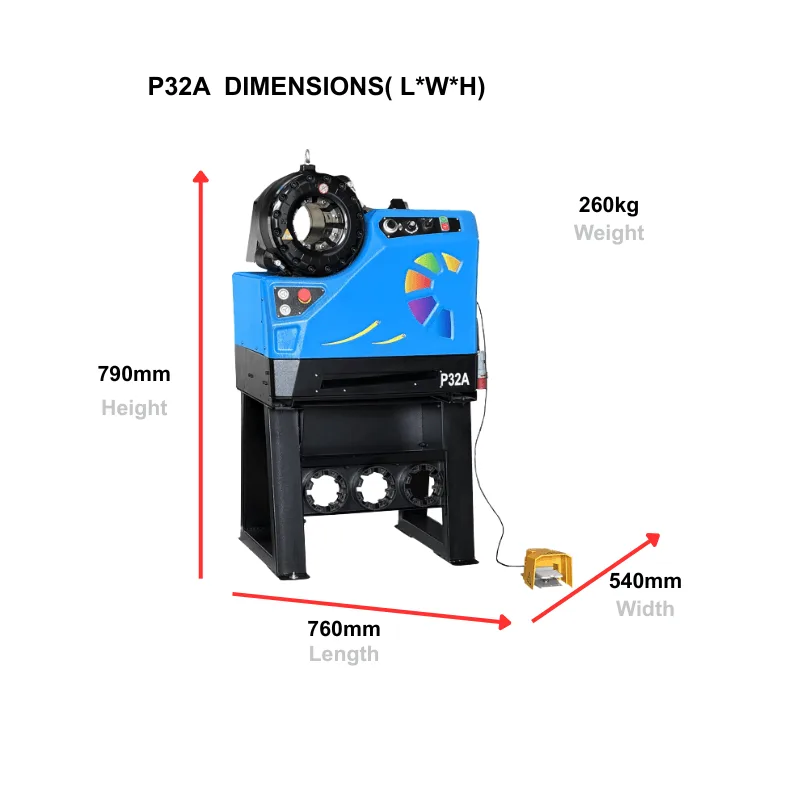
| Cost Factor | Bomba de mano (P16HP) | eléctrica CNC (P32A) | batería (P20CSZ) |
|---|---|---|---|
| Machine cost | $600 | $3,200 | $3,500 |
| Juegos de matrices incluidos | 8 sets | 14 sets | 6 sets |
| máquina costo por prensado (5,000 crimps) | $0.12 | $0.64 | $0.70 |
| Labor por prensado (2 min @ $25/hr) | $0.83 | $0.83 | $0.83 |
| Materials (hose + conexiones) | $8-15 | $8-15 | $8-15 |
| Total por ensamblaje | $9-16 | $9-16 | $10-17 |
The machine cost per crimp is negligible compared to labor and materials. The real question is which power source fits your work environment and daily volume.
Maintenance: Keep the Hydraulic Crimper Working
Every hydro crimping tool — whether a the hydraulic crimper for daily production or a field unit — needs three things to stay reliable:
- Hydraulic oil changes — every 2,000 cycles or 12 months. Old oil carries metal particles that score cylinder walls.
- Seal inspection — every 6 months. If you see oil weeping from the ram seal, replace it before it fails during a crimp.
- Die cleaning — after every use. Metal shavings between die segments cause uneven crimps and die damage. See hydraulic machinery maintenance principles for background.
Some workshops run a bench-top CNC machine for daily production and keep a hand-pump portable unit as backup. The CNC machine goes down for maintenance once or twice a year. During those 4-8 hours, a $600 manual crimper keeps production running. These hydraulic clamping tools are also used as standby hydraulic crimping equipment on mining and construction sites.
Not Sure Which Crimper You Need?
Compare all 9 product serie — from 60 T portátil to 1,750 T de servicio pesado CNC.
Preguntas Frecuentes
¿Es una herramienta de prensado hidráulico lo mismo que una prensa hidráulica?
No. A hydraulic press applies force in one direction (typically downward). A hydraulic crimping tool applies radial force inward from all sides simultaneously — that’s what creates the uniform crimp.
¿Puedo usar una prensadora hidráulica en mangueras no hidráulicas?
Yes — for air lines, water hoses, and low-pressure applications. The crimper doesn’t know what’s inside the hose. Make sure the die size matches the ferrule.
¿Cuánto dura una prensadora hidráulica?
Con el mantenimiento adecuado (cambios de aceite, reemplazo de juntas, limpieza de matrices), 10-15 años de uso diario es común. Prevea $100-200 por año en piezas de mantenimiento.


 English
  Español
  Русский