Tabla de Contenidos
¿Qué son las pinzas de prensado de mangueras?
Pinzas de prensado de mangueras are hand tools designed to close ear clamps, spring clamps, and single-use crimp rings on low-pressure hoses. Think fuel lines, coolant hoses, air intake tubing, and vacuum lines.
They cost $15–$60 and weigh under a pound. A set belongs in every mechanic’s toolbox — but they are not, and never will be, a substitute for a prensa hidráulica when you’re assembling high-pressure hose.
The confusion starts because both tools “crimp.” But the physics, the force, and the result are completely different.
According to Wikipedia’s definition of crimping, it’s “a method of joining metal by deforming one or both pieces.” Pliers deform a thin steel or aluminum clamp around a hose barb.
A hydraulic crimper compresses a steel ferrule into the hose reinforcement layer at forces up to 1100kN. These are not the same operation.
Dónde funcionan las pinzas: Abrazaderas de manguera de baja presión
Estas herramientas manuales manejan bien tres tipos de abrazaderas:
| Tipo de abrazadera | Cómo funcionan las pinzas | Presión típica | Aplicación |
|---|---|---|---|
| Abrazadera de oreja (Oetiker) | Jaws squeeze the “ear” closed | <5 bar | Líneas de combustible, refrigerante, vacío |
| Abrazadera de resorte | Las pinzas expanden la abrazadera para extracción/instalación | <3 bar | Refrigerante, manguera de calefacción |
| Abrazadera de gusano | Las pinzas aprietan el mecanismo de tornillo | <10 bar | Admisión de aire, radiador |
Todas estas son conexiones de baja presión y baja responsabilidad. Si falla una abrazadera de manguera de refrigerante, se produce una fuga en el suelo del taller.
If a hydraulic hose crimp fails at 250 bar, you get a high-pressure fluid injection injury. The tool needs to match the risk.
One Reddit user on r/Hydraulics asked about a “$500 press” for making hoses at home. The consensus: skip the pliers-class tools and get a proper manual hydraulic hose crimper even for occasional use.
Dónde fallan las pinzas: Conjuntos de mangueras hidráulicas
Here is exactly where these pliers hit a wall — and it’s a hard one:
1. Fuerza insuficiente
A pair of pliers delivers maybe 200–500N of force through your grip. A hydraulic hose crimper uses Pascal’s law to multiply force through cylinder area, delivering 80–200 tons (800–2000kN) to the die set.
That’s a 1,600× difference. No grip strength workout closes that gap.
2. Sin control de matriz
Pliers have fixed jaws. They can’t profile a crimp to match a specific ferrule inner diameter.
A crimper die set is machined to ±0.03mm for each hose-fitting combination — a measurement taken with a vernier caliper according to the manufacturer’s crimp specification table. Pliers give you one shape: “squished.”
3. Sin repetibilidad
Every crimp with pliers is slightly different — different hand pressure, different angle, different jaw position. On a hydraulic system, that means some assemblies hold and some blow off at pressure. A hydraulic crimper with CNC control hits the same crimp diameter every single cycle.
4. Material incorrecto
Las pinzas deforman abrazaderas blandas (aluminio, acero al carbono fino). Las férulas hidráulicas son de acero endurecido.
Try crimping a #6 SAE flange ferrule with pliers and you’ll round the jaws before making a dent. As Wikipedia notes, hose clamps are designed for “attaching and sealing a hose onto a fitting such as a barb” — a low-pressure connection, not a high-pressure hydraulic assembly.
Pinzas vs prensadora hidráulica: Comparación lado a lado
| Especificación | Hose Crimping Pliers | Prensadora hidráulica manual (P16HP) |
|---|---|---|
| Fuerza máxima de prensado | ~500N | 950kN (95 ton) |
| Hose size range | 1/4″–3/4″ (low pressure only) | 1/4″–1″ (up to 4SP) |
| Tolerancia de prensado | Sin especificación — depende del operador | ±0.03mm |
| Ferrule type | Solo abrazaderas de oreja blandas | Steel ferrules, one-piece & interlock |
| Working pressure | <10 bar | Hasta 420 bar (SAE 100R12) |
| Repetibilidad | Ninguno | Cada prensado idéntico |
| Coste | $15–$60 | $400–$1,200 |
| Peso | <1 lb | 34 kg (P16HP) |
| Standards compliance | N/D | SAE J517, ISO 8434 |
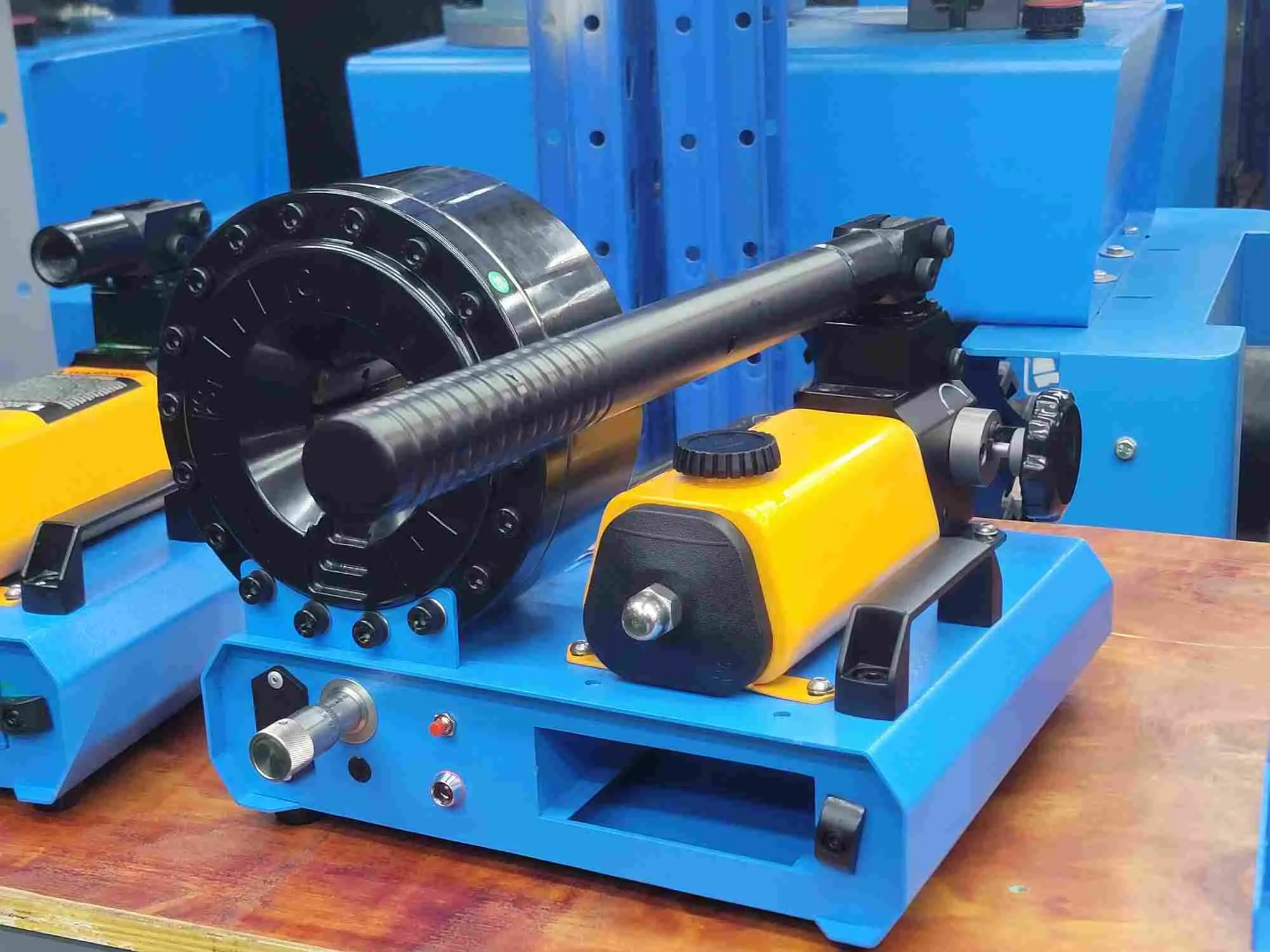
The P16HP is TRC’s lightest prensa hidráulica. It weighs 34 kg and runs on a hand pump — no electricity needed. The 95-ton crimp force handles hoses from 1/4″ up to 1″ (2SP), which covers the majority of mobile equipment and workshop assemblies.
El umbral de presión: Cuándo debe cambiar
The line between pliers and a real crimper is simple: if the system pressure exceeds 10 bar (150 psi), pliers are the wrong tool.
Here’s why that number matters:
- Coolant hoses run at 1–2 bar → pliers are fine
- Fuel lines run at 3–5 bar → pliers with ear clamps work
- Power steering runs at 70–100 bar → need a proper crimper
- Hydraulic systems run at 100–420+ bar → only a hydraulic crimping machine
A hose crimped with pliers on a 200-bar system will not hold. The ferrule won’t compress enough to grip the hose reinforcement layer.
According to industry crimping standards, incorrect crimp diameter is the #1 cause of fitting blow-offs. Under pressure, the fitting separates — and hydraulic fluid escaping at 200 bar through a 1/2″ hole moves fast enough to cause injection injuries.
If you’re setting up a mobile repair service or a small workshop, skip the pliers for anything hydraulic. Start with a manual hydraulic hose crimper like the P16HP.
It’s not expensive relative to the liability of a failed crimp. The ISO 8434 standard exists for a reason.
Preguntas Frecuentes

¿Puedo usar pinzas en mangueras hidráulicas?
No. Pliers cannot generate the force needed to compress hardened steel ferrules onto hydraulic hose reinforcement. You need a prensa hidráulica with the correct die set for your hose and fitting combination.
¿Cuál es la diferencia entre pinzas de prensado de mangueras y una prensadora hidráulica?
Pliers deform soft ear clamps and spring clamps at low pressure (<10 bar). A hydraulic crimper compresses steel ferrules at 80–200 tons of force, creating permanent seals rated for 100–420+ bar working pressure.
¿Son seguras las abrazaderas de oreja para líneas hidráulicas?
No. Ear clamps are rated for low-pressure applications only. Hydraulic lines require crimped or swaged ferrule fittings that meet SAE J517 and ISO 8434 standards.
¿Qué herramienta de prensado de mangueras necesito para trabajo automotriz?
For fuel and coolant lines under 5 bar: pliers with ear clamps. For power steering, transmission cooler, and A/C lines: you need a manual hydraulic crimper with the right dies.
¿Pueden las pinzas prensar abrazaderas de acero inoxidable?
Some heavy-duty pliers can close stainless ear clamps on large-diameter coolant or air hoses. But this is still a low-pressure connection. Stainless clamps don’t make pliers suitable for hydraulic assemblies.
¿Qué pasa si prenso una manguera hidráulica con pinzas?
The ferrule won’t compress enough to grip the hose reinforcement. Under system pressure, the fitting separates from the hose. At 200+ bar, this creates a high-pressure fluid stream capable of causing injection injuries.
Do I need a hydraulic crimper for 1/4″ hose?
Yes, if it’s a hydraulic hose running above 10 bar. Even small-diameter hydraulic hoses (1/4″ SAE 100R1) operate at 200+ bar working pressure. Use a hydraulic crimping machine with the correct die.
¿Cuánta fuerza aplica una prensadora hidráulica frente a las pinzas?
Pinzas: ~500N a través del agarre manual. Prensadora hidráulica: 800–2000kN (80–200 toneladas) mediante multiplicación de presión hidráulica. La diferencia es aproximadamente 1.600×.
¿Necesita una prensadora real?
Pliers won’t cut it for hydraulic hose. TRC manufactures manual, electric, and portable hydraulic crimpers — starting from 95 tons of crimp force.
Artículos Relacionados


 English
  Español
  Русский