
Hose Crimping Machine Types: Guillotine, CNC, and Bench-Top Compared
Not every hose crimping machine does the same job. Some sit on a bench and run 200 crimps before lunch. Others ride in a service truck and run on batteries.
And one type — the guillotine — doesn’t crimp at all; it cuts. Here’s how to tell hose crimping machine types apart and pick the right one for your work.
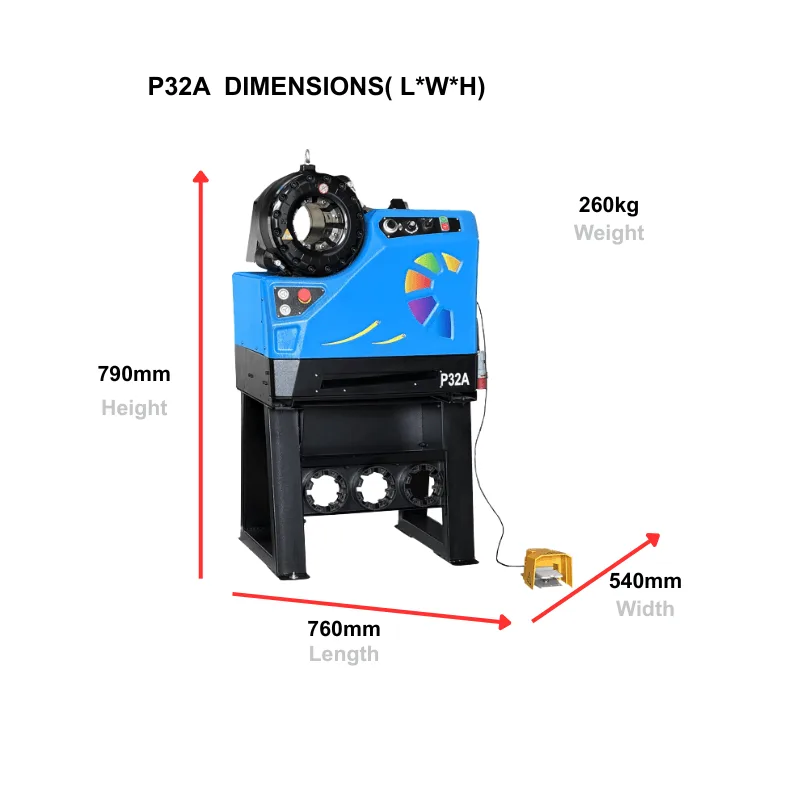
Tabla de Contenidos
- 3 máquina Types Every taller Needs
- Bench-Top vs portátil vs Guillotine
- Cómo elegir: 3 preguntas
- Flujo Completo de Ensamblaje de Mangueras
- CNC vs Manual Control
- Skiving: The Step You Can’t Skip
- SAE J517 norma de mangueras
- Seguridad de la máquina prensadora
- 5 Signs Your Machine Needs Service
- Preguntas frecuentes
3 tipos de máquinas prensadoras de mangueras que todo taller necesita
The market divides hose crimping equipment into three categories based on function and scale.
Tipo 1: Máquina prensadora de banco
This is the workhorse. Bolted to a bench, powered by electricity, designed to run all day. A bench-top hose crimping machine handles the full range of hydraulic hose — from ¼″ to 6″ depending on tonnage.
| Especificación | Entry (120 T) | Mid (300 T) | producción (800+ T) |
|---|---|---|---|
| Hose range | ¼″–1½″ | ¼″–3″ | ½″–6″ |
| Control | Manual / Auto-return | Auto-return / CNC | CNC con registro de datos |
| Cycle time | 12–20 seconds | 8–15 seconds | 8–12 segundos |
| Daily capacity | 80–120 crimps | 150–250 crimps | 200–400+ prensados |
| precio Range | $1,500–3,000 | $3,000–5,000 | $5,000–15,000 |
The key spec that separates entry from production isn’t tonnage — it’s control type. A CNC hose crimping tool stores crimp parameters and repeats them with ±0.05 mm accuracy. See our prensa hidráulica overview for the full range.
Tipo 2: Máquina prensadora portátil / de campo
Diseñada para camiones de servicio y reparación de campo. Ya sea de bomba manual o a batería. La contrapartida siempre es portabilidad vs. capacidad de diámetro de manguera.
- Hand-pump units (60–137 T): ¼″–2″ hose, 8–35 kg, $300–1,200. See manual hydraulic hose crimpers.
- Battery units (95–200 T): ¼″–2″ hose, 10–25 kg, $2,000–5,000. Cordless, 80-150 crimps per charge.
- Vertical inline units (180–200 T): ¼″–1½″ hose, 15–20 kg. For 90° fitting crimps in tight spaces. See US18 & US20 vertical crimpers.
Tipo 3: Guillotina / Máquina de corte de mangueras
Not a crimper at all — but a required part of the hose crimping workflow. A guillotine-style Máquina de corte de mangueras produces square, clean cuts required before crimping.
- Manual cutter: $100–400, hand-operated blade, ¼″–2″ hose
- Semi-auto cutter: $500–1,500, motor-driven blade, auto-clamp, ¼″–3″ hose
- CNC cutter: $2,000–4,000, programmable length, barcode integration, ¼″–6″ hose
A bad cut (angled, crushed, or ragged) means a bad crimp. An Amoladora produces ragged ends that prevent ferrule seating.
Comparison: Bench-Top vs Portable vs Guillotine
| Factor | Bench-Top | Portátil | Cizalla |
|---|---|---|---|
| Primary function | Prensado | Prensado | Corte |
| Location | Fixed workshop | Field / truck | Taller |
| Energía | 220V / 380V | Hand / Battery | 220V / Manual |
| Volumen Diario | 100–400+ | 30–120 | 50–200 cuts |
| Accuracy | ±0.05–0.1 mm | ±0.1–0.2 mm | Cut angle <1° |
| Coste | $1,500–15,000 | $300–5,000 | $100–4,000 |
| Required for producción | Sí | Optional (field only) | Sí |
Cómo elegir: 3 preguntas
1. ¿Dónde trabaja?
Taller fijo → de banco. Servicio móvil → portátil. Ambos → uno de cada uno, con el portátil como respaldo.
2. How many prensados por día?
- Menos de 30: portátil de bomba manual es suficiente
- 30-100: de banco eléctrico (estándar o retorno automático)
- Más de 100: de banco eléctrico con control CNC
3. What’s your largest hose?
- Hasta 1½″: cualquier máquina lo maneja
- Hasta 2″: necesita 120+ T (de banco o portátil pesada)
- Hasta 4″: necesita 300+ T de banco
- Up to 6″: need 800+ T (heavy duty hydraulic crimper)
Flujo de trabajo completo de conjunto de mangueras
Un taller profesional de mangueras usa los tres tipos de máquinas en secuencia:
- Measure and cut — guillotine hose pipe crimping machine companion produces a square cut
- Skive (if required) — máquina de pelado removes rubber cover for interlock fittings
- Insert fitting — push ferrule and fitting onto hose end
- Prensar — bench-top hose crimping machine compresses ferrule
- Inspect — digital caliper checks crimp diameter against specification
- Prueba de resistencia — pressurize to 2× working pressure (SAE J517 requirement)
Skipping any step risks a leak. The most common shortcut is cutting hose with an angle grinder instead of a proper cutting machine. For more on proper procedures, see the hydraulic fluid safety guidelines and pipe vs hose standards.
For detailed setup instructions, see our machine setup guide. For power source comparison, check our hydro crimping tool comparison. For field applications, browse our portable hydraulic hose crimper series.
CNC vs Manual Control: What You’re Really Paying For
The control system is the single biggest price driver on a bench-top machine. Here’s what each tier gives you.
Manual / Auto-Return
The operator sets the crimp stop position using a micrometer dial. Each full turn equals 1 mm. The operator presses start, the machine prensados to the stop, then retracts.
Accuracy: ±0.1 mm. Good enough for field work and low-volume production.
PLC (Programmable registroic Controller)
The operador enters the target diámetro de prensado on a keypad. The PLC controls the válvula hidráulica to stop at the programmed position. Stores 10-50 crimp programs.
Accuracy: ±0.08 mm. Suitable for medium-volume production where you change hose sizes several times per day.
CNC (Computer Numerical Control)
Full digital control with a servo motor. Touch-screen stores 500+ programs with parameters for each hose size, fitting type, and manufacturer. Many generate quality reports for Trazabilidad ISO 9001.
Accuracy: ±0.03-0.05 mm. Required for aerospace, mining, and any production line with traceability requirements.
| Tipo de control | Accuracy | Programs | Price Premium | Ideal para |
|---|---|---|---|---|
| Manual / Auto-return | ±0.1 mm | Ninguno | Base | Field work, < 50/day |
| PLC | ±0.08 mm | 10-50 | +30-50% | Multiple tamaño de mangueras daily |
| CNC | ±0.03-0.05 mm | 500+ | +80-150% | ISO production, aeroespacial |
Skiving: The Step You Can’t Skip (For Some Hoses)
Before crimping, some hoses need the outer rubber cover removed so the ferrule grips the wire reinforcement directly. This is called skiving.
Skive vs No-Skive conexiones
- Skive fittings: Remove rubber → ferrule grips wire directly → stronger crimp. Required for 3,000+ PSI and 4-spiral/6-spiral hoses (R12, R13, R15).
- No-skive fittings: Crimp over rubber cover → faster, simpler. Used for low and medium-pressure 1-wire and 2-wire hoses.
If you work with 4SP or 6SP spiral hose, you need a hose pipe crimping machine setup that includes a skiver. Budget $500-2,000 for a bench-top skiver. Skipping the skive on a skive-required fitting produces a crimp that pulls apart under pressure.
Hose Standards: SAE J517 Quick Reference
The SAE J517 standard defines 16 hydraulic hose types. Here are the six you’ll encounter most:
| Tipo | Construcción | Rango de presión | Crimp requisito |
|---|---|---|---|
| 100R1 | 1-wire braid | 2250–725 PSI | No-skive conexión OK |
| 100R2 | 2-wire braid | 5000–1450 PSI | No-skive conexión OK |
| 100R12 | 4-spiral wire | 5000–1500 PSI | Skive required |
| 100R13 | 6-spiral wire | 5000–1500 PSI | Skive required |
| 100R15 | 6-spiral, de alta presión | 6000–1825 PSI | Skive + conexión interlock |
| 100R17 | trenza de 2 alambres, compacta | 3250–1125 PSI | No-skive conexión OK |
Each hose type requires a different die set. This is why CNC machines with stored programs are worth the premium — the operator selects the program instead of manually changing dies.
Seguridad de la máquina prensadora
A hose crimping machine generates 60 to 1,750 tons of force. Safety rules aren’t optional.
- Never put hands inside the die area during a crimp cycle. Most machines have two-hand start buttons.
- Wear safety glasses. A ferrule under 200 tons can chip or shatter if defective.
- Keep the work area clean. Hydraulic oil on the floor is a slip hazard. Metal shavings contaminate the next crimp, especially when you’re crimping machine for hydraulic hoses at high volume.
- Disconnect power before die changes. Accidental cycle start causes severe injury.
- Check hydraulic oil level daily. Low oil causes pump cavitation and cylinder damage.
5 señales de que su máquina prensadora necesita servicio
- Inconsistent crimp diameters — same settings, different results → hydraulic seal wear or die wear
- Oil weeping from the ram → main cylinder seal needs replacement. $20 part, 30 minutes to fix.
- Slow cycle time — 20-second cycle that used to take 10 seconds → pump wear or clogged filter
- Visible scoring on die faces → dies past their service life. Scored dies produce uneven crimps.
- Motor struggling or tripping breaker → hydraulic pump failing or partial blockage
Most issues are $50-200 fixes if caught early. A 10-minute daily inspection catches 90% of problems. Browse our crimper catalog or visit our full product line for more.
¿Listo para Equipar su Taller?
From bench-top CNC to portátil field unidades — we cover all 9 product serie.
Preguntas Frecuentes
¿Puedo usar una prensadora portátil para producción diaria de taller?
Technically yes, but you’ll be slow. A hand-pump unit takes 30-45 seconds per crimp cycle. An electric bench machine takes 8-15 seconds.
Over 100 crimps per day, that’s 50 minutes vs. 20 minutes — a big difference when paying shop labor rates. For high-volume work, a hose crimping machine tool with CNC control is the right choice.
¿Necesito una máquina de corte separada?
For professional production, yes. An angle grinder produces ragged, angled cuts that cause ferrule alignment problems. A proper cutting machine costs $300-1,500 and eliminates this class of defects. See hydraulic hose construction details for why clean cuts matter.
What’s the difference between a hose crimping machine and a pipe crimper?
Una prensadora de mangueras comprime las férulas radialmente desde todos los lados (prensa 360°). Una prensadora de tubos deforma la pared del tubo en uno o dos planos. No son intercambiables.




 English
  Español
  Русский