
Une machine de coupe de tuyaux en caoutchouc doit être achetée en fonction d'une liste de tuyaux définie et des exigences de coupe. “ Coupe jusqu'à deux pouces ” n'est pas suffisant car le caoutchouc souple, la tresse métallique et le renforcement multi-spirale se comportent différemment au niveau de la lame.
Un appel d'offres sans la construction du tuyau ne peut pas être chiffré correctement
Une équipe achats envoie un appel d'offres qui mentionne seulement “ machine de coupe de tuyaux en caoutchouc ”. Les fournisseurs ne peuvent pas sélectionner de manière responsable sans la construction du tuyau, le diamètre extérieur maximum, le renforcement, le schéma de lot, les utilités et l'état final attendu.
Préparez une fiche d'application
Incluez :
- la famille et la construction du tuyau ;
- le diamètre extérieur minimum et maximum réel ;
- les couches de renforcement ;
- la fréquence de coupe normale et en pointe ;
- les longueurs et tolérances requises ;
- la tension ou l'air comprimé disponible ;
- l'emplacement en atelier ou dans le véhicule de service ;
- l'exigence de nettoyage en aval.
Utilisez des échantillons représentatifs pour tout tuyau difficile ou peu familier.
Comparez la machine, pas le titre
Pour une machine de coupe de tuyaux en caoutchouc, renseignez-vous sur la spécification de la lame, l'ouverture, les exigences du moteur ou de l'air, la méthode d'alimentation, le maintien de la pièce, la protection et le remplacement de la lame. Pour un modèle automatique, ajoutez les fonctions de contrôle de la longueur et de lot.
Une machine de coupe de tuyaux hydrauliques à vendre doit avoir une identité de modèle exacte et une liste de colisage. Les photos d'une machine similaire ne sont pas suffisantes pour l'approvisionnement.
Exigez un essai de coupe
Un rapport d'échantillon utile enregistre le tuyau, la lame et la configuration de la machine, puis vérifie :
- l’équerrage de coupe ;
- la déformation de l’alésage ;
- l'état du renforcement ;
- les dommages thermiques ;
- les débris visibles ;
- la répétabilité sur plus d'une coupe.
L'essai n'établit pas une capacité universelle. Il soutient le tuyau et les conditions testés.
Planifiez le nettoyage après la coupe
La coupe et le nettoyage sont des opérations distinctes. ISO/TS 18409:2018 prend en charge la collecte d'échantillons de contamination mais ne sélectionne pas le coupeur et ne prescrit pas une voie de nettoyage universelle. Définissez le processus en aval en fonction de l'assemblage et de l'exigence d'utilisation finale.
Mettez les données TRC vérifiées dans l'appel d'offres
| Modèle | Portée de tuyau enregistrée | Lame | Voie d'alimentation | Indice d'utilité |
|---|---|---|---|---|
| C250AC | Jusqu'à 1 pouce 4SH | 250 × 3,5 × 32 mm | Manutention manuelle | 1,5 kW, triphasé 380 V |
| C300 | Jusqu'à 2 pouces 4SH | 300 × 4 × 32 mm | Avance manuelle | 4,0 kW triphasé ou 2,2 kW monophasé |
| C300A | Jusqu'à 2 pouces 4SH | 300 × 4 × 32 mm | Pousseur pneumatique | Air 6 bars plus alimentation électrique |
| C300D | Jusqu'à 1 pouce 2SH | 300 × 4 × 32 mm | Automatique et manuel | Alimentation programmée et empreinte de ligne |
| C520A | Jusqu'à 6 pouces de tuyau industriel | 520 × 4 × 50 mm | Pousseur pneumatique | Air 6 bars, 5,5 kW |
Ces enregistrements aident à créer une liste restreinte. La catégorie de coupeur de tuyaux TRC contient les voies actuelles, mais l'appel d'offres doit inclure des échantillons de tuyaux réels ou des données de construction.
Vérifiez le transfert vers le nettoyage et l'assemblage
La coupe acceptée nécessite toujours une voie de nettoyage définie et un stockage protégé. Si l'application exige une vérification de la contamination, ISO/TS 18409:2018 fournit des méthodes de collecte d'échantillons pour l'analyse des particules solides. Elle ne définit pas une méthode de nettoyage ou une classe de propreté.
Mesurez la sortie du coupeur par rapport à la capacité en aval. Un lot de 100 pièces n'a aucune valeur si la moitié des pièces attendent sans bouchon sur un établi sale.
Transformez une fiche d'application en une comparaison équitable des fournisseurs
Envoyez à chaque fournisseur la même révision. Si un fournisseur chiffre un coupeur manuel compact et qu'un autre suppose une alimentation pneumatique plus des lames de rechange, les offres ne sont pas concurrentes.
| Ligne de comparaison | L'acheteur fixe | Le fournisseur retourne |
|---|---|---|
| Jeu de tuyaux | Construction, diamètre extérieur et échantillons représentatifs | Supported scope and exclusions |
| Production | Normal batch and changeovers | Proposed feed and control route |
| Cut result | Photos and written reject conditions | Trial record and sample identity |
| Services publics | Voltage, phase and available air | Exact motor and air configuration |
| Delivery scope | Blade, guards, supports, spares and documents | Included and optional items |
| Acceptation | FAT and destination checks | Test method and evidence format |
We prefer a supplier that writes an exclusion over one that quietly assumes every rubber hose cuts the same way.
Choose representative samples
The sample set should include the hardest normal hose, the most common hose and one size near the proposed capacity boundary. Mark each piece before shipping and photograph the identification.
Ask for several cuts per hose. One good face can be luck; a short sequence shows feed stability, heat and repeatability. The report should record blade and machine identity, not just show loose samples beside a ruler.
Match the machine to the actual job
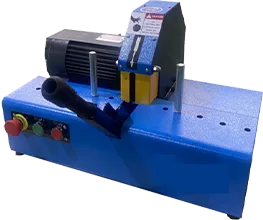
For compact reinforced-hose work, C250AC is recorded for up to 1 inch 4SH with a 250 × 3.5 × 32 mm blade, 1.5 kW three-phase 380 V power and 22 kg mass. It is a different route from C300, which is recorded for up to 2 inch 4SH with manual feed and a 300 × 4 × 32 mm blade.
C300A adds pneumatic feed and requires 6 bar air. C400F and C400A use a 400 × 4 × 50 mm blade and 5.5 kW power for their recorded 2-inch 4SH scope. C520A targets industrial hose up to 6 inches and needs a complete handling plan around its 132 mm opening.
| Job | First route to investigate | Boundary to verify |
|---|---|---|
| Mobile or compact 1-inch workshop | C250AC | Three-phase 380 V and sample suitability |
| Mixed manual 2-inch hose work | C300 | Alimentation par l'opérateur et support du matériau |
| Repeated pneumatic 2-inch work | C300A or C400A | Stable 6 bar air and guarding |
| Large industrial hose | C520A | Handling, floor space and representative trial |
These figures come from the product record. They do not replace a sample trial for an unfamiliar reinforcement or compound.
Write the FAT around accepted parts
The factory acceptance test should use the identified sample set and destination configuration. Check guards and controls before running. OSHA 1910.212 provides US general machine-guarding context, while the machine manual and site assessment control the specific test. Record first-off quality, several repeated cuts, blade heat or visible damage, bore condition, wire pull-out and debris.
Acceptance rule: “Machine runs” is not a FAT result. The record needs an identified workpiece, an accepted cut criterion and the exact configuration tested.
Photograph accepted and rejected faces from the same angle. Confirm the blade list, spare parts, manuals and packing items before the crate closes.
Repeat the core checks after installation with the same hose if practical. Destination power, air quality, support tables and handling can change the result.
Price the operating package, not the enclosure
The useful comparison is:
delivered cutting cell = machine + feed/support + blades + spares + packing + freight + setup + training
Keep duty and destination charges outside any supplier guess unless the exact route and terms are known. Ask suppliers to use the same Incoterm and named place.
A low machine price can be reasonable, but blank rows for blade replacements, support, air preparation or documents are not zero-cost items. Leave them visible until someone owns them.
Hand the process to the site team
Before production, give the operator the approved hoses, blade identity, inspection photographs, cleaning route, stop conditions and maintenance contact. Include a safe jam-clearance and blade-change procedure from the machine manual.
Review performance after a locally chosen amount of real work. We look for accepted pieces, cut defects, blade changes and downstream insertion problems. There is no useful universal 30- or 90-day rule.
New hose families return to sample review. That keeps the purchase decision accurate after the product mix changes instead of stretching the original test beyond its evidence.
You should also preserve one approved cut sample or a controlled photo record at receiving. We use that reference when the destination team questions whether a new defect came from shipping, installation, blade condition or a different hose. It turns a vague complaint into a comparison.
Ask the supplier to state which hoses were not tested. This short exclusion list matters because a successful 2-inch 4SH trial does not prove performance on every industrial rubber hose with the same nominal bore. Purchasing can then decide whether the untested work needs another sample, another machine or an outsourcing route.
Keep that exclusion list with the signed configuration.
Work through an RFQ that suppliers can answer
Consider a distributor that cuts two normal groups: 1-inch wire-reinforced hydraulic hose in short daily batches and 2-inch 4SH hose several times each month. It also receives occasional large industrial rubber hose that is stiff and difficult to support.
One “six-inch rubber hose cutter” request would be a poor specification. The buyer should first decide whether the occasional large work justifies a C520A-type cell or remains outsourced. The regular 1- and 2-inch work can then be compared across C250AC, C300, C300A, C400F and C400A using samples.
| Question | Workshop answer | Effect on RFQ |
|---|---|---|
| Which hose controls daily output? | 1-inch reinforced stock | Compact route remains relevant |
| Which hose controls machine capacity? | 2-inch 4SH | Trial must include this hose |
| Which work controls material handling? | Occasional large industrial hose | Separate handling and outsourcing decision |
| Is compressed air stable? | Buyer records pressure and demand | Determines whether pneumatic feed is practical |
| What is accepted? | Defined face, bore and reinforcement condition | Gives suppliers the same trial boundary |
This scenario does not produce an automatic model answer. It produces a quotation structure in which each assumption is visible.
Decide whether one cutter should cover every job
The largest machine is not automatically the most economical choice for small daily work. A large opening does not remove setup, blade, support and operator considerations.
Compare two cells only when the workload supports them: a compact daily machine and a larger machine for heavy hose. Otherwise, compare the cost of outsourcing the rare large cut with the floor space, utilities, handling gear and maintenance required to own it.
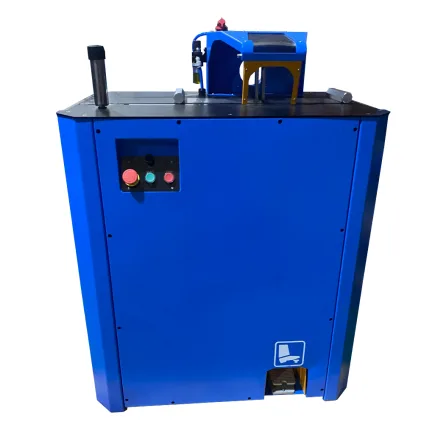
We would not approve the two-machine route from diameter alone. The buyer should show enough accepted large-hose volume or downtime exposure to justify the second cell.
Close technical deviations before the order
Suppliers may propose a different blade, feed or model after testing the samples. Record each deviation against the RFQ and state whether it is accepted, rejected or still open.
| Deviation | Review question |
|---|---|
| Different blade | Was it used for the accepted sample and is replacement available? |
| Larger machine | Which sample or handling limit requires it? |
| Avance pneumatique | What air pressure, volume and preparation are required? |
| Manual support | Can the destination site reproduce it safely? |
| No cleanliness claim | What downstream cleaning route will the buyer use? |
Do not let a change agreed in a call disappear from the signed configuration. The purchase order, test plan and packing list should all point to the same revision.
Give receiving a practical checklist
Receiving should verify the machine nameplate, destination electrical data, blade identification, guards, controls, supports, spares, manuals and packing list before the installation team signs off.
Then run the same identified hose used for the FAT. If the site result differs, check utilities, blade condition, support and handling before changing the acceptance rule.
Procurement view: A rubber hose cutter machine is ready when the delivered package can reproduce the accepted cut at the destination. The crate arriving intact is only the first gate.
Foire aux questions
Quand faut-il remplacer une lame de coupeur ?
Investigate rising force, heat, tearing, wire pull-out or cut variation. Replace only with the blade specified for the machine and operating conditions.
Test the hardest normal hose before choosing the machine
Utilisez la Catégorie de coupeurs de flexible hydraulique TRC to identify formats, then send the application sheet for a sample plan.