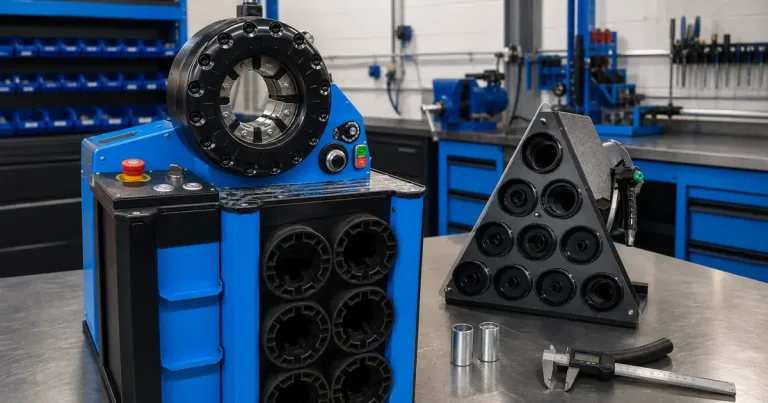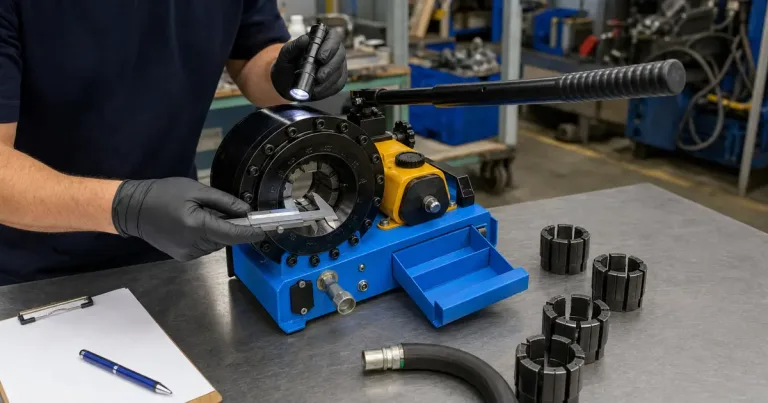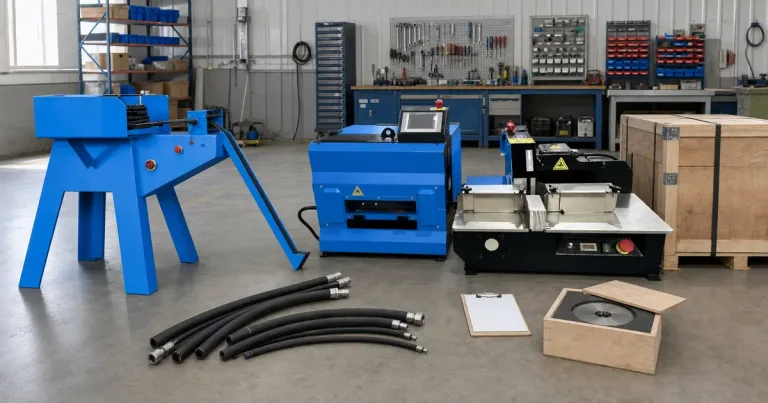

Une sertisseuse utilisée par un précédent propriétaire doit être comparée selon son périmètre prêt à l'emploi, et non selon la description accrocheuse du vendeur. “ Complète ” et “ en état de marche ” ne suffisent pas.
Cet article se concentre sur la qualité et la configuration de l'annonce. L'inspection physique reste une tâche de réception distincte.
Deux annonces similaires peuvent comporter des risques différents
Deux annonces de machines d'occasion montrent des photos similaires. L'une inclut l'identité du numéro de série, l'inventaire de l'outillage et les dossiers d'entretien ; l'autre n'indique qu'une famille de modèles. La seconde ne peut pas être évaluée comme un ensemble prêt à l'emploi tant que ces lacunes ne sont pas chiffrées.
Informations qu'une annonce utile devrait fournir
- modèle exact et plaque signalétique lisible ;
- preuve de l'année ou de l'âge, si disponible ;
- emplacement actuel et spécification de puissance ;
- photos de tous les côtés et de la tête de sertissage ;
- identification des matrices ;
- pompe, support et accessoires de commande ;
- défauts connus et réparations ;
- manuel d'utilisation ;
- périmètre d'emballage et de chargement.
Une sertisseuse d'occasion à vendre sans ces informations nécessite une provision d'inspection plus importante.
Évaluez l'outillage séparément
Ne comptez que les matrices qui peuvent être identifiées et mises en correspondance avec les composants prévus. Une boîte de matrices non marquées peut avoir une valeur de rebut ou de retouche, mais elle ne doit pas être évaluée comme un ensemble de production vérifié.
Vérifiez également la présence d'adaptateurs, de matrices maîtresses, de jauges et d'outils spéciaux.
Les affirmations du vendeur nécessitent des preuves
“ Récemment étalonnée ” doit être accompagné d'un enregistrement identifiant la machine et la méthode. “ Faible utilisation ” nécessite des preuves de fonctionnement ou d'entretien. Une peinture propre ne révèle pas l'état du cylindre ou du siège de matrice.
Transformez le langage de l'annonce en demandes de preuves
Considérez “ en état de marche ”, “ complète ” et “ récemment révisée ” comme des questions, et non comme des faits. Demandez quel travail a été effectué, par qui et quel enregistrement existe.
| Phrase du vendeur | Preuve à demander | Ce qui reste inconnu |
|---|---|---|
| En état de marche | Vidéo de démarrage à froid plus échantillon représentatif | Précision, répétabilité et couverture des composants |
| Complète | Liste détaillée des matrices et accessoires | Si l'outillage correspond à votre programme |
| Récemment révisée | Facture, pièces et périmètre de la révision | Travaux non inclus dans la révision |
| Prête à expédier | Plan d'emballage, méthode de chargement et dimensions | Protection pour le transport et configuration à destination |
| Étalonnée | Méthode, référence et date | Si le résultat s'applique à vos pièces |
Un vendeur qui répond clairement vous donne un élément à chiffrer. Un vendeur qui répète l'adjectif laisse le risque à l'acheteur.
Demandez un jeu de photos standard
Demandez la plaque signalétique, la machine complète, la tête de sertissage, le siège de matrice, les commandes, les données de puissance, les zones hydrauliques, toutes les matrices disposées avec leurs marquages et chaque accessoire détaché. Incluez le côté chargement et la base afin que le transport puisse être planifié.
Conservez les fichiers originaux. Les images recadrées des places de marché peuvent masquer la date, l'échelle et l'état.
Comparez la machine nue avec le poste de travail
Intégrez les matrices manquantes, les outils de mesure, les supports, les protections, les manuels et la conversion de puissance dans le modèle de coût. Ajoutez ensuite le chargement, le fret, le déchargement et la mise en service.
| Ligne de coût | Annonce A | Annonce B | Evidence status |
|---|---|---|---|
| Machine | Buyer input | Buyer input | Seller quote |
| Usable dies | Buyer input | Buyer input | Component map required |
| Repairs | Buyer input | Buyer input | Inspection or allowance |
| Freight and loading | Buyer input | Buyer input | Named route required |
| Mise en service | Buyer input | Buyer input | Scope required |
| Ready-to-work total | Calculated | Calculated | Do not leave blanks as zero |
We recommend comparing three numbers: purchase price, delivered price and ready-to-work price. Only the third belongs beside the cost of a supported alternative.
Work through two similar listings
Suppose two presses share a size label. Listing A costs less but has no nameplate photo, an unidentified die cabinet and no loaded test. Listing B costs more, shows the serial, includes a die inventory and produces an identified sample.
The difference is not “cheap versus expensive.” Listing A contains unpriced identity, tooling and repair risk. You can still buy it, but only as a project with a reserve and a clear walk-away point.
Buyer note: Do not use a reserve to make an unknown machine feel affordable. Use it only for repair items that someone has identified and priced.
Make the offer conditional on the evidence
State the exact machine, serial or nameplate identity, included tooling, sample test, loading condition and collection date in the offer. If an item cannot be proven, either exclude it from value or make payment conditional on verification.
For a remote sale, keep the marketplace message, seller contact, videos and agreed list with the order. Move final promises into the sale document rather than relying on chat history.
Inspect receiving condition immediately
Photograph the package before unloading, then reconcile the machine and each loose item with the agreed list. Record transport damage while the carrier evidence is still available.
Commission against the same sample and condition used for purchase. If the result differs, the inspection record helps separate transport, installation and pre-existing problems.
The final valuation should use actual commissioning cost. That closes the gap between a good-looking listing and the machine that your shop can safely use.
Build a listing that a serious buyer can audit
A seller who wants a fair price should remove easy uncertainty. State the exact identity, current location, power, included dies, known faults, loading route and whether a representative sample is possible.
Separate description, evidence and opinion
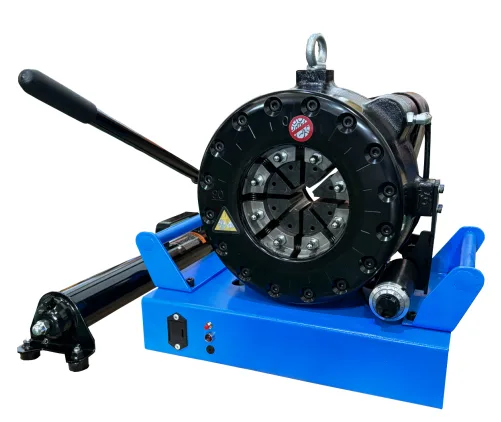
“P20HPZ, 137 ton, separate-pump manual hydraulic hose crimper” is a factual model description from the TRC product record. “Excellent machine” is an opinion. A used listing needs more of the first and less of the second.
For another brand, use that brand’s nameplate, manual and current records. Do not copy TRC parameters to a visually similar machine.
| Listing block | Useful content |
|---|---|
| Identity | Manufacturer, model, serial and nameplate photo |
| Configuration | Pump, voltage, controls, dies and accessories |
| État | Known faults, leaks, repairs and current operating context |
| Preuve | Cold start, loaded sample and completed measurement |
| Commercial | Price basis, location, loading and collection |
| Assistance | Manuals, parts route and service contacts available |
This structure lets the buyer decide whether to travel, request an inspection or decline.
Use capacity claims carefully
The machine’s recorded range does not prove that the included tooling covers the buyer’s components. List the machine capacity and die inventory separately.
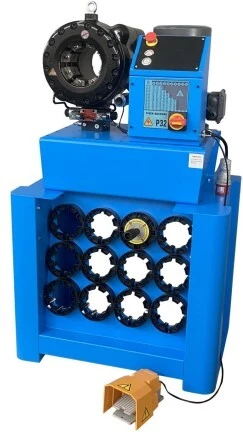
If the listing says “up to two inches,” specify the hose construction and source of that claim. P32’s TRC record states up to 2 inch 4SP and 200 ton or 2000 kN. Those values apply to P32, not every press that sellers describe as a 200-ton machine.
Compare listing A and listing B on buyer effort
Listing A contains six photographs, no nameplate and “many dies.” Listing B identifies the model, lays out ten marked die sets and shows a current sample with a measurement record.
Even when Listing A costs less, the buyer must spend time resolving identity, tooling and condition before making an offer. That effort has a commercial value, especially when travel and international freight are involved.
| Buyer task | Annonce A | Annonce B |
|---|---|---|
| Identify machine | Open | Closed |
| Map tooling | Open | Inventory available, compatibility still checked |
| Judge condition | No loaded evidence | Sample evidence available |
| Plan freight | Dimensions missing | Package route can be quoted |
| Make conditional offer | Many unresolved clauses | Fewer unresolved clauses |
The table does not prove Listing B is mechanically better. It shows that the buyer can price it with fewer assumptions.
Include the phrase buyers actually search
Many buyers search “used hose crimping machine for sale” and then land on pages that contain only an auction photograph and phone number. A useful listing should answer the technical questions before asking for a deposit.
Likewise, “used hose crimper for sale” should not imply the dies are included or usable. Put the included package in a table and photograph it.
Close the sale with the same inventory
The seller and buyer should sign or acknowledge the final inventory before pickup. Number loose crates or die boxes and photograph them after loading.
At receiving, the buyer repeats the count before commissioning. If an item is missing, both parties can work from the same list rather than debating what “complete” meant in the original advertisement.
This is also why deleting a listing immediately after payment can be a mistake. Save the original page, photographs and messages with the purchase record.
Choose the selling channel by evidence and buyer reach
An industrial equipment dealer can help when the seller needs inspection, loading and buyer qualification. An auction can reach more buyers quickly, but its inspection window and sale terms may shift more risk to the buyer. Direct outreach to hose shops or maintenance contractors can work when the machine has clear records and a local market.
General marketplaces are useful for exposure, yet the technical file should live outside a short advertisement. Give serious buyers a controlled PDF or page with the identity, inventory, faults and test evidence. Do not hide the important facts behind “message for details.”
| Channel | Useful when | Seller must still control |
|---|---|---|
| Industrial dealer | Support, loading or valuation help is needed | Accurate machine and tooling record |
| Equipment auction | Time and broad reach matter | Inspection limits and sale terms |
| Direct industry sale | Seller knows likely users | Evidence pack and payment controls |
| General marketplace | Local visibility is useful | Buyer qualification and safe communication |
The FAQ question about alternatives to Facebook Marketplace has no single global answer. The machine’s value, location, support status and buyer population should decide the channel.
Make the listing readable on a phone
Put the model, location, power, included tooling and known condition near the top. Use a full-machine photograph first, then nameplate, controls, head, dies and loaded sample.
Keep paragraphs short and tables simple. A buyer reading on a phone should be able to decide whether the machine fits the rough application before downloading the complete file.
Record what you refused to claim
If no current loaded test exists, say so. If the dies have not been mapped, call them unverified tooling. Honest boundaries reduce casual inquiries and help a technically qualified buyer price the work.
A good used listing does not need to sound confident about everything. It needs to make the known and unknown parts obvious.
Let the buyer reproduce the comparison
Provide photographs at full available resolution and keep the measurement method visible. If a video shows a sample crimp, identify the component, die and finished result in the same file set.
Do not stage accessories around the machine merely to make the package appear complete. Lay out only the items included in the sale and number each group. If another cabinet or pump is available separately, list it as a separate option.
The buyer should be able to take the listing evidence, add its own component schedule and calculate the missing work. That is the practical test of a professional listing.
Les instructions de montage preventive-maintenance guidance for a specified crimper family illustrates why oil, cleanliness, lubrication, wear and completed crimp results belong in a condition review. Its intervals and fluids remain Parker-specific.
Gates’ crimp data and dies manual shows the component-system evidence a buyer should expect before valuing loose dies. Gates dimensions must not be transferred to another machine or hose system.
State the collection boundary
Clarify whether the machine is disconnected, whether oil or batteries require special handling, who supplies lifting equipment and when the buyer assumes risk. Give measured loading access and package information when available.
A technically strong listing can still fail commercially when the buyer discovers that a crane, export crate or another collection day is required. Surface those conditions before accepting the offer.
Foire aux questions
Where can I sell an unused Finn Power hose crimper besides Facebook Marketplace?
Use industrial machinery dealers, auction platforms, hydraulic-industry groups and regional hose-equipment distributors, but prepare the evidence pack before listing. Show the nameplate, model, power, dies, manuals, condition, location and a current operating test. A specific listing attracts qualified buyers and reduces repeated questions about what is actually included.
Send the listing, not just the price
Envoyez TRC the listing, nameplate, tooling photos and intended hose system. The used-equipment resource provides a neutral comparison route.