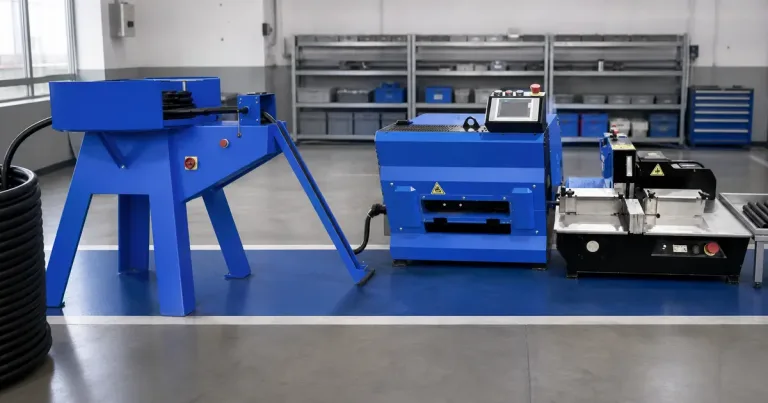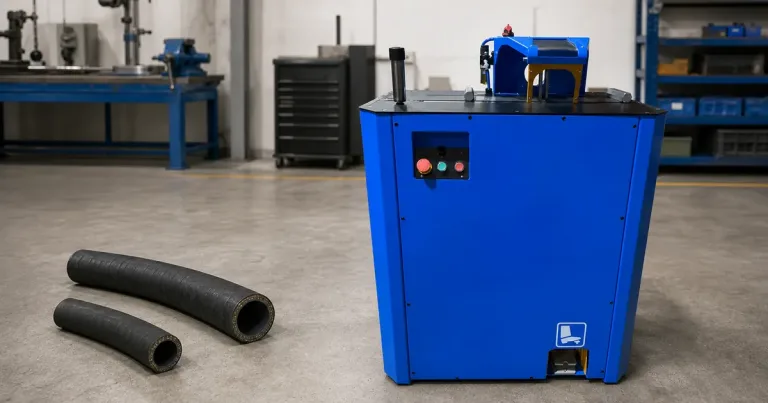
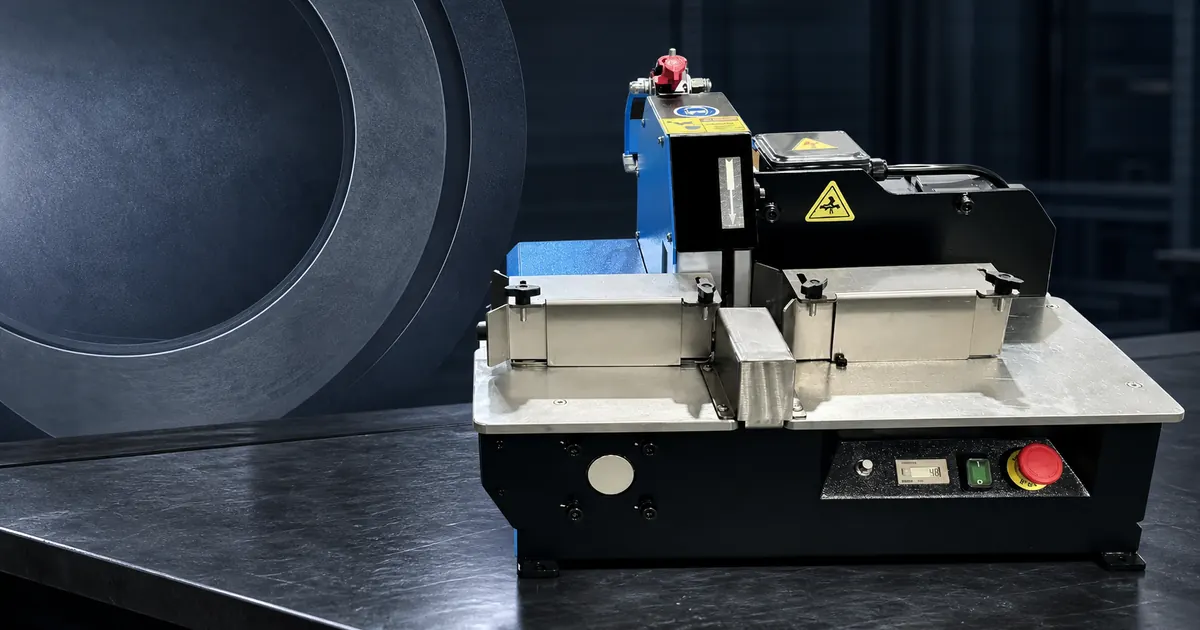
Una sierra cortadora de mangueras hidráulicas debe cortar caucho y refuerzo sin aplastar el interior, sin arrancar alambre del extremo y sin generar calor ni residuos inaceptables. La elección de la cuchilla depende de la construcción de la manguera y de la máquina que la impulsa.
Una cuchilla desgastada puede hacer que una buena máquina parezca incorrecta
Una sierra que cortaba limpiamente el mes pasado ahora deja marcas de calor y refuerzo expuesto. Antes de cambiar de máquina, el operador debe revisar el tipo de cuchilla, su estado, la presión de avance, la sujeción de la pieza y si existe soporte para cuchillas de repuesto.
¿Cuchilla de sierra o cuchilla recta?
Una cuchilla circular motorizada es común para trabajos repetidos con mangueras reforzadas porque puede mantener el movimiento a través de las capas de alambre. Una cortadora de mangueras de cuchilla recta puede ser adecuada para mangueras más blandas o pequeñas cuando la herramienta está diseñada para ese material.
Ningún método es universalmente mejor. Revise la manguera más dura, no la muestra más fácil.
| Ejemplo de TRC | Cuchilla registrada | Motor | Alcance registrado de mangueras |
|---|---|---|---|
| C250AC | 250 × 3,5 × 32 mm | 1,5 kW, trifásica 380 V | Hasta 1 pulgada 4SH |
| C300 | 300 × 4 × 32 mm | 4,0 kW trifásica o 2,2 kW monofásica | Hasta 2 pulgadas 4SH |
| C400F | 400 × 4 × 50 mm | 5,5 kW | Hasta 2 pulgadas 4SH |
| C520A | 520 × 4 × 50 mm | 5,5 kW | Hasta 6 pulgadas de manguera industrial |
Estas especificaciones provienen del archivo del producto. No intercambie las dimensiones de la cuchilla entre máquinas ni asuma que una cuchilla más grande proporciona automáticamente un corte más limpio.
Evalúe una muestra de corte
Revise el extremo para verificar:
- corte en escuadra con respecto al eje de la manguera;
- interior abierto y sin distorsiones;
- refuerzo controlado;
- sin caucho quemado ni vitrificación intensa;
- sin partículas sueltas en el interior de la manguera;
- superficie aceptable para el siguiente paso de preparación.
El proveedor de conexiones puede requerir marcado, pelado u otro paso de preparación después del corte.
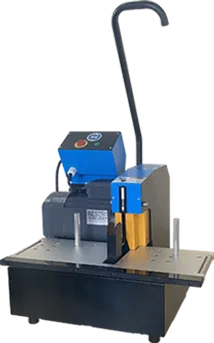
El estado de la cuchilla cambia el resultado
Las cuchillas de repuesto para cortadoras de mangueras deben ser identificadas por el fabricante de la máquina. El diámetro por sí solo no establece el ajuste del eje, el espesor, el material ni la idoneidad operativa.
Las señales comunes de que una cuchilla necesita revisión incluyen avance más lento, aumento de calor, desgarro, arranque de alambre y mayor esfuerzo del operador. Primero verifique el estado de la cuchilla, la instalación y la configuración de la máquina. No compense forzando la manguera contra la cuchilla.
| Síntoma de corte | Verificación relacionada con la cuchilla | Otra verificación |
|---|---|---|
| Humo o caucho vitrificado | Cuchilla desafilada o inadecuada | Presión de avance |
| Alambre arrancado | Estado del filo y compatibilidad de la cuchilla | Soporte de la manguera |
| Cara en ángulo | Entrada de cuchilla desigual o daño | Torsión de la manguera |
| Rebaba o residuos crecientes | Tendencia de desgaste de la cuchilla | Proceso de limpieza |
| Aumento del esfuerzo del operador | Estado de la cuchilla | Sujeción y alineación |
La limpieza es un control separado
El corte produce residuos. La guía de limpieza de ensamblaje de mangueras de Gates señala que los métodos abrasivos pueden crear más polvo y fragmentos de manguera que el corte controlado. Cualquiera que sea el método utilizado, el taller necesita un procedimiento definido de limpieza posterior al corte.
ISO/TS 18409:2018 respalda la recolección de muestras para análisis de contaminación. No aprueba una cuchilla en particular ni promete que el aire comprimido por sí solo sea suficiente.
Nota de ingeniería: Un corte con pocos residuos facilita la limpieza. No certifica que el ensamblaje esté limpio.
Protección y sujeción de la pieza
Mantenga protegido el punto de operación y soporte la manguera para que no pueda torcerse ni tirar del operador hacia la cuchilla. OSHA 1910.212 es una base útil de protección general de maquinaria, mientras que el manual real de la máquina sigue siendo la autoridad operativa.
Browse the Categoría de cortadores de manguera hidráulica TRC and provide hose construction, OD and workload when requesting a blade or machine recommendation.
The buyer should photograph the normal loading position during a trial. Look for hands crossing the cutting plane, unsupported coil tension and cut pieces falling back toward the blade.
Blade speed and blade identity belong together
A replacement blade must match the arbor, thickness, material and operating speed of the machine. OSHA has warned in another cut-off-machine context that fitting a blade designed for a different speed and purpose can raise reactive forces and failure risk. The practical rule is simple: do not improvise a “similar” blade from diameter alone.
After installation, verify direction, seating, guard position and free movement using the machine instructions. Make the first cut without forcing the feed. A blade that needs excessive pressure is not ready for production.
TRC records C300 at 2,850 rpm on 50 Hz and 3,370 rpm on 60 Hz. C400F uses the same recorded speed values with a different 400 × 4 × 50 mm blade and 5.5 kW motor. These model-specific values explain why a blade recommendation must name the machine.
Revise el C300 product page o C400F product page for the matching route.
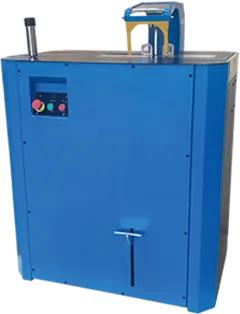
Separate four causes of a poor saw cut
Do not correct every defect by pushing harder. First inspect the blade: identity, direction, damage and contamination. Then inspect the machine: arbor seating, guard, movement and specified speed. Third, check work holding and whether the hose bends or twists at the blade. Finally, check whether the selected saw method suits the reinforcement.
Change one factor at a time and make another sample. This preserves the evidence needed to select a replacement blade or a different cutting method. Random adjustment can produce one acceptable end without revealing why the previous cuts failed.
Set a blade-change trigger before production
Do not wait for smoke or exposed wire. Record cut quality at the start of each shift or batch using the same reference hose when practical.
| Disparador | Acción |
|---|---|
| Cut face moves outside the shop criterion | Stop and inspect blade, support and feed |
| Operator must add force to maintain output | Review blade condition |
| Debris rises from the normal baseline | Check blade and cleaning route |
| Blade damage or missing material is visible | Isolate machine and replace per manual |
| Replacement blade identity differs | Obtain supplier approval before installation |
The trigger can be visual, dimensional or based on a controlled number of cuts. Use shop data; do not invent a universal blade-life interval.
Run a three-stage saw trial
Make an initial cut after setup, a cut after the machine has reached normal operating condition and a final cut at the end of the planned batch. Inspect all three.
Use stable accepted output = accepted cuts ÷ total trial time. Include blade inspection, loading, cutting, cleanup and end inspection. A supplier who quotes only the instant of blade contact has not measured the shop’s task.
Consejo profesional: Keep the rejected cut beside the accepted cut during training. Operators learn faster from a visible defect than from the phrase “cut quality must be good.”
Read the complete blade marking before ordering
The replacement request should include machine model, blade diameter, thickness, bore, direction and any manufacturer reference. Photograph both sides of the installed blade after the machine has been isolated according to the manual.
Do not rely on a handwritten label from an old storage box. Match the replacement to the current machine record.
| Purchase field | Por qué es importante |
|---|---|
| Diameter | Must fit machine and guard arrangement |
| Thickness | Changes fit and cutting behavior |
| Bore | Must match the mounting system |
| Material and edge | Must suit the intended hose and speed |
| Direction | Controls correct installation |
| Maximum permitted speed | Must be compatible with machine operation |
The manufacturer should resolve any mismatch. An operator should not enlarge a bore, add improvised spacers or run a blade outside its stated route.
Use one-variable troubleshooting
Suppose the cut begins pulling wire after a month. First inspect and, if approved, replace the blade without changing hose support or feed. Run the reference hose again.
If the defect remains, review support and twisting. Then review whether the hose construction changed. This sequence preserves the evidence.
Changing blade, feed pressure and support at the same time may produce a better cut, but the team will not know which change worked. The problem returns at the next blade change.
Track blade condition through the batch
Record first-piece quality and check at a buyer-defined interval based on risk and observed wear. The interval may be every batch for mixed low-volume work or a set number of pieces in stable production.
Use accepted cuts between blade changes ÷ blade cost only as a local cost measure after enough history exists. Do not publish the result as universal blade life.
The better maintenance question is whether the blade is replaced before cut quality and operator effort drift outside the accepted range.
Include guarding in the replacement review
A blade with the correct bore may still be wrong for the existing guard or operating speed. Check guard clearance and machine instructions before running.
OSHA’s general guarding rule supports control of points of operation, rotating parts and flying material. It does not approve a particular blade-machine combination.
Write the failure report so a supplier can help
Send the machine model, blade marking, hose identity, photos of the full setup and close photographs of the defect. State when the problem began and whether it changes after warm-up.
A message saying “the blade is bad” gives the supplier little to diagnose. A labeled first, middle and final sample often shows whether wear, heat or handling is developing through the run.
Work through a replacement-blade decision
A C300 operator sees more wire pull and smoke. The installed blade marking matches the recorded 300 × 4 × 32 mm dimensions, but the edge is visibly damaged.
The team isolates the machine under its procedure, records the old blade and installs the approved replacement. It then runs the reference hose without changing feed or support.
If the cut returns to the accepted condition, the evidence points to blade condition. If not, the team continues with seating, support, feed and material review. That is more defensible than ordering a higher-power machine after one bad week.
Keep cutting speed inside model records
C300 and C400F product records list 2,850 rpm at 50 Hz and 3,370 rpm at 60 Hz. These are model values, not instructions to alter speed.
The destination power configuration should match the machine. An operator should not change pulleys, motor or frequency to chase a cleaner cut without manufacturer review.
Review the blade after abnormal contact
If metal, a fitting or another foreign object reaches the blade, stop and inspect. Do not continue because the next empty rotation sounds normal.
Check guard, mounting and cutting area for damage. Remove affected product from the good batch until reviewed.
Control blade storage
Store replacements dry, protected and identified. Keep edges from contacting other tools.
Use first-in, first-out where shelf condition and supplier guidance support it. Do not remove the manufacturer’s marking.
Make training machine-specific
Show operators the C300 or C400F controls, guard, feed position and stop route. General saw experience is not enough.
Use accepted and rejected cut samples. Ask the operator to name the first check for heat, wire pull and angled faces.
Review the arbor and mounting without improvisation
Maintenance should inspect the mounting parts named by the machine manual. Worn or damaged components can affect blade seating.
Do not add washers, machine the bore or tighten by feel outside the documented method. Ask the supplier when the assembly differs from the drawing.
Keep a blade issue out of purchasing shorthand
The purchase order should state model and complete blade specification. “One spare cutter blade” invites substitution.
Receiving should compare marking and dimensions before adding it to service stock.
Use photographs that show scale
Include the whole hose end and a close view with a scale. A macro image alone can make a small rubber strand look like major wire pull.
Photograph the blade only after safe isolation. Do not remove guards for a better marketing image.
Decide when another cutting method is needed
If the approved blade and setup still burn, pull wire or deform the bore on a specific hose, stop forcing the saw route.
Provide the supplier with the material cross-section and acceptance need. A different blade or machine may be required.
Keep the failed sample and complete blade record until the issue is closed. When the new method arrives, test it against the same hose and end criterion. This creates a fair comparison.
The goal is not to prove that a saw can cut every hydraulic hose. It is to define a stable range where the machine, blade and support produce ends the assembly process can accept.
Put that range on the maintenance and sales records. When a new reinforcement or OD appears, request another trial instead of quietly expanding the promise. This preserves the evidence behind the original blade selection.
If the trial fails, record the material and defect. The rejection is useful selection data, not wasted work.
Read the cut end before changing the machine
The cut face gives useful clues if you inspect it immediately. Wire pulled in the direction of feed can point to a dull or unsuitable blade, unstable support or an aggressive feed. A flattened bore may come from clamping or bending rather than the saw itself. Glazed rubber and odor suggest heat that deserves investigation.
We recommend photographing the same hose under controlled trial conditions. Record the hose reference, OD, reinforcement, blade reference, machine, support arrangement and operator feed method. Make at least three cuts after the setup is stable. One attractive sample does not show repeatability.
In an illustrative distributor workshop, operators complain that a two-wire hose “sometimes explodes” at the cut. Review shows that short pieces are supported, while long pieces hang from the coil and rotate as the blade enters. Adding a feed guide and offcut support removes most variation without increasing motor power.
Nota de ingeniería: A larger motor cannot correct an unidentified blade or unsupported workpiece. Power is only one part of the cutting system, and more aggressive feed can increase heat, deformation and wire damage.
After the mechanical problem is solved, define the cleaning and end-protection route. ISO/TS 18409 describes methods for sampling contamination from hydraulic hose assemblies; it does not promise that a particular saw or air blow produces a clean assembly. If the end application has a cleanliness target, connect preparation, cleaning, sampling and protection as one controlled process.
Blade change records also help. Note the installation date, hose mix and reason for removal. Over several months, that history shows whether shortened blade life follows a particular material, feed habit or alignment issue instead of encouraging premature replacement on a fixed calendar.
Preguntas frecuentes
What is the best tool for cutting wire-braided hydraulic hose?
Use a guarded powered cutter with a blade and feed method proven on the exact hose construction. Test the hardest normal hose and inspect squareness, bore shape, reinforcement and debris.
Request a blade recommendation with evidence
Send TRC the machine identity, current blade marking, hose cross-section, OD and defect photos. That information is safer than ordering a hose cutter replacement blade by size alone.