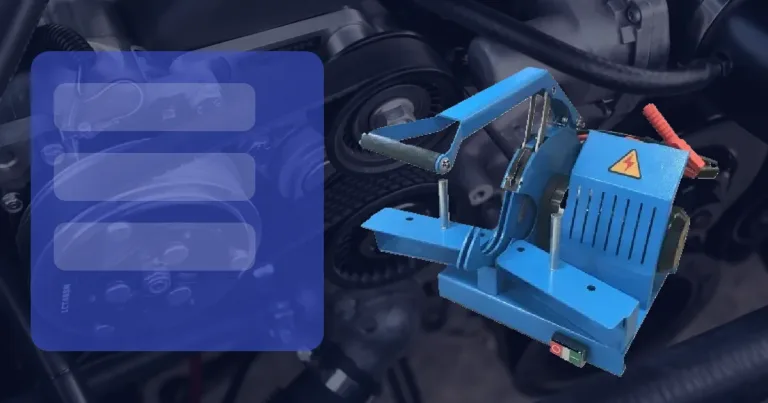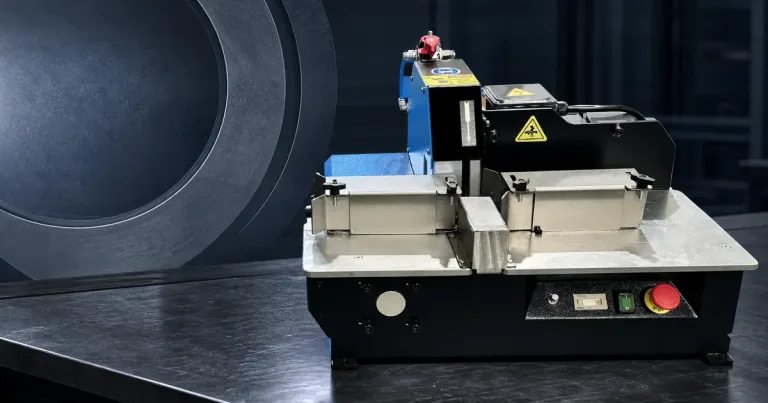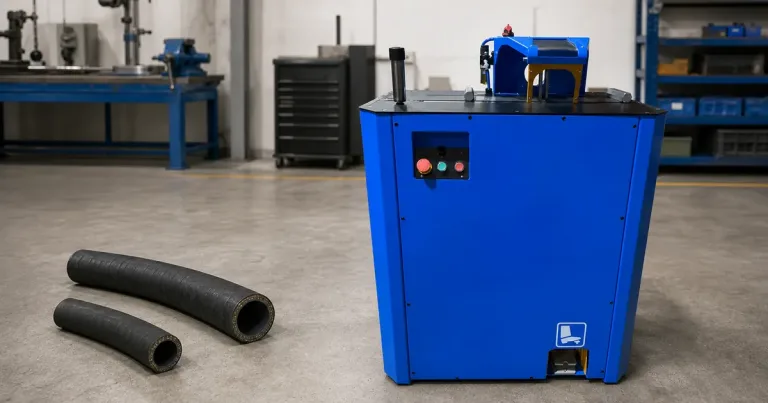

Una cortadora automática de mangueras de caucho puede reducir la medición y alimentación repetidas, pero la automatización no elimina la necesidad de adaptar la máquina a la construcción de la manguera e inspeccionar el corte.
La pregunta de compra más útil es: ¿qué partes del ciclo de corte están controladas y cuáles aún dependen del operador?
La automatización comienza antes de la cuchilla
Una línea de producción mide y corta longitudes repetidas todo el día, pero el operador aún endereza cada bobina y retira cada pieza a mano. Llamar automático al ciclo de la cuchilla oculta el verdadero cuello de botella; la trayectoria completa del material debe cronometrarse e inspeccionarse.
Defina “automático”
Una cortadora automática de mangueras puede controlar la longitud de alimentación, el conteo de cortes, el ciclo de la cuchilla o alguna combinación de estos. Pida al proveedor que indique cada función de la máquina cortadora de mangueras. No infiera el control de longitud CNC solo por un movimiento automático de la cuchilla.
Verifique la trayectoria del material
El sistema de alimentación debe mover la manguera sin aplanarla, deslizarla o introducir errores de longitud. La manguera enrollada puede resistirse a la alimentación recta. Las mangueras grandes o rígidas pueden necesitar soporte externo.
Revise:
- DE de la manguera y refuerzo;
- longitud de corte mínima y máxima;
- tamaño del lote;
- manejo de bobinas;
- método de avance y sujeción;
- tipo de cuchilla;
- área de descarga y recolección.
Mida la producción del ciclo completo
El tiempo de cierre de la cuchilla no es la tasa de producción. El ciclo completo incluye carga, enderezado, alimentación, corte, retiro de la pieza, recuperación de la cuchilla, limpieza e inspección.
Para una prueba realista, ejecute la manguera y longitud previstas en un lote representativo. Registre los cortes rechazados y las intervenciones del operador, así como las piezas exitosas.
La calidad del corte sigue siendo la puerta de aceptación
La automatización no debe aprobarse si produce extremos angulados, diámetro interior aplastado, calor excesivo o refuerzo suelto. El proceso de ajuste y ensamblaje posterior establece la condición de corte utilizable.
Después del corte, aplique el proceso definido de control de contaminación. Una máquina automática no es automáticamente un proceso de manguera limpia.
Defina las transferencias alrededor de la automatización
Una cortadora automática de mangueras de caucho puede medir y alimentar material, pero un operador aún puede cargar bobinas, corregir la curvatura, retirar piezas cortadas, inspeccionar extremos y manejar fallas. Anote cada transferencia. La automatización es valiosa cuando elimina un cuello de botella repetido; es decepcionante cuando el cuello de botella simplemente se traslada a la carga o inspección.
Para una prueba, registre la longitud programada y la longitud de corte medida en todo el lote. Anote paradas, correcciones y extremos rechazados. El resultado es una cifra de producción utilizable, no una cifra promocional del ciclo de la cuchilla.
Ponga en marcha una familia de productos a la vez
Cargue la primera manguera, verifique la trayectoria de alimentación y haga un lote corto. Verifique la longitud real y la condición de corte antes de almacenar el programa. Registre la referencia del material con el nombre del programa; un número como “25 mm” es ambiguo si varias construcciones de manguera usan el mismo tamaño nominal.
Repita la verificación después de un cambio de bobina, cambio de cuchilla o ajuste mayor de alimentación. Si la máquina incluye conteo de lotes, concilie el contador con las piezas aceptadas en lugar de asumir que cada ciclo produjo una pieza utilizable.
Decida dónde se sitúa la inspección
Un operador puede inspeccionar cada corte, muestrear a una frecuencia definida o usar otro plan aprobado. La elección depende del riesgo de la aplicación y la estabilidad del proceso. Lo que importa es que la inspección esté planificada, no omitida porque la alimentación sea automática.
Use C300D como ejemplo de nivel de control
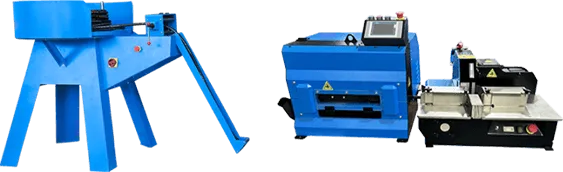
TRC registra C300D para manguera de hasta 1 pulgada 2SH. Tiene funciones de corte automático y manual, una cuchilla de 300 × 4 × 32 mm, motor trifásico de 4,0 kW o monofásico de 2,2 kW y precisión registrada de tamaño repetido de ±0,2 mm.
Ese valor de ±0,2 mm pertenece solo a C300D. Debe verificarse con la manguera del comprador, el estado de la bobina, la configuración de alimentación y el método de longitud de corte.
| Conjunto C300D | Tamaño registrado |
|---|---|
| Enrollador de manguera | 900 × 1.350 × 1.200 mm |
| Contador de manguera | 700 × 530 × 640 mm |
| Barra de corte | 650 × 600 × 450 mm |
La línea ocupa más que el recinto del cortador. Dibuje el enrollador, contador, cortador, posición del operador y área de piezas terminadas en el plano de planta antes de ordenar.
Revise el Ruta del producto C300D después de confirmar que su alcance de 1 pulgada 2SH coincide con el lote.
Separar el corte automático de la producción automática
Un ciclo de cuchilla automático no endereza la bobina, identifica la manguera, retira las piezas rechazadas ni inspecciona el extremo. Escriba quién es responsable de cada transferencia.
| Etapa | La máquina puede asistir | El operador o la línea aún controla |
|---|---|---|
| Desenrollado de bobina | Coiler supports material supply | Correct coil and tension |
| Length feed | Counter and programmed route | First-off length verification |
| corte | Automatic or manual function | Blade condition and safe setup |
| Part removal | Depends on layout | Segregation and handling |
| End acceptance | No automatic claim in product record | Squareness, bore and debris inspection |
Advertencia: Do not call a line unattended unless the manufacturer documents every loading, guarding, sensing and discharge function. “Automatic” is not a safety category.
Calculate accepted output after rejects and changeovers
Uso:
accepted pieces per hour = (total pieces − rejected pieces) ÷ elapsed hours
Then calculate first-pass yield = accepted pieces ÷ total pieces × 100.
If an illustrative trial cuts 100 pieces in two hours and five require rejection or rework, accepted output is 47.5 pieces per hour and first-pass yield is 95%. These figures only demonstrate the calculation; they are not TRC field results.
Time a size change separately. A fast repeated batch can coexist with a slow changeover, especially when coils, length programs and downstream labels all change.
Commission one hose family at a time
Start with a stable hose reference and a length that represents normal production. Verify the first piece, middle piece and last piece for length and cut quality.
Add a second length only after the first program is stable. Add another hose construction last. This order helps the team separate feed, blade and material effects.
Create a program record another shift can restore
The program name should identify hose family and cut length without relying on one operator’s memory. Record the hose reference, coil setup, feed path, length target, blade and first-off result.
| Program field | Example format | Razón |
|---|---|---|
| Program ID | Shop-defined code | Prevents duplicate names |
| Manguera | Manufacturer and series | Separates similar black hose |
| Cut length | Drawing reference and unit | Avoids unit or revision error |
| Coil setup | Payout and tension note | Controls feed behavior |
| First-off | Measured result and disposition | Releases production |
| Revision | Date and approver | Removes obsolete settings |
Do not save a corrected length under the old drawing revision. The next shift may restore the wrong setup and produce a full batch before inspection.
Control starts and restarts
Make a first-off check after loading a new coil, changing the program, changing the blade or restarting after a fault. Check again after a long interruption if the site’s process requires it.
A machine that resumes automatically can still start with a different material condition. Coil tension may have changed, the first feed may include a bent end or an operator may have moved the stock.
Keep rejected pieces traceable
Place rejected lengths in a marked container and record the cause. Do not return a short or damaged piece to the good stack because the next station may not see the defect until fitting insertion.
Track:
- wrong length;
- angled or damaged face;
- feed slip;
- blade defect;
- wrong hose;
- interrupted cycle.
The distribution tells the team whether to improve programming, material handling, blade maintenance or identification.
Calculate changeover loss
Uso:
changeover loss = scheduled production time − accepted production time
Break the loss into coil removal, material identification, program selection, trial pieces, inspection and cleanup. If searching for the correct program consumes more time than changing the coil, fix program control before buying more automation.
An illustrative changeover might take 18 minutes: six minutes for material, four for program review, five for first pieces and three for cleanup. This is an example calculation, not a C300D claim.
Plan labels with the cut batch
If downstream operators cannot identify the hose and length, automated cutting has created an anonymous pile. Generate or apply batch identification at discharge.
The label should survive normal handling and link to the hose reference, cut length, quantity and program. Keep it away from the fitting insertion zone.
Audit the claimed accuracy correctly
The C300D record states ±0.2 mm repeated-size accuracy. Verify the machine value with a stable method on the buyer’s material.
Record the measuring instrument, reference points, piece temperature if relevant, operator and sample count. Do not compare a cut-hose measurement with a finished-assembly tolerance.
If the results change across the batch, review coil feed, slip, stock tension and measurement before editing the program.
Decide when automation is the wrong answer
Manual feed may be stronger for short mixed jobs, frequent unusual materials or a shop where the operator must inspect every special cut. C300D is built around repeated-length control and a recorded 1-inch 2SH scope.
Do not buy automatic equipment solely because the normal hose is smaller. Buy it when repeated length, batch control and operator intervention are measured constraints.
Connect the production order to the program
The order should state hose, drawing revision, cut length, quantity and due date. The program record should reference that order.
At completion, reconcile programmed quantity, accepted pieces, rejects and remaining stock. Do not close the order because the controller reached its count.
Handle partial coils
Mark remaining hose with identity and usable length. Return it to controlled storage.
If the coil is too short for the next programmed piece, the line should stop or reject it by the documented method. Do not splice or improvise.
Review counter and feed condition
Length variation can come from slip, tension, dirty rollers, stock deformation or measurement. Inspect the complete feed path.
Do not change the program until the mechanical and material causes are checked.
Prepare maintenance access in the layout
The C300D coiler, counter and cutter bar need room for cleaning, blade service and feed inspection. Leave space around covers and controls.
Show the maintenance team the proposed layout before fixing machines and utilities.
Use a low-volume manual mode deliberately
C300D records both automatic and manual cutting functions. Manual mode can support setup, trials or special work under its instruction.
Do not let manual mode become an undocumented workaround for bad programs. Record the piece and inspection.
Review automation with operators
Ask where they intervene, why they stop and which alarms or conditions repeat. Compare this with recorded rejects.
The best improvement may be a better coil stand, program name or discharge rack rather than a control change.
Check the first piece against the production order
The operator should compare hose identity, length, drawing revision and program before release. A correct measured length from the wrong hose is still a reject.
Use a second-person check where process risk justifies it.
Reconcile controller count with physical quantity
Count accepted parts in labeled containers. Subtract rejects and setup pieces.
If the controller says 500 and the batch contains 497 accepted pieces, investigate before closing the order. Do not edit the paperwork to match the screen.
Measure downtime by cause
Separate coil change, program review, blade service, feed fault, inspection hold and material shortage. The total alone does not show what to fix.
Use the largest recurring cause for the next improvement. Automation cannot solve a missing coil or late drawing.
Review spare controller data
Record controller model, software or configuration information supplied with the machine. Ask how replacement and restore are handled.
Do not connect unauthorized devices or copy settings outside the supplier and site procedure.
Set a clear end-of-batch routine
Reconcile quantity, label remnants, clear rejects, return the program to its approved state and clean the cell safely.
The next operator should not find an unknown hose threaded through the feed system.
Keep production planning realistic
Schedule setup pieces, inspection and changeover. A plan based only on controller cycle count will overstate available hours.
When the line receives many small orders, group compatible batches only if identity and drawing controls remain clear. Do not combine work merely to keep the machine moving.
Review schedule performance with accepted output, not total cuts. That single choice keeps the planning number tied to saleable pieces.
Approve the first production week
Review every batch record from the first week: program, first-off, accepted quantity, rejects, remnants and operator intervention. Look for recurring correction.
Close program and layout issues before increasing volume. A quiet controller does not prove that labels, feed and physical output agree.
Compare scheduled quantity, controller count and accepted physical pieces. Review every mismatch by cause.
Keep the first-week programs under tighter approval until another trained operator can restore them, run a changeover and close a batch record correctly.
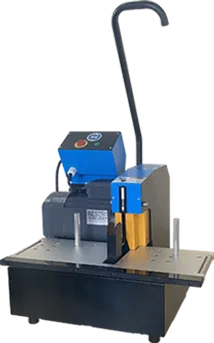
Revise el C300A pneumatic-feed cutter when assisted feed, rather than programmed length, is the measured requirement.
OSHA 1910.212 provides general guarding context. ISO/TS 18409:2018 covers contamination sample collection; it does not approve automatic cutting or set a universal cleanliness class.
Calculate output from accepted pieces, not programmed cuts
Automatic feeding earns its place when repeated lengths dominate the schedule. It does not remove coil handling, straightening, size changes, cut inspection, cleaning or rejected pieces. We recommend a timed batch that begins with the actual supply form and ends with accepted, labeled pieces ready for the next process.
The C300D source record, for example, lists automatic and manual control, repeated-size tolerance of ±0.2 mm and a stated range up to 1 inch 2SH. Its 300 × 4 × 32 mm blade and motor options belong to that model record. Those facts help define a trial; they do not authorize the same result on every hose construction.
For an illustrative 100-piece order, suppose programmed feeding and cutting takes 18 minutes. Coil loading, first-piece confirmation, two changes, inspection and cleaning add 22 minutes, and five pieces are rejected. The useful rate is 95 accepted pieces in 40 minutes, not 100 programmed cuts in 18 minutes.
Record why an operator intervenes. Common categories include coil snag, length correction, cut-end defect, blade stop and discharge problem. A machine that needs frequent hand correction may be powered but not practically automatic for that job.
Production note: The first target is a stable accepted-piece rate across a representative batch. Only after that should you optimize blade cycle time. Fast cutting with unstable feeding simply creates defects sooner.
Keep rejected pieces by defect category during the trial. A pile marked “length,” “fray,” “bore” and “handling” tells the supplier where the automatic sequence loses control and prevents one average reject rate from hiding several causes.
Preguntas frecuentes
When should a cutter blade be replaced?
Review the blade when force, heat, noise, tearing, length variation or rejected cuts increase. Follow the machine maker’s blade and maintenance instructions.
Send a batch, not one easy sample
For an automatic-hose-cutter review, envíe a TRC the coil condition, hose structure, target lengths, tolerance requirement and batch pattern. Trial the normal range and the difficult edge case.