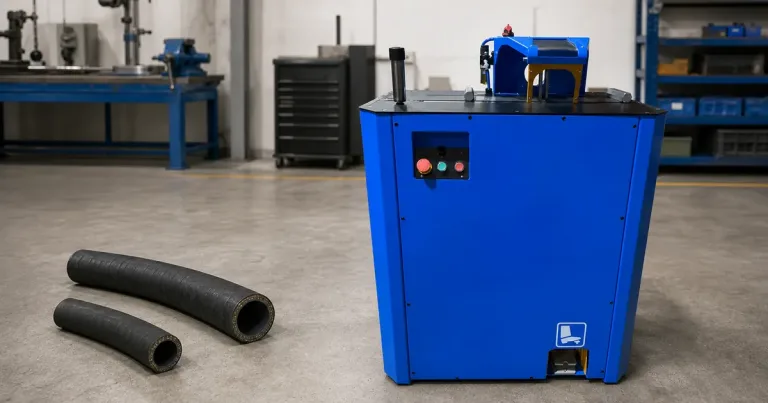
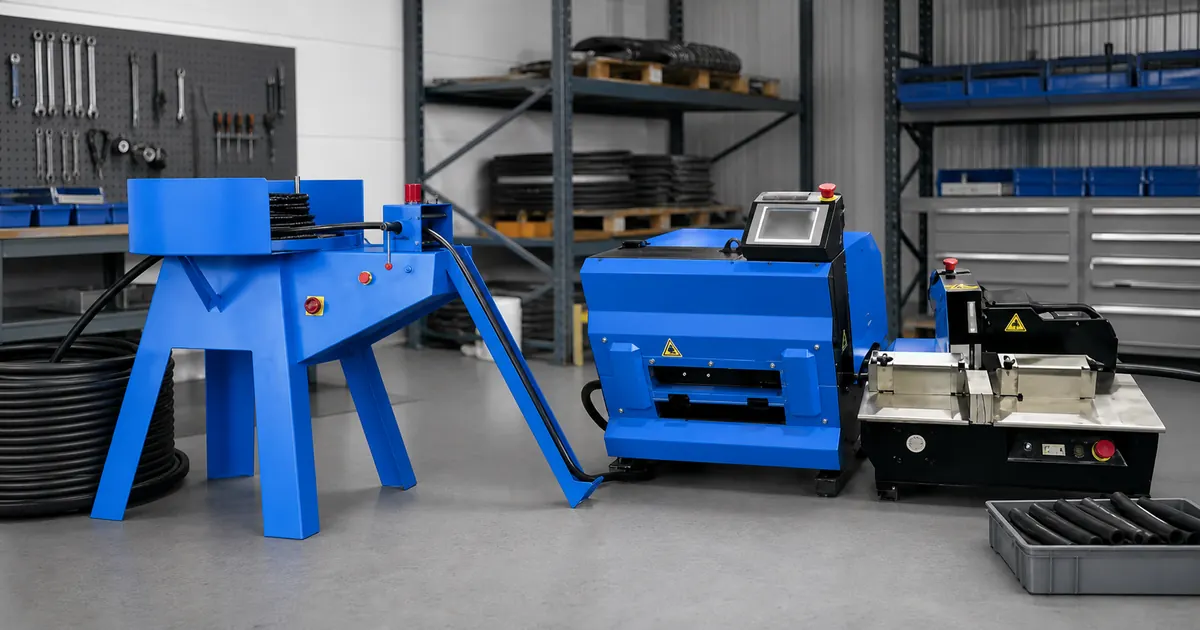
Eine automatische Hydraulikschlauch-Schneidmaschine steuert mehr von der Vorschub-und-Schneid-Sequenz als eine manuelle Maschine. Das kann Wiederholungsarbeiten verbessern, aber nur, wenn der Schlauch gleichmäßig zugeführt wird und die programmierte Länge an realen Teilen überprüft wird.
Ein Mischspulenversuch deckt den echten Engpass auf
Ein Käufer entscheidet zwischen einem manuell beschickten Schneidgerät und einem System mit programmierter Länge. Der nützliche Versuch fährt eine repräsentative Spule und zeichnet Vorschubkorrekturen, Ausschussenden, Reinigungszeit und Bedienereingriffe auf, anstatt nur die Klingenbewegung zu zitieren.
Maschinen mit manueller Steuerung
Der Bediener misst, positioniert und führt jedes Stück zu. Dieser Weg kann für Mischbetrieb, kurze Chargen und häufige Wechsel geeignet sein. Er macht die Ausbringung auch abhängiger von Handhabung und Markierung.
CNC- oder programmgesteuerte Vorschubmaschinen
Programmgesteuerte Hydraulikschlauch-Schneidmaschinen können Länge und Menge über eine Charge steuern. Sie sind am nützlichsten, wenn sich derselbe Schlauch und dieselbe Schnittlänge oft wiederholen.
Fragen Sie, was die Steuerung tatsächlich verwaltet:
- Vorschubdistanz;
- Schnittzähler;
- Klingenzyklus;
- Chargenspeicher;
- Fehler- oder Stoppbedingungen.
Gehen Sie nicht davon aus, dass jede als automatisch beschriebene Maschine alle fünf umfasst.
Vergleichen Sie die Gesamtarbeit, nicht eine Bewegung
Der vollständige Prozess umfasst Spulenbeladung, Richten, Zuführen, Schneiden, Teilehandhabung, Reinigung und Prüfung. CNC kann wiederholtes Messen reduzieren, aber sie kann schlechte Schlauchunterstützung oder eine verschlissene Klinge nicht beseitigen.
Akzeptieren Sie den Schnitt, bevor Sie die Ausbringung akzeptieren
Prüfen Sie Rechtwinkligkeit, Bohrungszustand, Verstärkung und Wärme. Wenden Sie den nachgelagerten Reinheitsprozess an. Ausbringung, die häufige Nacharbeit benötigt, ist keine produktive Ausbringung.
Vergleichen Sie manuelle und programmierte Steuerung mit derselben Charge
Verwenden Sie einen realen Auftrag mit mehreren Längen. Erfassen Sie Rüstzeit, Messarbeit, akzeptierte Stücke und Korrekturen. Manuelle Steuerung kann für wenige unregelmäßige Längen schneller sein, weil Programmierung und Spuleneinrichtung Zeit kosten. Programmgesteuerter Vorschub wird nützlich, wenn ein stabiles Material und eine wiederholte Längenliste genügend manuelles Messen einsparen, um die Einrichtung zu rechtfertigen.
Der Vergleich sollte Umrüstungen einschließen. Eine Maschine, die eine Länge schnell fährt, aber lange braucht, um das korrekte Programm, die Führung und die Klingeneinrichtung für den nächsten Schlauch wiederherzustellen, verbessert möglicherweise nicht die Tagesleistung.
Vergleichen Sie C300 und C300D als unterschiedliche Produktionswege
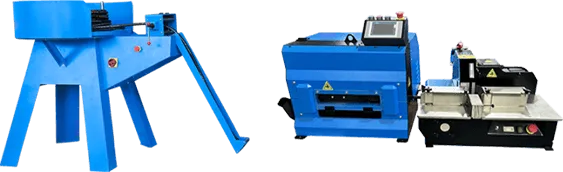
| Feld | C300 | C300D |
|---|---|---|
| Aufgezeichneter Schlauchumfang | Bis zu 2 Zoll 4SH | Bis zu 1 Zoll 2SH |
| Vorschub und Steuerung | Manueller Vorschub | Automatisches und manuelles Schneiden |
| Klinge | 300 × 4 × 32 mm | 300 × 4 × 32 mm |
| Motor | 4,0 kW 3-phasig oder 2,2 kW einphasig | 4,0 kW 3-phasig oder 2,2 kW einphasig |
| Wiederholgenauigkeit | Kein Wert in der Produktdatei | ±0,2 mm aufgezeichnet für C300D |
| Hauptgrund für die engere Auswahl | Breiterer aufgezeichneter Bereich für verstärkte Schläuche | Wiederhollängen-Steuerung |
C300D ist kein C300 mit höherer Kapazität. Es tauscht einen engeren aufgezeichneten Schlauchbereich gegen einen stärker automatisierten Vorschub- und Längensteuerungsweg.
Vergleichen Sie das C300 Modell mit manuellem Vorschub und C300D Automatikmodell mit demselben Chargenplan.
Halten Sie Schnittlänge und fertige Montagelänge getrennt
Die Schlauchschnittlänge ist nicht immer die fertige Montagelänge. Armaturen fügen Geometrie hinzu und die Einstecktiefe verändert die Beziehung zwischen beiden.
| Längenaufzeichnung | Was sie beschreibt | Wo ein Fehler auftritt |
|---|---|---|
| Programmierte Vorschublänge | Von der Schneidlinie vorgeschobenes Material | Falsches Programm oder Vorschubschlupf |
| Schlauchschnittlänge | Schlauchstück nach dem Schneiden | Endenrechtwinkligkeit und Messmethode |
| Fertige Montagelänge | Fertiger Schlauch mit Armaturen | Incorrect take-up or insertion |
Approve the relationship through the component drawing or assembly instruction. Do not adjust the cutter until a fitting take-up error has been ruled out.
Technischer Hinweis: The C300D ±0.2 mm field is a machine product value. It is not a universal finished-assembly tolerance.
Plan the full C300D footprint
The product file lists three main assemblies: a 900 × 1,350 × 1,200 mm coiler, 700 × 530 × 640 mm counter and 650 × 600 × 450 mm cutter bar.
Add operator access, control access, finished-part handling and maintenance clearance to those dimensions. A line squeezed into the cutter’s enclosure footprint will be awkward to run.
Specify the control level in operating terms
“Automatic” is too vague for an RFQ. Write down which actions the machine performs and which actions still belong to the operator.
| Funktion | Manual route | Programmed route | Acceptance evidence |
|---|---|---|---|
| Length setting | Operator marks or positions material | Controller stores feed length | First-off measurement |
| Menge | Operator counts pieces | Batch counter stops at target | Batch reconciliation |
| Feed correction | Operator repositions hose | Parameters or guides are adjusted | Restart sample |
| Material change | Physical setup and new mark | New program plus physical setup | Approved changeover |
| Fault recovery | Operator follows manual procedure | Operator resets after cause is cleared | Recovery test |
This table prevents a buyer from paying for a controller that does not solve the actual repeated task.
Control programs and restarts
Give each approved program a hose identity, length revision and owner. Restrict edits to trained staff, but keep a documented manual route for recovery. After a power interruption, sensor fault or material slip, the operator should know whether the feed position is still valid.
Run a first-off piece after a restart that could change position. Do not let an automatic counter turn an unverified batch into hundreds of identical rejects.
Prove repeatability with one mixed batch
Test one repeated length, one changeover and one difficult coil. Measure setup, accepted pieces, rejects, interventions and usable remnant. The same batch should be run on the manual and automatic route if you want a fair comparison.
C300D’s product record states automatic and manual cutting, a 300 × 4 × 32 mm blade, up to 1 inch 2SH and repeated-size accuracy of ±0.2 mm. That accuracy belongs to the recorded machine function. It is not a universal finished-assembly tolerance and it does not raise C300D to the C300’s recorded 2-inch 4SH scope.
Measurement note: Verify the gauge or length method before judging a ±0.2 mm result. A display value cannot correct a loose reference point or inconsistent hose tension.
For a 500-piece order, an automatic route is attractive only if setup and feed remain stable. If the first 25 pieces need several corrections, stop and fix the cause. Do not average the error across the full batch.
Keep length records connected to the drawing
The program length, cut hose length and finished assembly length are different records. Fitting insertion and take-up affect the completed assembly.
When a drawing changes, revise the program reference and approve a new first-off. Keep units visible. A 500 mm program copied into an inch-based job is an avoidable control failure, not a machine-capacity problem.
Identify cut pieces when several lengths look alike. A simple batch traveler with hose, length, quantity and program revision is usually enough.
Plan failure ownership before installation
The operator should know who handles a failed counter, feed sensor, controller or backup. Keep current electrical information and a saved copy of approved programs with the asset.
Manual backup is useful, but only if operators have practiced it and the manual route has its own measurement check. “The machine can also run manually” is not a recovery plan.
At installation, prove:
- destination power and safe access;
- material path and coiler setup;
- first-off measurement;
- changeover and restart;
- emergency stop and guarded operation;
- record backup and restore;
- downstream cleaning and identification.
The C300D consists of a coiler, counter and cutter-bar assembly in the product record. Floor planning must include operator and material movement around all three, not only the cutter enclosure.
OSHA 1910.212 provides US general machine-guarding context for the cutting cell. Where the application requires a measured contamination result, ISO/TS 18409:2018 addresses collection of a fluid sample from hydraulic hose or assemblies; it does not define the automatic cutter’s cleaning process.
Decide with accepted output, not automation level
Use accepted pieces per labor hour, first-pass yield and changeover time. A manual C300 can be the better choice for mixed short work and the broader recorded hose scope. C300D is the better route when repeated lengths inside its 1-inch 2SH scope justify programmed feed.
We recommend a trial with your normal coil and length list. That result gives purchasing an operating reason for the control level, rather than a preference for the word “CNC.”
A production order should survive a shift change
Automatic cutting fails quietly when the controller contains a correct number with no material context. The second shift sees “1250,” loads a different hose and assumes the program remains valid.
Use a short traveler that follows the batch:
| Traveler field | Example of the required fact |
|---|---|
| Schlauch | Exact internal material reference |
| Drawing revision | Current finished-assembly drawing |
| Program | Approved name and revision |
| Feed length | Value and unit |
| Erststück | Measured result and approver |
| Menge | Planned, cut, rejected and accepted |
| Umrüstung | Time and reason |
| Remnant | Identity and usable length |
The table is intentionally simple. An operator should be able to reconcile it with the coil, program and finished pieces without opening several systems.
Treat coil behavior as part of the setup
Two coils of the same nominal hose can enter the guides differently after storage or transport. Watch for drag, twist and inconsistent payout. If the operator repeatedly pulls the hose straight by hand, the line is not controlling the material path.
Record a guide or tension correction against the hose lot when it materially changes feed. Do not quietly edit the length program to compensate for a mechanical problem; the next stable coil will inherit the wrong value.
Measure automation losses by cause
Separate setup, changeover, material fault, machine fault, inspection and waiting time. “Downtime” is too broad to tell you whether a different machine will help.
An illustrative mixed batch might contain 200 repeated pieces and ten specials. If the repeated pieces run smoothly but the specials consume most of the setup time, keeping a manual route for the specials may cost less than forcing every order through the automatic line. This is a planning example, not a TRC output claim.
The same logic applies to remnants. A programmed machine can hit quantity while creating unusable short stock. Record remaining length by hose identity, then decide whether the next order can consume it.
Prove backup and restore
Export or document approved programs according to the controller instructions. Then test one restore with a non-production job before the backup is trusted. A file that exists but cannot be restored is not protection.
After restoration, run a first-off piece and compare it with the traveler. The check confirms the program, units, feed reference and measurement route together.
Werkstattsicht: Automation is earning its cost when another trained operator can reproduce the accepted batch without guessing what the last operator changed.
Before purchase, ask the second-shift operator to review the proposed traveler and trial plan. The questions raised by the person who did not create the program often expose unclear names, missing units and hidden manual adjustments. That review costs little and tests whether the automatic route can operate without one expert standing beside it.
Keep the accepted first-off beside the traveler until the batch is released. A visible reference catches a wrong hose or program faster than a production report reviewed after the pieces have moved downstream.
Häufig gestellte Fragen
Wie sollte ein Schlauch nach dem Schneiden gereinigt werden?
Apply the documented cleaning process after accepting the cut, then protect the ends. Use cleanliness sampling only when the application requires a measured contamination result.
Review the control level you actually need
Send the length list, tolerance method, coil condition, batches and downstream handling to TRC. The proposal should state which steps remain manual.